Thursday, January 19, 2012
Five & Dime 2010: Wide Angle Lens (Eleven Year Pix)
These graphs cover 2010 (top bar) through 2000 (bottom bar). The bar is the percentage of players reporting who played the game 5+ times in the given year. The games here first appeared on the Five & Dime lists in 2000.
Battle Cry (AH)
Carcassonne (includes expansions but not stand-alone "cousins")
Cartagena (includes Cartagena 2)
Citadels
Lord of the Rings (includes expansions)
Princes of Florence
Taj Mahal
Tichu
Web of Power (includes China)
Zertz


Five & Dime 2010: Wide Angle Lens (Twelve Year Pix)
These graphs cover 2010 (top bar) through 1999 (bottom bar). The bar is the percentage of players reporting who played the game 5+ times in the given year. The games here first appeared on the first Five & Dime list in 1999.
Apples to Apples
Crokinole
Loopin' Louie
Lost Cities
Mamma Mia (includes Sole Mio)
Ra
Ricochet Robot(s)
Schotten-Totten/Battleline
Union Pacific
Zirkus Flohcati
Wednesday, January 18, 2012
Five & Dime 2010: Wide Angle Lens (Thirteen Year Pix)
This is Year Thirteen - and that means that these graphs continue to get better at showing patterns of repeated play. (Note: this graph - along with the rest of the 2010 graphs - should have been posted last spring. These are NOT the graphs for the 2011 Five & Dime.)
These graphs cover 2010 (top bar) through 1998 (bottom bar). The bar is the percentage of players reporting who played the game 5+ times in the given year. The games here first appeared on the first Five & Dime list in 1998, though many of them were released before that.
Acquire
Bohnanza (includes expansions)
Can't Stop
Carabande (includes Pitchcar)
El Grande
Euphrat & Tigris
For Sale
Formula De (includes Formula De Mini & Formula D)
Guillotine
Liar's Dice (includes Perudo)
Medici
Metro (includes Iron Horse & Cable Car)
Mu & Mehr
Samurai
Schnäppchen Jagd/Bargain Hunter
Settlers of Catan (includes expansions but not stand-alone "cousins")
Settlers of Catan Card Game (includes The Rivals for Catan)
Showmanager (includes Atlantic Star)
Take 6/6 Nimmt/Slide 5
Take It Easy
Through the Desert
this is not a political blog...

...but every once in a while, it drops in my lap.
And, no surprise, it's the people we elected who have written a vague piece of legislation to "cure" a problem... SOPA and PIPA are like handing out flamethrowers to kill flies.
Want to know more? You can start with the EFF site.
Today is Internet Blackout Day... but I am NOT a web guru with mad skillz, so you're going to have to settle for the graphic at the top of the page.
Tuesday, January 17, 2012
Best New (to me!) Games of 2011
I really, really wanted to make this a top ten list… but then, thanks to the magic of Christmas, I had to add one more. So, I used my board game blogging superpowers to smoosh two of the games into one entry. (Next, I’ll leap a tall building in a single bound in order to stop an argument between rules lawyers… I have promised to use my powers for good.)
You’ll notice that there’s a BUNCH of sci-fi/fantasy games on here… it’s been a really great year for those of you who like that kind of thing.
10. Battleship: Galaxies AND Star Trek: Fleet Captains
 I am so glad I own both of these games… and yet, they just don’t get to the table as much as I want. In fact, after an initial flurry of play when I first received Fleet Captains, it hasn’t made it’s way out again. Battleship: Galaxies has seen more sustained play, but pretty much just because my 10 year old son loves it.
While they both share the whole sci-fi/space vibe, they’re very different games. Fleet Captains is an immersive Klingon vs Federation adventure in the Star Trek universe. (In my review here on the Opinionated Gamers, I called it “an experience game” and dubbed it “Dungeonquest in Space”.) Battleship: Galaxies, on the other hand, is a starship combat game that utilizes energy points to limit how many ships and/or action cards you can power each turn.
 At the same time, they have some similarities: they both look great when they’re set up… and both take a lot of time to get set up. (Both games have some pretty serious deck-building decisions front-loaded during game prep… which makes both games tougher to teach than they are to play.) Both games have a detailed mythos that adds to the flavor… and both are lacking something.
- In the case of Battleship: Galaxies, it’s a crying need for scenarios that vary up the basic “charge or turtle” decision inherent in any combat game. The five scenarios provided with the game are just not enough, Hasbro!
- In the case of Star Trek: Fleet Captains, it’s the need to expand into the huge universe… it’s past due for some Romulans & the Borg.
9. Quarriors
 I acknowledge that Quarriors has problems (tiny dice that are sometimes hard to read, for example)… and that it’s especially prone to slow to a crawl with gamers who want to min-max their probabilities. That said, I’ve had a blast every time I’ve played it with my son… it’s fast, it’s funny, there’s a lot of interesting things to do, you get to cheer and/or boo your dice rolls, and I find myself smiling when I play.
The new game to compare this to is probably King of Tokyo – which I also enjoyed but felt like I was much more at the mercy of the dice & the foibles of the other players. So, though it made me laugh as well, I’d pick Quarriors.
8. The Struggle for Catan
 I was worried that this would be the card game equivalent of the Catan Dice Game… that it would have the thematic trappings without any of the fun of the (still wonderful) original Settlers of Catan. Thankfully, I was wrong.
It’s not a deep game, mind you – it’s a filler card game that romps along at a nice clip, with a nice mix of “take that”, hoarding resources & a few special ability buildings thrown in for good measure.
Not only does it play in under 30 minutes with 2-4 players, it also works well with 2, 3 or 4.
7. City Square Off
 Do not let the fact that I’ve been friends with the designer (Ted Cheatham) for over 12 years keep you from trying this lovely two-player Tetris-y game. It’s a quick filler that everyone from my six-year-old to my mom has enjoyed.
And the most important point for many who read the website is what I said in my review: “My non-gamer wife voluntarily taught the game to one of her friends.”
6. The Rivals for Catan
 I want to put this higher up on the list – I’m a long-time fan of the original game & (as I said in my Opinionated Gamers review) I think the new version improves on an already tremendous game. The problem with ranking it higher is, well, opportunities to play the game. I’ve got a couple of folks who are willing to sit down for 60-90 minutes of building our kingdoms… but more recent advances in “card game technology” make it harder & harder for that to happen.
I will say that the recently released expansion, Age of Darkness, adds some really nifty twists with buildings you can put in your opponent’s kingdom & cards that are tied to regions rather than settlements/cities.
And, yes, this is the first of three games on this list that was actually published in 2010… but I didn’t play until 2011.
5. Innovation
 This new-to-me game barely made it onto the list – I only received my copy of the game a couple of days after Christmas – but I am utterly taken with this extremely random & wholly tactical civilization building card game.
That’s right, I said it: if the cards don’t fall right for you, you can be in serious trouble. But, since a 2 player game of Innovation only takes about 30 minutes, I don’t find that to be as frustrating as some other folks do. In fact, I’m willing to trade the swing-y randomness of the game for the multitude of card powers & combos… and with that plethora of options, the ability to create some truly awesome plays.
One quality of a great game, by the way, is as follows: “A great game gives players the opportunity to make moves/plays that they can delight in… even if those moves/plays don’t win them the game.” (I’m quoting myself… which is the last step before falling into the Bob Dole-ish morass of 3rd person self-referential.) Innovation is stuffed to the gills with those kind of opportunities.
I’ve played one game with the expansion, Echoes of the Past, and I think I need to back up & play with the base game a little more. There’s nothing wrong with it – I like the concepts of Echo & Foreshadow – but there’s so much to track that I found it easy to get lost.
I feel the need to say one negative thing… the special achievement cards have a horrible choice for a background that renders them unreadable across the table.
4. The Ares Project
 I’m a sad, sad example of a computer gamer… the last RTS game I played was Warcraft II. I didn’t even manage to purchase the original Starcraft… which is the basis for this fantastic battle card game.
Like Summoner Wars (which we’ll get to in a minute), each faction has a distinctive feel & play style… but unlike Summoner Wars, the differences are so pronounced that each faction in The Ares Project has it’s own mini-rulebook. They produce & use power in different ways, have different units, modify those units with different kinds of cards… even create new units through various methods.
All of this complexity means you have a game with lots of variety… but you also have a game that’s difficult to teach. One of my hopes for 2012 is getting a core group of players “up to speed” so we can knock out battles in short order.
3. Ascending Empires
 I’m just going to quote myself (from an Opinionated Gamers review) again:
Ascending Empires has been described by many people (including myself) as a weird & wonderful cross between a dexterity game like Carabande or Catacombs and a space civilization game like Twilight Imperium or Starcraft: the Board Game. There’s two problems with that description:
- It’s really a space empire-building game with flicking rather than a flicking game with a space theme. (Flicking is used simply for movement – and unless you’ve managed to ramp up your tech, you don’t actually want to run into other people’s ships.)
- Though it is a space empire-building game, it has a playing time of about 75 minutes… which is roughly 1/4 of a game of Twilight Imperium & 1/3 of a game of Starcraft: the Board Game.
And with that said, I want to recommend that you try this game. Right now, if possible.
2. Summoner Wars
 Summoner Wars was a “hey, I got an Amazon gift card & I don’t want to spend it on mp3 downloads” post-Christmas purchase last year… well, at least the first two boxes were. Then I went kinda nuts… and a year later, I own everything Plaid Hat Games has published for Summoner Wars.
Which would be kind of stupid if I only played it a couple of times a year (sigh – reference me & my three Plano boxes filled with Battlelore figures)… but I managed to get in 40+ games of Summoner Wars in 2011. I wouldn’t be surprised to get that many games in again in 2012.
In my OG review of the Master Set, I described Summoner Wars as “a fantasy battle board game that involves positional board play, deck & hand management, and dice combat.” What got left out of that description was just how much fun it is to play. There’s a healthy helping of randomness to spice up the game, but there’s also some real skill in playing each faction well… and Colby Dauch (the designer) deserves a mountain of praise for getting such variety out of a simple & straightforward game system.
Even if you don’t like fantasy combat games, you should give this one a try.
1. Risk: Legacy
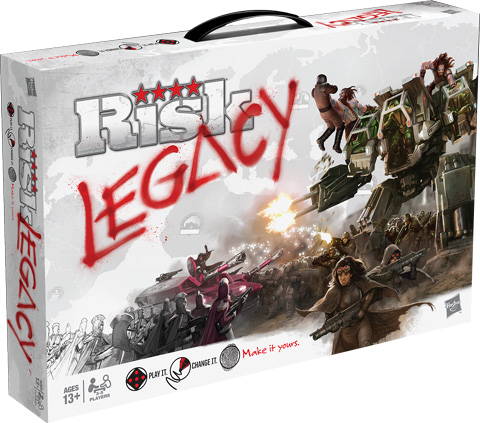 I’m not sure how to extol the virtues of this wonderous Risk reboot without spoiling some of its well-hidden charms, but I’ll give it a shot.
Risk: Legacy is…
- …a product of nearly a decade of experimenting with this classic game system. (It incorporates ideas from Risk 2210 & Risk: Black Ops to make the game shorter & yet packed with thematic touches.)
- …an innovative board game concept – something we don’t see nearly as often as we’d like to think. (The whole “open this pack of cards when this happens” way of changing the game is brilliant.)
- …a reminder of what was really great about my old RPG days – we’re working together to tell a story about this new world we’re fighting over. (In our case, the founding of Great Humongustan, the DEW line populated with installations left over from the Battle of the Northern Wastes… and most recently, the Cataclysm in Southern Europe.)
- …gamer catnip. (Let me explain – each time you get to open a new packet, it feels very similar to the “rush” you get when opening a new game or game expansion. And it not only gives you the “new car smell” effect, the added stuff takes the story of the game in a new direction.)
- …fun even for people who don’t particularly like Risk. (One of the guys in our group – the founder of Great Humongustan – is not a fan of “dudes on a map w/dice” games & esp. not a fan of Risk. Yet he’s having a grand time playing Risk: Legacy with us… and even commented the other night when he arrived after a game had started that “it was just fun watching you guys play.”)
Kudos to Rob Davaiu… it is hitting the table EVERY week at our gaming group with people clamoring to play.
And one last thought: even after we finish the 15 game “story arc” (and someone gets to name the world), I can see this board/set being my Risk variant of choice – both to enjoy the memories/history of battles past and because the various tweaks & modifications in this game are really, really nifty. (BTW, this comes from someone who has four other versions of Risk in his collection… yes, it’s that good.)
This post originally appeared on the Opinionated Gamers website. Review copies were provided for some of the games on this list.
Monday, January 09, 2012
Game Review: The Wizard’s Tower (Castle Panic expansion)
 The Wizard's Tower
- Designer: Justin De Witt
- Publisher: Fireside Games
- Players: 1-6
- Ages: 12+
- Playing Time: 60 minutes
Review by Mark Jackson on a review copy provided by Fireside Games (5 plays)
Once upon a time, in a clearing in the midst of the monster-filled forest, there sat a castle with the less-than-tourist-ready name of Castle Panic. Of course, the nearby monsters were not happy one bit about the human interlopers & their big stone monstrosity that was messing with their property values & sight lines… so they decided to take care of the problem without resorting to real capital “E” evil. (In other words, lawyers.)
The monster population was more of a do-it-yourself kind of group – Bob Villa in reverse – and so they pelted the walls with giant boulders and sent goblins, orcs & trolls to assault the defenders.
Sadly, though, the human invaders proved to be difficult to eradicate. Every time they managed to knock most of the castle into ruins, they just built it back & dared the monsters to give it another try.
Just a few weeks ago, the monsters decided to get serious. They recruited a plethora of new creatures to their cause, as well as absconding with a trebuchet & the technology to make flaming boulders. Finally, by sacrificing their previous goblin army as dragon snacks, they managed to attract some really big brutes to fight on their side.
At the same time, though, the humans ramped up their defense system by building the local wizard a tower of his own & recruiting him to cast spells on the advancing horde.
The battle lines are set. The forest is teeming with beasties. The wizard’s tower hums with potential power. The game is on.
—–
Here at the Jackson home, we’re big fans of cooperative games. Shari (my wife) and I have been playing Minion Hunter (a classic GDW co-op game set in the Dark America universe) for a long, long time… and we’ve recently taught our boys to join us at Knizia’s Lord of the Rings co-op game. Pandemic & Forbidden Island are also favorites.
So the addition of Castle Panic to my collection a year or so ago was welcome – it was easier to set up than most cooperative games, played quickly and was simple enough that my then-5-year-old could play with the rest of the family. The tile draw/dice roll to place monsters made for a random but very enjoyable cooperative experience.
We also began playing Castle Panic using the “overlord” rules, where one player takes on the role of the evil genius behind the castle attack while the other players try to thwart him. (One of the nice things about the game system is that it works quite well this way with only a few minor rules tweaks.)
So when The Wizard’s Tower showed up on our doorstep, we were predisposed to like a way to expand a well-loved game… and we were not disappointed. In fact, I think the expansion is better than I expected it to be – color me pleasantly surprised!
 Monsters
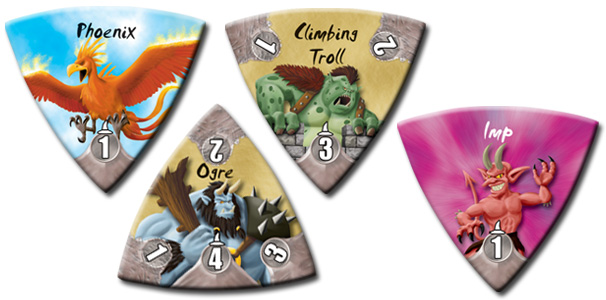
When “installing” the expansion into the game, you dump all of the Goblins (1 hit point monsters) and most of the Orcs (2 hit point monsters) & Trolls (3 hit point monsters) in favor of a wide variety of new monsters: Centaurs, Cyclops, Gargoyles, Golems, Ogres, etc. Many of those monsters have special powers – including invincibility at certain ranges and the power of flight!
Imps have also appeared… based on some monster powers and tokens in the bag, Imps are 1 hit point monsters that can appear in large groups, basically flooding the field of combat.
As well, some of our old “friends” are back with new capabilities – there are Climbing Trolls (who ignore walls) and Goblin Calvary (who move at double speed). There’s also a Trebuchet (which flings a Giant Boulder that hits flying creatures but misses those on the ground)… and then there’s…
Fire!
If you need a soundtrack for this portion of my review, I strongly suggest humming “Burning Down the House” (by the Talking Heads) to yourself.
It turns out there are a lot of flammable items in the game: castle towers, castle walls, Flaming Boulders, the Phoenix… and pretty much every monster out there. (I love the smell of roasting Ogre in the morning.) Fire can damage the attackers… but it also makes your fortifications weaker (monsters attacking a wall or tower on fire don’t take a hit) – sometimes to the point of collapse. Fireside Games has thoughtfully provided a bunch of fire markers that slide onto the side of whatever object is currently engulfed in flame.
 Mega-Bosses
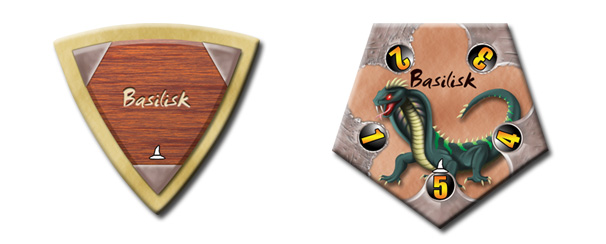
One of the niftiest additions to the game is the Mega-Boss concept. Six new very tough monsters can potentially enter the battle:
- the Basilisk (who causes players to lose cards & keeps them from drawing Wizard cards
- the Chimera (who breathes fire while spiraling toward the castle)
- the Dragon (who breathes fire & moves in random ways)
- the Hydra (who sprouts Imps every time you hit him)
- the Necromancer (who puts dead Monsters back into the draw bag)
- the Warlock (who is impervious to Wizard cards & moves in random ways)
All of them have 4 or 5 hits… which means they have special tokens for the playing field. They also have Harbinger tokens in the same shape as the rest of the monsters. When preparing to play you randomly draw 3 of the 6 Harbinger tokens and dump them into the bag – meaning each game you’ll be facing a slightly different crew of Mega-Bosses.
 The Wizard’s Tower
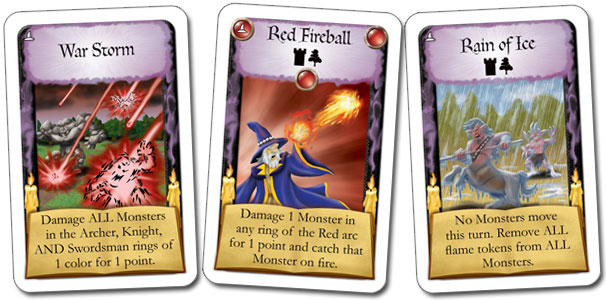
With all of that firepower coming in, the players need some kind of way to counteract the badness… and that’s where the Wizard’s Tower comes in to play. One of the regular towers from the base game is replaced with a taller (and cooler looking!) Wizard’s Tower – and as long as it’s still standing, players may use their “discard & draw” action to draw a card from the Wizard deck. This deck of 22 cards has a wide variety of high-powered actions that you can use to slow down or destroy the attackers.
Other Stuff
There are 10 new cards for the Castle deck (with some nifty new powers) as well as some helpful reference cards.
And there’s a draw bag – with monster eyes. (I know, I know… it’s not that big of a deal – but it’s a really cute draw bag & I’m glad they stuck it in here.)
In My Ever-So-Humble Opinion
First, I’d like to say a big “thank you” to Fireside Games for creating an expansion that is actually worth the dollars you pay for it. (Yes, Fresco #7: The Scrolls, I see you grinning sheepishly in the corner.) This box is packed full of stuff that, with the exception of the draw bag (which I’ll once again mention I really like) is not just cosmetic fluff.
On the other hand, while Castle Panic with The Wizard’s Tower isn’t a complicated game by gamer standards, it’s definitely a bit more challenging to learn with a number of special rules. The icons on the monster tokens work well… once you’ve played 2-3 games… but there are a lot of small details to remember.
But since I’m playing mental ping pong writing this, I want to point out that my boys (ages 10 & 6) have done just fine with the expansion… which leads me to believe that this expansion will work best with at least one experienced player and/or gamer at the table to help the group work through the rules on the fly.
I’m personally taken by the art on the new tokens – there’s a lot more color here. In fact, the greater level of variety between the powers of the monsters & the visual look of the game is a big plus for the game system.
My only gripe is that we have found the game a bit too easy as outlined in the rules… and so have begun experimenting with adding 4 Mega-Bosses to the bag at the beginning of the game. Our first game played this way was a nail-biter!
If you enjoyed the original game but wanted more variety from game to game, this expansion will provide that by the cartload. I’m glad it’s a part of our collection!
This review originally appeared on the Opinionated Gamers website.
Subscribe to:
Posts (Atom)


