Wednesday, September 07, 2016

Stellar Conflict - Taking Light Speed to Warp Speed (Game Review)


  • Designers: James Ernest & Tom Jolly (Light Speed) Anastasios Grigoriadis & Konstantinos Kokkinis (developed Stellar Conflict)
  • Publishers: Artipia Games & Stronghold Games
  • Players: 2-4
  • Time: 10 minutes
  • Ages: 10+
  • Times Played: 9 (with review copy of provided by Stronghold Games) 19 (with personal copy of Light Speed)

Once upon a time, there was a little tiny game company that published a whole lot of little tiny games in envelopes that tended to have odd but enjoyable themes with gameplay that usually lasted long past the actual point of enjoyment. (I’m talking about you, Kill Doctor Lucky and Renfield) There were flashes of design brilliance (Button Men, Brawl, Fightball) and genuinely inspired lunacy (Deadwood, Give Me the Brain). And then there were the abject failures (U.S. Patent No. 1)... and then there has to be a category lower than “abject failure” for garbage like Devil Bunny Needs A Ham.

That little tiny company (better known as Cheapa** Games) also put out a line of Hip Pocket Games. Along with the aptly named Very Clever Pipe Game (which would have been more clever and better served by being printed in color rather than greyscale), they published Tom Jolly’s Light Speed, a real-time game that literally took longer to score than it did to play. 


I’ve been a huge fan of Light Speed for a long time - so much so that my homemade game kit no longer fits in my hip pocket. I added colored stones to record hits & asteroid mining… and a stretchy string to check line of sight. (From now on, we’ll abbreviate “line of sight” as LOS… which will make all of the old wargamers and miniature players happy.)

So you can only imagine my joy when Stronghold Games announced that it would be releasing the Artipia Game re-imagining of Light Speed as Stellar Conflict.

The base engine for both games is the same - players place spaceships (cards) on the playing surface in real-time, attempting to position their ships to maximize the destruction of others and minimize the damage to their own ships. Ships cannot overlap any other card… which doesn’t make sense in the three-dimensional space (aka “the final frontier”) but makes for some very interesting game decisions. Ships are drawn from a shuffled deck of your own fleet - meaning you can know what ships you have but not what order they will appear.

Each ship has one (or more) laser shots of varying value emanating from their ship. As well, some ships have shields along the edge of cards that block laser fire. Ships also have an initiative value which determines the order in which the ships fire - the smaller the ship, the earlier they blast their opponents into submission… and the less damage they can take when hit before exploding into little tiny bits.


When ship placement ends, the ships open fire. (I like to think that all of the ships hyper-jumped into the same stretch of space in the matter of a few minutes.) Beginning with the lowest initiative-numbered ships, players resolve laser fire (different colored lasers cause 1, 2 or 3 points of damage) by tracing LOS to the first ship hit using the thoughtfully-provided rubber bands. Ships that are fully damaged after all ships of a particular initiative value have fired are removed from the playing surface and awarded to the player who did the most damage to the now-inoperable collection of flaming space debris. Hitting a cargo ship “steals” a cargo cube which is placed on the attacking ship.

The carnage continues until all ships have fired. Players add together the victory points from the ships they destroyed, the cargo they have stolen, and the cargo still remaining on their own cargo ship… and the player with the most points wins.

This is the game that I’ve described over the years as “it takes longer to score than it does to play” - and that’s still true. Since you can play with a timer (new rules) or “first to run out of cards stops the game” (Light Speed rules), it is unusual for the placement portion of the game to last more than 2 minutes. (In fact, the only way I can imagine it going longer is if you had a full table of AP-prone guys playing with the old rules…) Scoring length is a function of the number of ships in the game… but in our experience, we can play and score a four player battle royale in about 15 minutes.

What’s Different?

Square cards - I know this sounds like a silly thing to be excited about, but the small coaster-sized square cards make a lot more sense than the smaller rectangular cards from Light Speed.

Drafting - Each ship has a drafting cost… and the rules offer options for shorter/smaller deck games with a specific number of drafting points. So… do you want an armada of small fast ships (who can’t take a lot of damage) or a few capital ships to wreak havoc? Or do you decide to build your own specific mix of fighters & cruisers?

How the Game Ends - As mentioned earlier, the new rules use a timer for a 30 second, 1 minute or 2 minute playing time. (Each time limit has a suggested amount of drafting points.) The original “blitz” rules are included as a variant.

Cargo Ships & Flagships - Each deck has a cargo ship and a flagship that are used in every game. After you shuffle your deck, you place the cargo ship on top and the flagship on the bottom. The early placement of your cargo ship and the knowledge that you have a big capital ship at the end of your deck changes placement strategy in some intriguing ways.

Asymmetric fleet decks - Each deck has a unique mix of ships as well as a special ability specific to their race in the Among the Stars universe.

  • Some of the Wiss ships have ion lasers that hit enemy ships with a pulse that increases their initiative value.
  • Some of the Vak ships have shield penetrating lasers.
  • Some of the Hexai ships fire twice (in two different initiative phases).
  • The Tetrakori have extra scout ships that don’t have a drafting cost.

Among the Stars Theme - The original game was pretty generic… but Artipia Games slid this neatly into their Among the Stars ‘verse. Stellar Conflict is not the first stand-alone game in the series - New Dawn is another stand-alone game sharing the history, races and art style of the AtS ‘verse. (Tasty Minstrel Games has made a similar choice with Microcosm & Battlecruisers, both of which reside in the Eminent Domain universe but are separate games. (And, in my opinion, both are excellent additions to the sci-fi game genre.)

Is It Better?


Short answer: Oh, yeah.

Longer answer:

  1. For starters, a great game is back in print.
  2. The artwork is much more distinctive and evocative… and the various iconography needed for game play is easy to read.
  3. The square cards just make more sense.
  4. The drafting element adds a nice twist to the original design without overloading the base game engine.
  5. The asymmetric decks seem (so far) to be pretty well-balanced and offer some interesting choices.
  6. The new time limit rule works well - and the old Light Speed “play as fast as you can” rule is included as a variant in the rules.
  7. Using cargo ships instead of asteroids adds some defensive possibilities (since you score any cargo left on your ship) - and, once again, there are asteroid cards included so you can play with the original Light Speed set-up.


The Experts Chime In

Both of my sons are (a) gamers and (b) fans of the original Light Speed game… so they were as excited as their old man to get to play and review Stellar Conflict. I asked them some questions to garner their wisdom and share it with you.

Q: Do you like Stellar Conflict better than Light Speed?
A: (11 year old) Yes.
A: (15 year old) Yes.

Q: What’s your favorite change between the two versions - and why?
A: (11 year old) The different factions.
A: (15 year old) Yeah - the decks are balanced and I like the variety.

Q: Do you like the longer or shorter variants of the game?
A: (11 year old) Longer - I like getting to use all of the cards in my deck.
A: (15 year old) Longer - I like the way the table fills up.

Q: Does the Among the Stars theme help or hurt the game?
A: (11 year old) Neither, really - but maybe more people will buy it if they like Among the Stars. (Note: both boys also enjoy Among the Stars, with the 11 year old being an especially big fan. He and I are working on a review of Among the Stars: Revival.)

The Coaster


Stronghold Games had a promo at Origins - a coaster printed on both sides with variants:

  • The Chimera is a neutral ship that fires when it is hit… and which you can use to target your opponents, if they don’t target you first.
  • The Secret Base is a difficult to hit asteroid that awards points for the number of times it was hit to the most aggressive player… minus the hits of all the other players who hit it! (You can go negative in a multiplayer game.)

I don’t think it’s essential to enjoying this wonderful game… but I do appreciate Stronghold Games for putting out a promo that doesn’t mess up Stellar Conflict in the quest to make something cool.

This review originally appeared on the Opinionated Gamers website.

Tuesday, August 30, 2016

Bear Valley (Game Review)


    • Designer: Carl Chudyk
    • Publisher: Stronghold Games
    • Players: 2-6
    • Time: 15-30 minutes
    • Ages: 8+
    • Times Played: 9 (with review copy of provided by Stronghold Games)

    Bears, bears, they got no cares
    Bears don’t drink from a cup
    Sharp teeth and claws and furry paws
    To catch you and eat you up

    No, grizzly bears don’t wear underwear
    Socks, or jammies, or gloves
    No baby bears, don’t wear diapers
    No Pampers, no Huggies, no Luvs
    Bears” (from the album SLUGS, BUGS & LULLABIES by Andrew Peterson & Randall Goodgame)

    Actually, you are not a bear without cares in Carl Chudyk’s newest game, Bear Valley - you are a human who cares very much about surviving the wilderness and not being eating by the titular ursoids that inhabit the forest primeval. (Yes, I had to look up “ursoid” to make sure I was using it correctly - such is the price I pay for giving you scientific knowledge along with your game review.)
    Starting from an initial layout of the valley floor (marked by a salmon-filled river that evidently attracts bears in a similar fashion to the way I am attracted to Cadbury Eggs), the players explore and traverse the wilderness using a push-your-luck card-laying game system… encountering equipment, terrain, enchanted glades, and, yes, those darn bears. The first player to navigate from the starting camp (we’ve named it Camp Doom) to the safety of the ranger station wins. Alternately, a player can win by being the last surviving camper. (Yes, it’s kind of like the Friday the 13th film series, on the guy wearing the hockey mask is a grizzly.) If the exploration death runs out, all of the players lose… and the bears (the game system) wins.
    So, here’s where I’d normally put an extremely detailed, appropriately lucid & well-thought-out explanation of the central game mechanism: how to move. The only problem is that, in classic Carl Chudyk fashion, it’s substantially easier to explain the game in person with the components on the table than it is to write up in any kind of coherent fashion. (Seriously - try explaining the Splay or Dogma actions from Innovation or the process of how cards move from “pool” to workshop to merchant in Glory of Rome. I love both of those games… but until I played them, those concepts were clear as mud to me.)
    Instead, what you’re about to get is my rambling attempt at outlining the basics of the game
    • The player creates a pathway for their move by following the trail from card to card
      • Traversing adjacent cards that are already part of the tableau
      • Exploring by drawing and placing cards adjacent to their present point in the trail
    • The player piece is not moved until the player decides to stop traversing and/or exploring
    • There is no limit on the number of cards a player can traverse and explore, however...
      • The farther a player moves in a single turn, the more likely they will “get lost” or meet a bear
    • Only one player can move across/onto a trail on a card
      • When a card has two separate trails, two player pieces may be on the card
    • Terrain affects movement
      • You must stop traversing or exploring when you end up on a card with water… bears like water!
      • You must stop traversing or exploring when you move off of a mountain card… you are worn out & tired!
      • You can end up forced to explore in a different direction when you are in the woods… it’s dark & the trail isn’t always clear!
      • Bears aren’t terrain, per se, but your turn ends without moving when you find a bear… and you can’t traverse through a bear card.
    • There are tools scattered throughout the wilderness (evidently the bears have been eating tourists for a long time out here)
      • A canoe can help you cross water
      • A flashlight lets you move through a cave
      • A rope allows you to drop down from a bridge to the trail below
      • A machete lets you make a path through the underbrush
    • There are enchanted spaces that can affect you if you being your turn with them
      • Start in a mushroom field and you can reject one card you explore and draw a replacement
      • Start with a fox and other players don’t block your movement
      • Start with butterflies and you can’t get lost this turn
    I could go on - but there is a much better rules summary posted on BoardGameGeek that manages to condense all of this down into a very helpful format.
    The game also comes with 6 character cards - each character has a weakness. For example, Fozzie is scared of bears. (Though I’m not sure if he’d be scared of them in their natural habitat: a Studebaker. And, yes, I’ve seen The Muppet Movie way too many times.) If you’re playing with enchanted cards active (which I highly recommend), each character also has a special power which assists them in their journey.
    Once you’ve learned how the game works, gameplay flows quickly. In fact, that’s one of the things I enjoy about the design of Bear Valley - it’s a fast-moving game. It also has the “Carcassonne Effect” for new players - since there is no hidden information, experienced players can help get newbies up to speed.

    Issues?

    I have two small complaints about the game - or, maybe better said, the production of the game. While the card & component quality is good, the rulebook could have been better organized. As it stands, you need information from 3 different places in the rulebook as you are learning the game. Since the rulebook is broken up by a prodigious amount of examples (not a bad thing, by the way), this requires a good bit of leafing back and forth.

    Which brings me to my second complaint - I wish there was a player aid card that incorporated:
    • Movement effects
      • Getting lost
      • Meeting bears
    • Terrain effects
    • Enchanted glade effects
    There’s the aforementioned nice multi-page rules summary up on BGG… but I’m always a fan of player aid cards included in the original publication of the game.

    Please note: neither of these complaints are deal-breakers. I still really like the game.

    The Best Way To Play

    The rulebook has a plethora of game formats & variants:
    • Basic rules
    • Basic rules with
    • Advanced rules
    • Advanced rules w/Enchanted variant
    Each of those variations can be played with a suggested “long” or “short” course based on the number of players in the game.

    We’ve found that we like the game best using a long course with the “advanced” rules and the enchanted variant. The addition of the enchanted spaces can make it more difficult to block trails and enables end-game lunges. The same is true of the tool spaces - their special powers keep the game from devolving into “plug the chicane” mode. (“Plug the chicane” is a tactic familiar to anyone who has played Detroit/Cleveland Grand Prix and/or Ausgebremst.) As well, the consolation move rule from the advanced game can occasionally offer a helpful alternative to a busted turn.

    I also think the game works better with 2-4 players… though it’s perfectly playable and fun with 5-6 players. Both of our games at the higher numbers ended with the player who lagged behind and collected gold getting the win.

    Note: in 9 plays, we’ve never had the deck run out for a bear all-you-can eat buffet. I’ve wondered if discarding X number of cards (dependent on the number of players) might add some tension to that element of the game - but I haven’t experimented with it - yet!

    Final Thoughts

    I don’t think that Bear Valley is the best design from Carl Chudyk - I’m happy to give that honor to Innovation. At the same time, I think this is a great filler game that is both highly portable (it’s in a pretty small box and could easily be slipped into a baggie to be transported easily on trips) and lots of fun to play.

    It has what I’m going to call the Chudyk Factor - it’s a feature (or a bug, depending on your tastes) of pretty much every game design from Carl C. His games manage to include a great deal of randomness from the card draw and card effects - and yet experience with the games slowly reveal more ways to control and channel the randomness. Bear Valley is not an exception to this - each game we play seems less “throw yourself onto the mercy of the fates” and more “how do I make this odd turn of events work for me?”

    It’s quirky - and the various card effects take a bit to gel in your head - but once they did, we’ve had a great time with this filler card game - both with my boys and with gamers.

    And here’s the most important thing… I keep putting in my bag to take to game nights long past the requisite “4 plays before I’ll write a review” threshold. For all its eccentricities, Bear Valley keeps me wanting more.

    This review originally appeared on the Opinionated Gamers website.

    Monday, August 22, 2016

    #9: Descent: Journeys in the Dark [2nd edition] (Mark's 100)


    Descent: Journeys in the Dark [2nd edition]

    Mark's Ranking
    • 2014: 9th
    • 2012: prior to publication
    • 2010: prior to publication
    • 2005: prior to publication
    BoardGameGeek
    • rank: 55
    • rating: 7.8
    Print Status
    • in print
    Why It's On The List
    • All of the design ideas I’d loved from the original version of Descent are still here – one roll combat, customizable characters, great miniatures & artwork. At the same time, FFG has managed to knock off the “rough edges” – simplifying the Overlord system, losing the silly transport glyphs, etc. Most importantly, they've broken adventures down into bite-size (read: playable in 60-90 minutes) pieces… and then connected them via a simplified campaign system that works like a charm.
    Tips & Tricks:
    • There are a lot of expansions - I haven't worried about many of the hero/monster sets, but I've picked up all of the campaign boxes (which add plenty of new heroes & monsters as well as terrain & scenarios.)
    • The new Road To Legend mobile app is a fantastic way to play that turns Descent into a cooperative game.
    Extras

    Wednesday, July 13, 2016

    I'm Not Dead Yet


    OK, so the blog's been in hibernation for a while... suffice it to say that my life has been complicated, my job (though financially a blessing) is a time sink, and I've been using precious blogging time to actually play board games.

    I'm going to try and get going again - though I will warn you ahead of time that there could be dry spells through the early fall. 

    If you have a question for me to answer - it can be personal, spiritual, weird or just hobby-related - leave it in the comments section. I'll see if that doesn't inspire some more interesting (and offbeat) posts.

     Recent & Recommended
    • APP - Descent: Road to Legend (app for the iPad that works with your Descent: Journeys in the Dark 2.0 games & expansions to create a GREAT cooperative experience)
    • BOARD GAME - 7 Wonders: Duel (fantastic re-imagining of a multi-player classic as a 2 player game... can't wait for the expansion!)
    • BOOK - The Aeronaut's Windlass (first book in Jim Butcher's newest series... steampunk-y and creative)
    • CARD GAME - Bear Valley (weird little racing game that is easy to teach and fun to play... a run through bear-infested wilderness)
    • MOVIE - Captain America: Civil War (all the ways it could have gone wrong... and it didn't)
    • MUSIC - Andrew Peterson: The Burning Edge of Dawn ("The Rain Keeps Falling" is the song of my heart some days)
    • PODCAST - Revisionist History (Malcolm Gladwell + odd bits of history + musing on human behavior)
    • TV - Limitless (it's on Netflix... and it's cheerfully wacky)

    Friday, March 04, 2016

    CatanCon 2015

    I just realized that I never posted this report from last year's CatanCon on my blog... so I'm fixing that! The next CatanCon will be in Nashville April 22-24, 2016... and, yes, Collin & I will be there!
    It all began because of an article in GAMES magazine... and this highly touted import board game from Germany, The Settlers of Catan. I plunked down $35 at a local hobby store and brought home the original brown box edition with the photo art on the tiles... and my gaming life was never the same again.
    I soon traded in my American first edition for a German copy so I could get all of the expansions... and I began running Catan tournaments each year at my local game store.
    Push forward roughly 20 years and it's no surprise that I found myself with a press pass to the first annual Catan Con, held in Nashville, TN, on the grounds of the Opryland Hotel. Mayfair brought the Catan van, a truckload of games for sale, an extensive games library and a bunch of their "big" versions of their games for 48 hours of Catan-focused fun.
    I spend Friday evening, Saturday morning and Saturday evening at the convention (ah, the joys of living less than 20 minutes away). I'll go through some of my personal highlights, as well as the highlights for my 10 year old son who joined me on Saturday morning.
    FRIDAY EVENING
    The 5th Edition
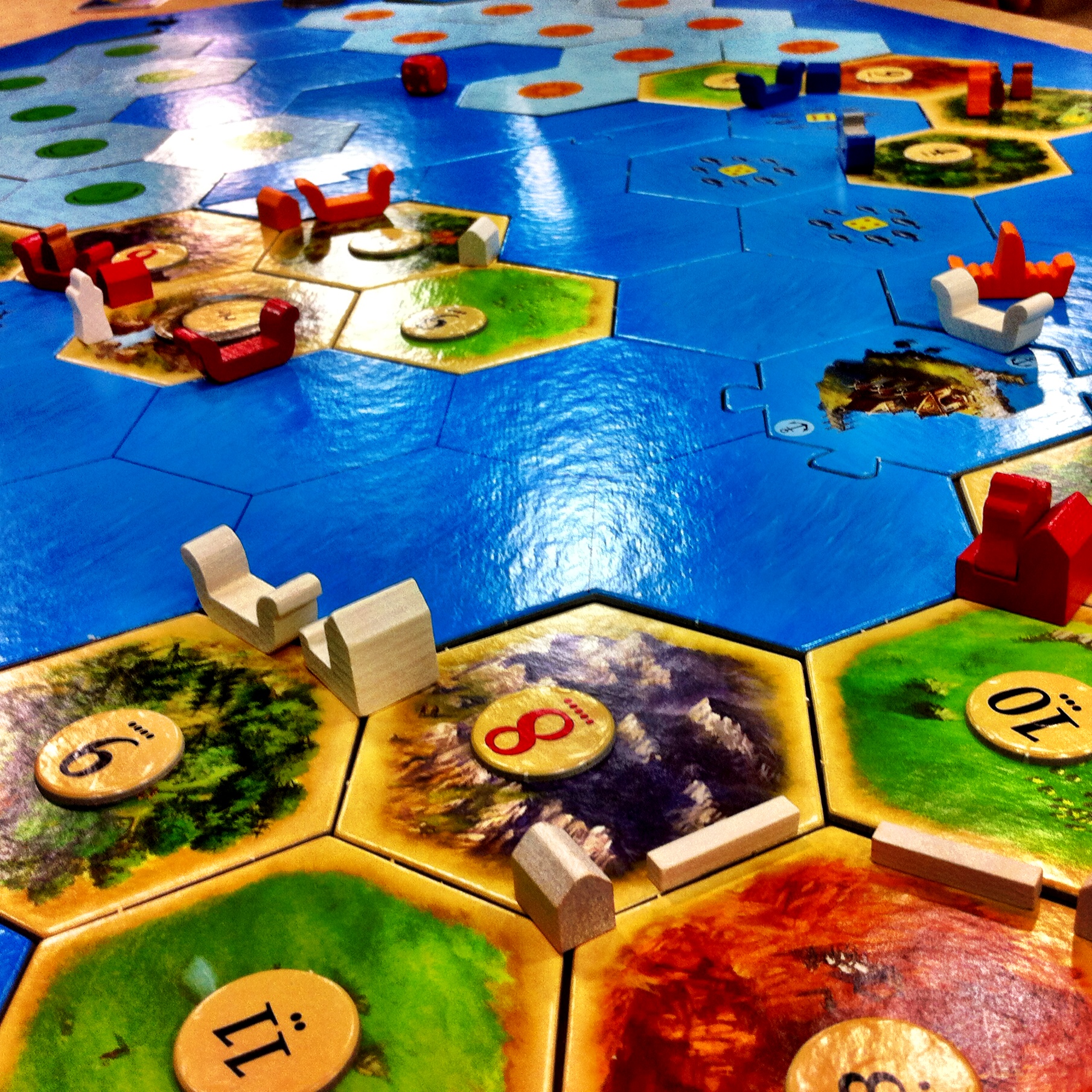
    That's right, Mayfair Games has just released a fifth edition of Settlers (which is now simply called Catan)... and I have to say that the new tile art (from Michael Menzel, the same guy who did the art for Stone Age & Legends of Andor) has me almost convinced to buy myself a new copy. The subtle differences in each tile are wonderful.
    Explorers & Pirates
    I had Catan: Explorers & Piratesthe opportunity to play the "whole enchilada" version of the newest Catan expansion... and I really enjoyed it. The shipping of spice & fish added some interesting twists, as did the new method for settling islands. I don't think it will convince anyone to change their minds about Catan, but I do think it's a splendid addition to the palette of available expansions.
    Of course, it probably didn't hurt my opinion that I managed to snake out a win from Morgan Dontanville (the designer of Asgard's Chosen and a long-time Facebook friend who I finally had the chance to meet face-to-face).
    Talking with Robert Carty
    Part of having a press pass was the opportunity to have some "face time" with Robert Carty, the Director of Sales & Marketing for Mayfair. We talked about a number of things:
    • that there are still people who wish they'd bring back the photo art tiles of the 1st & 2nd edition (really?!)
    • that Catan is more than 50% of Mayfair's sales (not a surprise...)
    • that he & I disagree about the Im Reich/Entdecker spin-off games (I like them a lot... Robert, not so much)
    • that they have big plans for The Big Game (more on that later in this article)
    • that Klaus Teuber may be working on something Catan-related that makes me very happy (but I'm not sure how much I'm supposed to say about... sigh)
    • that Downfall of Pompeii has sold really, really well since it's reprinting (which is a good thing, because it's a great game)
    • and a lot more "hey, we've both been in the hobby a long time" talk... but that's not why you're reading this
    SATURDAY MORNING
    3D Settlers3D Catan
    Even if one of my roads fell into the crack between two hexes and disappeared (indicating some sort of geological instability on the island of Catan), it was really neat to get to play Catan with my son & my good friend, Bob Trezise.
    BIG Karnickel
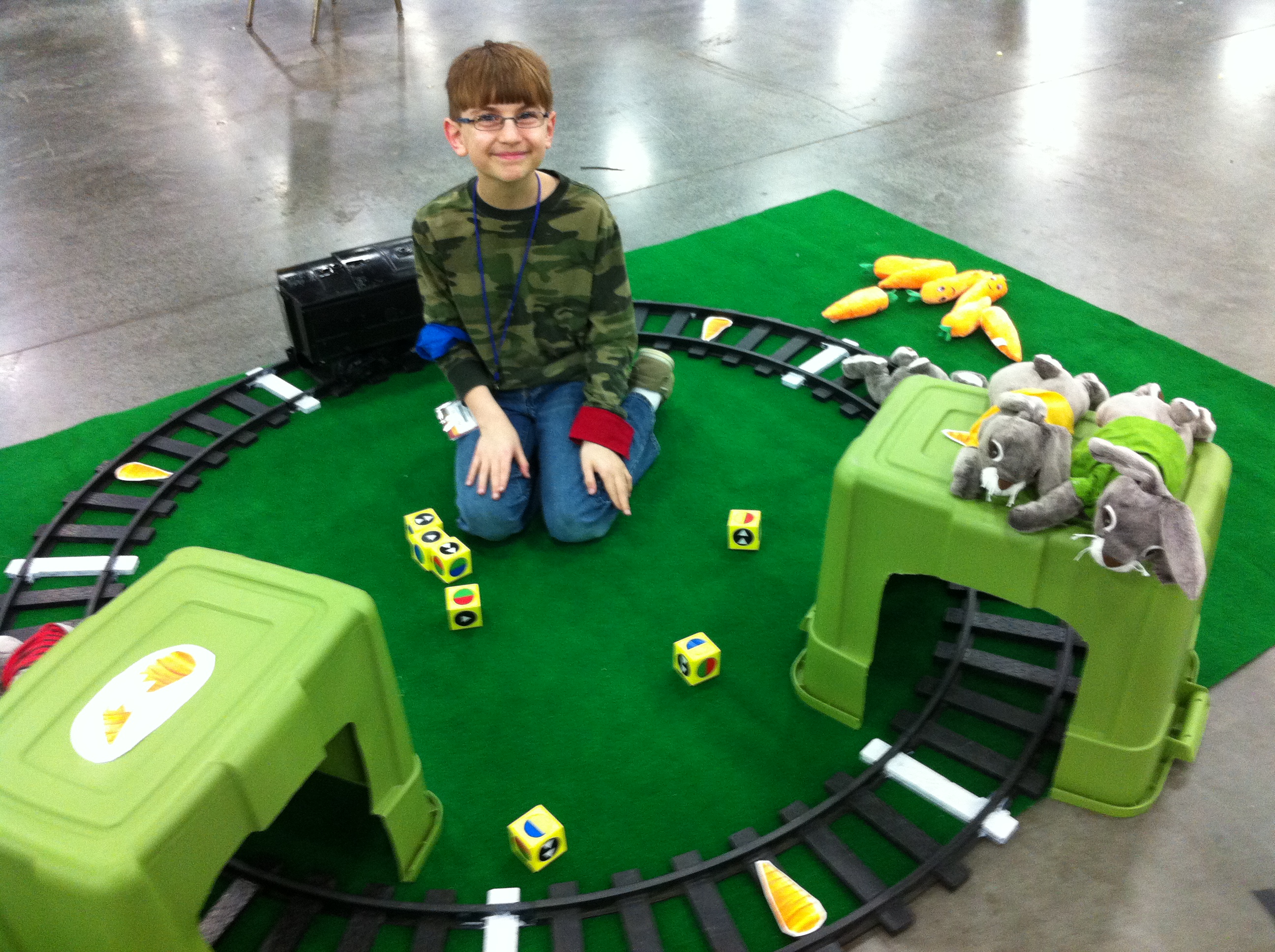
    KarnickelCollin (my son) noted that this was only "sort of Catan Con... maybe more like Mayfair Con". He wasn't entirely incorrect - the game library was liberally stocked with Catan and Catan expansions (both English & German), but there was also a pretty big selection of non-Catan Mayfair games.
    We ended up playing a big version of Karnickel, which I hadn't played before. I'm not sure I'd love the small size version of the game - which is a kid/family game - but throwing stuffed rabbits around and collecting piles of plush carrots was a lot of fun.
    BIG Downfall of Pompeii
    Yet another big game with Collin... since we already own this, it was more for Collin than for me (he liked the big games, even the ones we didn't play). They had a huge Settlers of America map, along with two different Star Trek Catan maps, a couple of regular Catans, and even a copy of Hot Tin Roof with stuffed cats & sardine tins.
    Catan Junior & Domaine
    We closed out our morning (well, early afternoon) with one game we'd both played before (and Collin stomped me at)... and Domaine, a Klaus Teuber design that I actively avoided for a long time in deference to my much beloved Lowenherz. With a couple of plays under my belt, though, I think I've gone over to the 'dark side' and like Domaine better.
    After this, I took Collin home and relaxed for a while before returning to the convention.
    SATURDAY NIGHT
    Catan: Ancient Egypt
    I'm not sure I'm sold on the Helpers of Catan (which I'm told also appear in Star Trek Catan as crew members and here as Egyptian gods)... they add some twists to the game but at the cost of some down time. On the other hand, Ancient Egypt is a very pretty game. (For those of you who've been around the hobby a while, it has some similarities to the Cheops scenario first published as a poster and later found in the original Historical Scenarios box... but there are definite tweaks to the game.)
    The Big Game
    Catan: The Big GameThe highlight of the evening was Catan: The Big Game - an event that Mayfair has run before at GenCon and will soon make available in kit form for charity events, schools and libraries. Without going into too much detail about the rules, it's Catan meets Take It Easy, as production numbers are "called" (like Bingo) and play simply alternates between sides of the table. 44 people played and the winning score is 25 - I was pretty proud to have 19 (or 20, I can't remember).
    Mayfair generously gave us all of us our wooden pieces and the card decks just for participating!
    FINAL THOUGHTS
    • The attendance was lower than they were set up for... but I don't think that's a complete surprise. This is a new event that will need more publicity - but I can easily see it growing as it was a very positive experience.
    • There was a good mix of folks with a variety of experience in the hobby... and more women and kids than I normally see at conventions. There were also folks from across the U.S. - I played with people from Illinois, Ohio, Alabama, Tennessee, New York & Washington state (that I know of!).
    • If they remain in the Gaylord Event Center, it will be a popular local event - parking is free and very close in the Opry Mills lot. (This is a "for Nashville folks" note - the con was not in the hotel proper.)
    • You'll notice I didn't mention the tournaments - as they aren't my favorite way of spending convention time, I didn't play in any of them. There were qualifiers for Catan and for Settlers of America.
    • Like my son said, this is more than just Catan. I saw folks playing a number of "gamer-friendly" Mayfair games, including Automobile and Caverna... and there were prototypes in various stages there being playtested, including the upcoming Extra! Extra!.
    All in all, a very good couple of days... and I'm looking forward to next year!

    This post originally appeared on the Opinionated Gamers website... and I was at CatanCon on a press pass for the OG.