Thursday, January 14, 2016

#14: The Princes of Florence (Mark's 100)


The Princes of Florence 

Mark's Ranking
  • 2014: 14th
  • 2012: 11th
  • 2010: 13th
  • 2005: 2nd
  • appeared on all four lists
BoardGameGeek
  • rank: 70
  • rating: 7.62
Print Status
  • in print
Why It's On The List
  • You have 21 moves - 7 auctions & 14 actions - in order to turn your estate into the perfect place for great artists & scientists to create their masterworks and bring prestige to your name... each action, each bit of coinage, each building, each recruitment is vital. What a perfectly formed & thematically rich (yes, I think it is!) Euro game...
  • ...it's the perfect balance between game length (70 minutes) and an unforgiving system. Any longer, and it would be soul-deadening to play out the final rounds when you know you've lost all hope of winning. Any shorter, and there wouldn't be enough time to make meaningful decisions in this game's Spartan structure.
Tips & Tricks:
  • I first started playing Princes of Florence with a German version and cheat sheets to translate the cards. The game was/is good enough that people were willing to get over themselves & learn to play this way. (I have since replaced all of the components in my set with English language equivalents except for the player boards.)
  • This game is subject to groupthink - despite much debate online, jesters & recruitment cards (both of which are valuable) are worth what the market will bear, not some arbitrary number established by a bunch of game nerds (he sez with his tongue firmly planted in his cheek).
  • There are two expansions available with the newest version of the game that are nice but not necessary. (For those of us who've played it a lot, they offer some variety - but the original game is so good that even I, the Man Addicted to Expansions, don't feel like they are important.)
  • The building strategy (building LOTS of buildings) can work - but only if you commit to it and only if you're the lone person attempting it.
Extras

    Wednesday, January 13, 2016

    First Impressions: Marvel Dice Masters - The Amazing Spider-Man

    • Designer: Mike Elliott & Eric. M. Lang
    • Publisher: WizKids Games
    • Players: 2 (with more players possible with more starter sets)
    • Time: 30 minutes
    • Ages: 14+ (on the box - but my 10 year old does just fine with it
    • Times Played: Amazing Spider-Man - 3 (with review copy provided by WizKidz Games); Uncanny X-Men - 16; (with our own copy purchased by me); the two sets combined - 2

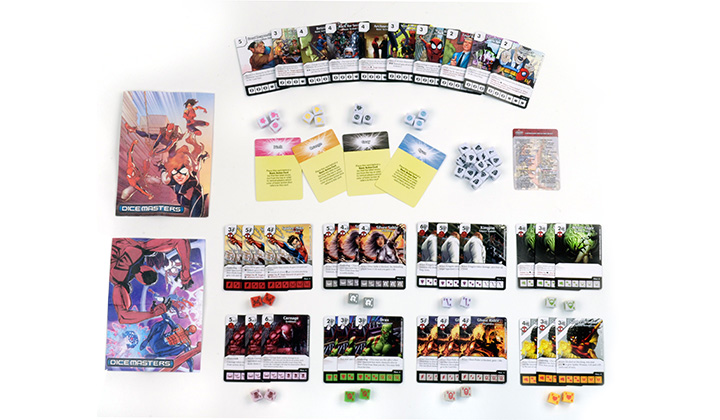
    spiderman_components2
    I have religiously avoided buying into the whole collectible card games addiction/credit card/crushing loads of debt death spiral. Well, if I’m completely honest, I did manage to buy a whole lot of Illuminati: New World Order (once it was OOP and on clearance)... and there was that brief flirtation with the Pez Card Game. (I take the Fifth on the buying of expansions, particularly games with plastic figures. Hasbro & Days of Wonder essentially have me in indentured servitude, thanks to Heroscape and Memoir ‘44.)

    But Marvel Dice Masters made it past my CCG radar - and not just because it was dice instead of cards. (Again, in the interest of complete honesty, it’s actually dice AND cards, but we won’t focus on that right now.) It was a Quarriors with Marvel super-heroes, which to my Avengers-obsessed sons was kind of like telling them that they could have pizza AND ice cream for dinner.
    The boys & I bought a starter pack of Uncanny X-Men, along with enough booster packs to fill out our forces. We have (spoiler alert) enjoyed the game as the grown-up and more gamer-friendly cousin to Quarriors.
    So when WizKidz wanted someone to write a review on the newest flavor of Dice Masters, my boys & I were happy to sign on.

    I’m A Little Bit Lazy

    The Grand Poobah of the Opinionated Gamers (paging Dr. Yu!) already did a very nice job of writing up how Dice Masters works - if you’re unfamiliar with the system, go right ahead and read his review of the Age of Ultron set
    Then come back here. I’ll wait for you.
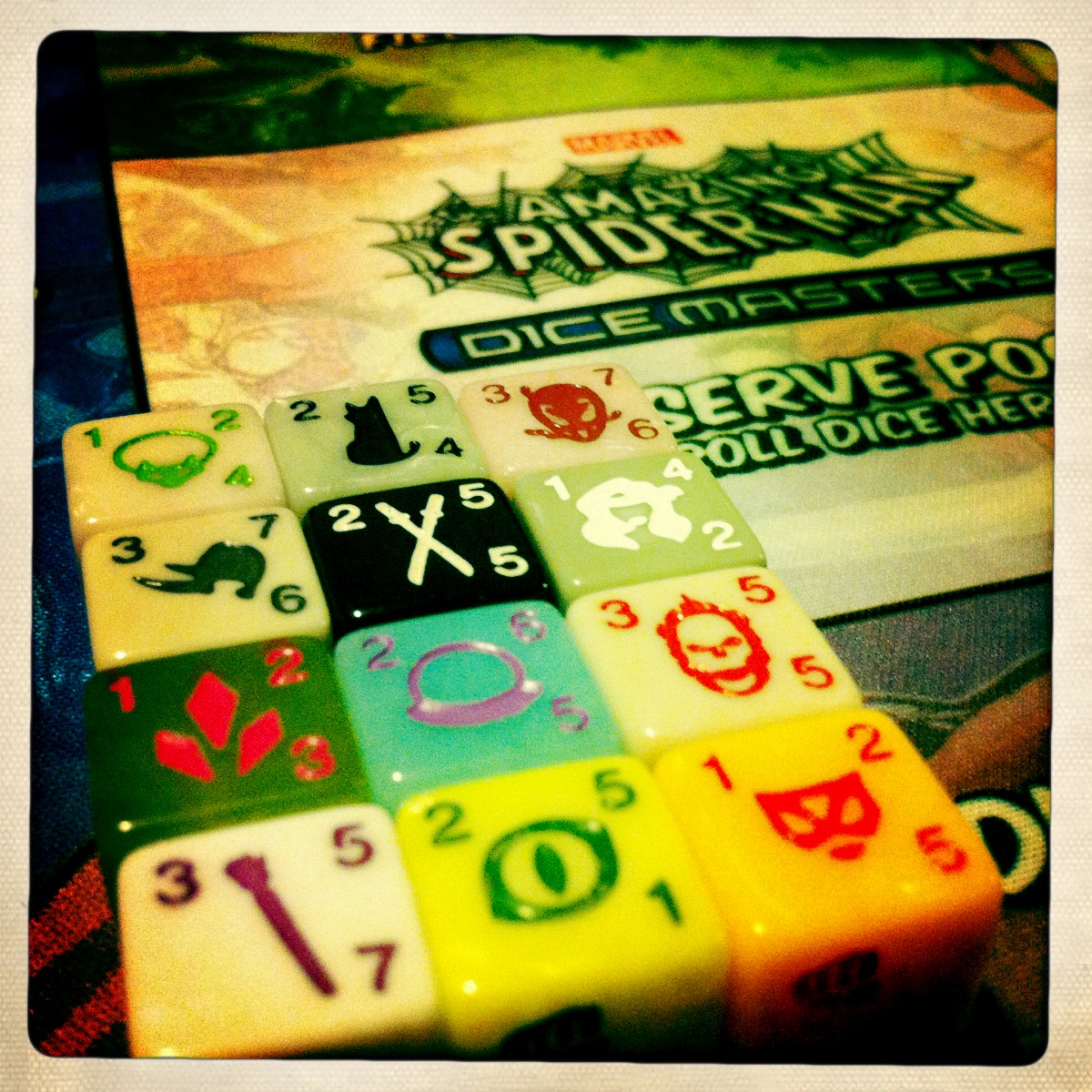
    photo(2)
    Welcome back! (Or, alternately, glad you hung around with me while we waited for all those folks to return.)

    Quarriors: Gamer-ized for Your Playing Enjoyment

    Since I haven’t really had a chance to chime in on why I think that Dice Masters is an improvement on the already enjoyable Quarriors system, I’ll take the opportunity here.
    Quarriors was the first “dice-builder” game design - but with the buying limits (one die per turn) and the required fighting (summon a creature and they immediately attack every other player in the game), it wasn’t a very subtle design.
    The Dice Masters system adds a variety of new wrinkles that increase the depth of the tactical decisions in the game:
    • after you roll your dice, you get a single reroll of any number of your dice
    • you can purchase whatever you can afford - no buying limits
    • global powers on various character cards and basic action cards (the rough equivalent of spells from Quarriors) give you new ways to spend your energy - sometimes even out of turn!
    • attacking is optional - meaning you can field dice for defensive as well as offensive purposes
    • dice that are KO’d go into your active pool - while dice that manage to inflict damage on your opponent going into the used pile… giving you reasons to mount inefficient attacks in order to build up dice for your next turn at potential cost
    All of these combine to make for a much richer and more involved gaming experience. (Note: this is not a knock on Quarriors - there are times when you just want hire a dragon, roll dice and smack everyone at the table.)

    Twist & Shout

    Part of this preview is highlighting a couple of new twists to the Dice Masters system. (Please note: I am not an expert on Dice Masters - just a fan.)
    There are three new keywords:
    • Aftershock: When a character die leaves by any means(damage/ability/action die) their ability kicks into gear
    • Ally: new special dice that also count as sidekicks (only in the field), in addition to their abilities
    • Underdog: an ability that activates when your opponent has more fielded dice than you 
    And, for the really geeky among us, two new affiliations:
    • the Sinister Six
    • Spider-Friends

    Cross the Streams

    We’ve played a couple of times mixing our two versions of Dice Masters together without any issues - I’m not claiming that constitutes adequate playtesting, That said, it’s worked fine and we have all enjoyed having the wider variety of heroes/villains to recruit.
    We’ve tried two different ways to set-up a mixed game:
    • giving each player their own set of dice/cards (in our case, Uncanny X-Men and Amazing Spider-Man) and letting them draft a team.
    • randomly choosing one card of each dice type… then shuffling those cards together and dealing an equal amount to each player. Players then draft from the cards they are dealt.
    The second method is a bit more labor-intensive on the front end - but no worse than sorting out Race for the Galaxy decks when you want to strip out the expansions to teach a new player. I prefer this method, as it keeps players from continually gravitating toward a few cards.

    Find Your Happy Place

    One of the things I like best about the Dice Masters system is the ease with which you can adjust the game during set-up to create your optimal battle environment. In our case, we’ve settled on drafting 10 dice and giving each player 25 lives.
    Conversation on BoardGameGeek seems to lean toward using the Rainbow Draft outlined in the rulebook - but for our money & time, a simple “alternate picking team members and choose the number of dice you want of that superhero/villain” seems to work very well.
    Since certain characters work well together (their special powers are keyed off an affiliation), we have also played games where each one of us simply took a group (Spider-Man allies, X-Men, Villains, etc.) and created our own teams using just those cards.
    There are also some variants that allow players to draft certain basic action cards (common pool dice with powers) into the game. We usually shuffle the basic action deck and simply deal out four cards before drafting our heroes - it’s a way of “varying the terrain”, so to speak.
    Like I said, the flexibility of game set-up is a real plus.

    Batteries Not Included

    No, you don’t actually need batteries - but you’re certainly going to want better dice bags than those included with the starter set. They are colorful printed paper bags that only hold up for a few games.
    You’re also going to want a better way to store the games - WizKids will be more than happy to sell one of their storage solutions, of course. We simply repurposed an extra Quarriors expansion box.
    I’m not really griping about this - one of the attractive things about the Dice Masters series is that the barrier to entry (cash-wise) is pretty darn low. The starter sets have a lot of dice & cards - but if they included high-quality bags, they’d be pushing the price point too high.
    I do want to say some nice things about their “mouse pad” mat for the game - it makes it much easier to teach when you have a playmat so players know what goes where. Again, I’m not sure it’s necessary, but if you’re going to be playing a lot of Dice Masters, it would be worth owning a couple of them (one per player).

    Final Thoughts

    I don’t think Dice Masters replaces Quarriors - they are different enough that I’m glad both of them are in my collection. But I do think that your interest in the Dice Masters series (including the newest incarnation, Amazing Spider-Man) will hinge on:
    • your willingness to deal with the collectible nature of the game system - are you able to resist needing to collect all the various cards & dice?
    • having adequate opportunities to play 2 player games
    If you’re good to go on those two, you’ll find the Dice Masters system to be relatively inexpensive ($15 for a starter pack, $1 for each 2 dice/2 card foil pack) and highly customizable fun. And for Spider-Man fans, you'll get a big chunk of the Spidey universe in dice form... which is not a bad thing. Not a bad thing at all.

    This first impression originally appeared on the Opinionated Gamers website...

    Tuesday, January 12, 2016

    #15: A Brief History of the World (Mark's 100)


    A Brief History of the World

    Mark's Ranking
    • 2014: 15th
    • 2012: 3rd
    • 2010: 14th
    • 2005: 35th (ranking the previous edition - the Hasbro/Avalon Hill version of History of the World)
    • appeared in all four lists
    BoardGameGeek
    • rank: 1183
    • rating: 6.99
    Print Status
    • in print
    Why It's On The List
    • it's all about the epic sweep of history - and this particular version of a game system originally published in 1991(!) is the best yet. It's tighter, smarter, and faster than any previous edition - playing time is about 3 hours for six players to experience this dudes/empires on a map masterpiece.
    Tips & Tricks:
    • I first played the Ragnor Brothers' History of the World in the mid-90s. The experience was a disaster - six new players coupled with the overly wargamer-tinged rules of the original Avalon Hill publication of the game meant it took us nearly four hours to complete two of the seven epochs... and then we abandoned the game.
      It was nearly six years later when I received an early prize table pick at a gaming convention and thanks evidently to a whiff of the massive amounts of plastic figures in the box decided to pick up the Hasbro/Avalon Hill edition as my first pick. The game was substantially better than I had remembered - esp. with the revisions that had been made to streamline the design. It became one of those "once a year" games (because of the length... 4-6 hours) though I wanted to play more often.
    • Fast forward to late 2009 as the Ragnor Brothers announced that they had - nearly 20 years after the first edition was published - once again made some major revisions to their signature game. The early press was positive enough for me to plunk down some hard-earned cash on it - seeing as how I hadn't played my beloved H/AH copy of HOTW in nearly 3 years.
    • I didn't waste a penny... though I miss the 7 different plastic minis (one type for each epoch) and the shiny capitol/city markers, everything else I love about the game system is still there - and less. It's shorter, leaner & tighter (our six player game this year took 3 1/2 hours with 2 new players)... and there's actually more room in the game for tactical & strategic decision-making while reducing the number of armies on the board. The refining of the empire deck (giving more thematically specific powers to some of the empires) and the costing of the event deck (many events now come with some kind of VP cost to activate) make for an even better game.
    • There is an iOS app - which is slowly but surely getting the bugs worked out. It's a lot of fun for personal play against the AI.
    • This is more of an experience game than a strategy game - but given the choice, you want to score when you have lots of pieces on the board (follow a late empire pick with an early empire pick) and deny the same opportunities to your opponents.
    Extras
    • I've quoted above pretty much the only thing I've written about A Brief History of the World.
    • Here's the two (admittedly short) blurbs from The One Hundred: the group blurb & my personal blurb.

     ==========

    If you feel a need to catch up on my admittedly-aging Top 100 as of February 2012 list, you can check out:

    Monday, January 11, 2016

    Kid Game Review: Crash Cup Karambolage

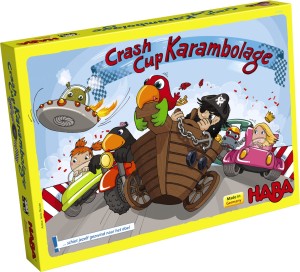
      crash cup box
    • Designer: Heinz Meister
    • Publisher: HABA
    • Players: 2-4
    • Ages: 6+
    • Playing Time: 15 minutes
    Review by Mark Jackson on a review copy provided by HABA Games (7 plays with Crash Cup Karambolage, 20 plays with the original 1995 edition)
    There are a LOT of flicking games out there… from the classics like Crokinole Carabande/Pitchcar to newcomers like Flick ‘Em Up & Cosmic Kaboom - and then there’s oddballs like Hobby World’s Desktopia and Z-Man’s Ascending Empires. (I do love Ascending Empires.) So how do you vary up a game genre that, by definition, has some pretty specific limits?
    Over a decade ago, the game Cairo used a die roll to determine which digit you had to flick with… hardly a major innovation, but still a nice idea. (Cairo also had you flicking a die… two years before the much-more successful Tumblin Dice.)
    But what if you added a piece of string?
    Seriously - that’s the innovation behind the original Karambolage (which won the Kinderspiel award back in 1995)... and the updated version of the game recently published by HABA, Crash Cup Karambolage. Wooden discs are flicked by putting a short piece of string behind the disc and pulling the string taut - thus shooting the disc forward like a slingshot.
    I’m on record as being a fan of the original version of Karambolage - though it didn’t make my Kid Games 100 list as I’ve always felt like it was better for older kids and adults than it was for the typical “HABA yellow box set” of preschoolers & early elementary children. The first two games in the rulebook (Rumble Rage & Drift Derby - which appeared in the 1995 version of the game as Karambolage & Karamba) both fall in this category.
    Of course, the very things that make it a stretch for younger kids make it ideal for families and gamers:
    • it’s a dexterity game - and the string-flicking at the heart of the game requires some practice to master, as you want to carefully control where the disc you are flicking ends up
    • it’s a game with a need for “look ahead” - much like billiards, you want to finish your shot either by leaving yourself in a position to make another shot by leaving your opponent in a position where he can’t make the first shot
    • it’s a “push-your-luck” game - basic Karambolage scoring is based on how many shots in a row you can successfully make… if you miss, you lose all the points you had gathered that round
    So, you ask, why are these three things problematic for younger kids?
    • Dexterity games are not necessarily bad for kids (I’m happy to point families with younger children to games like Maus nach Haus or any one of the multitude of Animal Upon Animal games) - but dexterity games that require finesse demand precision and estimation that are unlikely to be developed enough to compete with older children/siblings and adults.
    • “Look ahead” is a tricky concept for some adult gamers, let alone early elementary school children.
    • “Push-your-luck” isn’t a problem for younger kids - one of the best push-your-luck games out there is HABA’s Cheese Snatching - but combined with the skill needed to keep scoring, this can be frustrating to younger players.
    However, all bets are off when you get to the third game in the box, the titular Crash Cup Karambolage. Rather than the billiards-like positioning games in both the original & new editions of Karambolage, this is a racing game using the string-flicking method of propulsion and the flexibility of the new wall design. There are power-ups (small cardboard discs that activate when hit) in this Carabande-ish way to play, as well as the potential for “denting” your car.
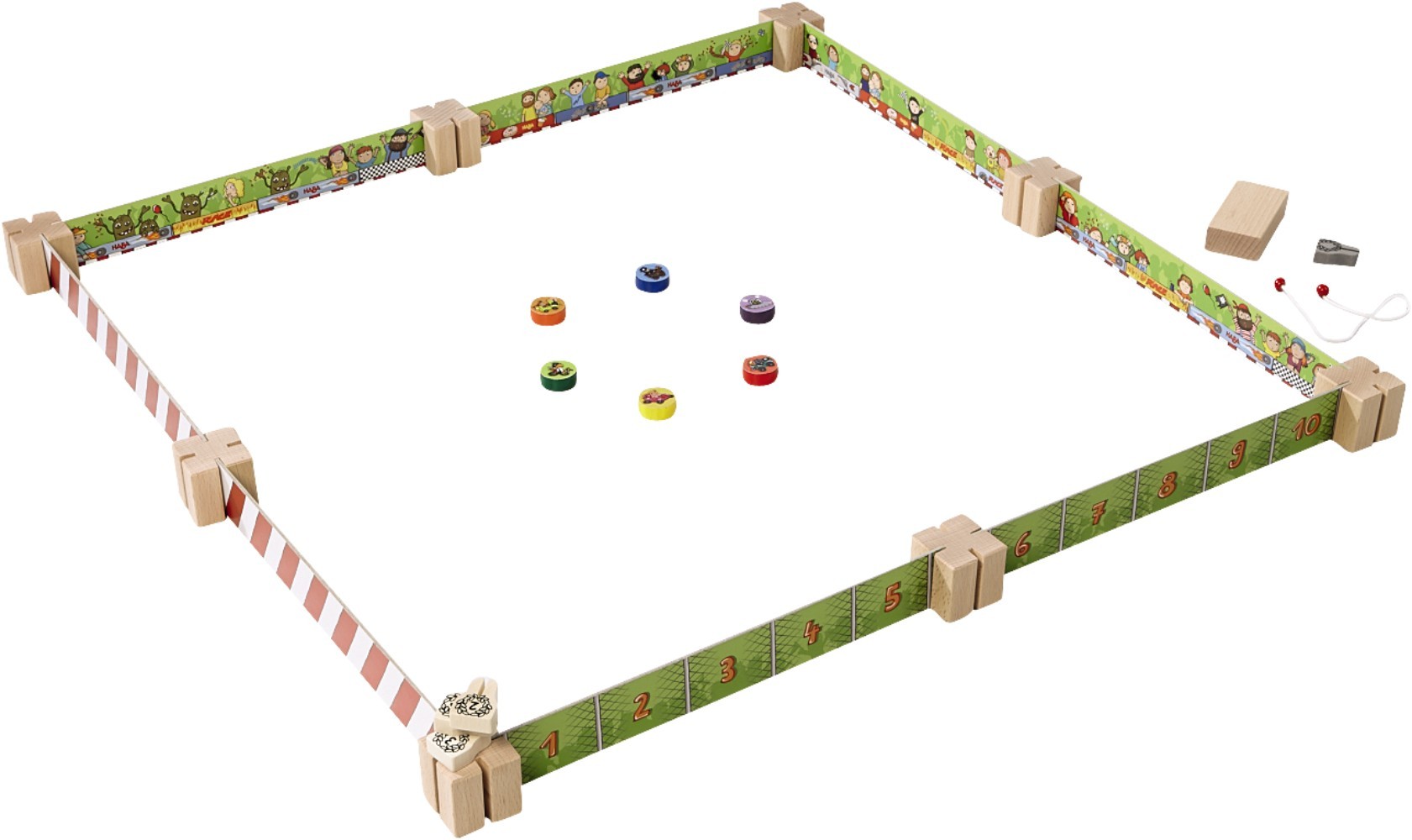
    crash cup setup classicThe Stuff In the Box
    • Rulebook (in many, many languages)
    • 8 hefty wooden boundary blocks for anchoring the sideline banners
    • 8 cardboard sideline banners
    • 6 wooden discs (with stickers for their “new” and “damaged” sides)
    • the flicking string
    • the “drift” block (a wooden block used for banking)
    • two six-sided color dice (each side corresponds to a color of one of the wooden discs)
    • 5 wooden point/lap markers (that slot nicely onto the side rails)
    • cardboard tokens & player boards (for the Crash Cup version of the game)
    The Games In the Box
    There are three different games in the box - each of which involve flicking one of the discs with the string in order to achieve a particular goal. None of them are difficult to teach or play - but playing them well (especially Drift Derby) can be tricky.
    Rumble Rage (aka Karambolage)
    • Roll the two color dice to pick two discs.
    • Flick one of those discs into the other for a point. (You get an extra point if you used the drift block to ricochet the disc you shot into the other disc.)
    • Bank your point(s)... or roll again and make another shot.
    • Miss your shot or hit the wrong disc and/or the boundary banners… you lose all the points you’ve gained this turn.
    • Roll doubles (the same color on both dice): double your current points acquired that turn and roll again.
    • First player to 10 points wins.
    Drift Derby (aka Karamba)
    • The same basic rules as Rumble Rage…
    • ...but the die roll tells you which two discs you must shoot another disc between - as if you’d drawn an imaginary line between the two colors that you must cross.
    HABA Grand Prix
    • First player to circle the track 3 times wins.
    • If you hit another disc or the boundary banner or go off the table, you reset your turn and flip your disc over to the distressed side.
    • If you have another accident while you’re distressed, you take your disc off the race track and restart that lap on your next turn.
    • If you tag a power-up token during your move, you draw from a pile of smaller tokens that contain both good one-use powers (repair, two flicks, etc.) and bad events (lose a turn, distress your car).
    crash cup setupSome Thoughts From a Long-Time Karambolage Player
    • HABA Grand Prix is very kid-friendly… I’ve played it with children as young as 7 who do quite well with it. That said, I’d be inclined to take out the “flat tire” chips from the power-up pool when playing with early elementary age kids, as they can pretty much doom your chances of winning and/or finishing the race.
    • There is a specific set-up for the Grand Prix in the rulebook - but nothing prevents you from using the provided barriers to create your own racetrack. You can make it easier or much, much harder by varying the number of barriers and the distance between them, as well as the number of laps required.
    • The playing surface you use will make a big difference in the game. You want to avoid sectional tables and tile countertop-type tables. (This is not specific to Crash Cup Karambolage - it’s true of pretty much any flicking game.)
    • As much as I’ve enjoyed the HABA Grand Prix, I still think that the shining star here is the original game (Rumble Rage).
    • I will say that the new sideline banners are easier to set up and - more importantly - easier to determine if a player has flicked a disc against them (a “foul” in all three of the games in the box). I miss the flexibility of the block & string arrangement from the original version - but not that much.
    • There’s a lot of air in the box - but that’s necessary because of the length of the boundary banners. The box is the same size as Kayanak  or Die Kullerbande (two HABA games pretty much every family should own).
    Odd Little Factoid
    There’s actually a set of rules in the original edition of the game called Karamboli. Due to the new way in which the borders are created, it can’t easily be played with the new set… but I don’t think that’s much of a loss, as it’s the least effective game in the original box.
    Conclusion
    It’s great to have this Kinderspiel-winning game system back in print and available to a new generation of players - and it’s even better because of the quality of the components, the clarity of the rules, and the fun that can be had with this wonderful design from Heinz Meister. (Yes, I’m a Heinz Meister fanboy - sue me.)
    The age recommendation of 6+ seems right on the edge for me… but I can easily see this as a great game for families with a wide variety of ages. (Then again, I’ve seen kids that age play and enjoy this immensely, so what do I know?)

    This review originally appeared on the Opinionated Gamers website... 

    Sunday, January 10, 2016

    #16: Dungeonquest (Mark's 100)


    Dungeonquest

    Mark's Ranking
    • 2014: 16th
    • 2012: 15th
    • 2010: 9th
    • 2005: did not appear
    BoardGameGeek
    • rank: 993
    • rating: 6.68
    Print Status
    • in print... in a second revised edition from FFG (both the original edition as well as the first FFG reprint are OOP)
    Why It's On The List
    • I have always described this game as "similar to playing Dungeons & Dragons with a DM who hates your guts" - it's a short (no more than an hour...and often shorter!), brutal & intensely fun experience game/dungeon crawl.
    Tips & Tricks:
    • While I appreciate what Fantasy Flight did in reprinting Dungeonquest, I wasn't a fan of the goofy combat system they loaded onto it or the seriousness they added to the proceedings by transporting the game into their Terrinoth universe. (Part of the charm of Dungeonquest is the off-beat dark humor - which I attribute to the unique blend of Swedish designer & British publisher.)
    • That said, I have not played the Revised Edition reprint... which has better buzz than the earlier version.
    • If you manage to track down a copy of the original game + the two expansions, consider yourself incredibly lucky. It took me nearly 8 years to find the expansions - and even then I had to replace some of the missing miniatures from the used copy I bought.
    • The FFG edition includes some of the expansion stuff - so if you can find that at a reasonable price, it's still a good deal. (But look on BGG for alternate ways to do combat that don't slow the game down.)
    • We have a house rule... you can't win by simply surviving (running in a couple of spaces & running right back out). You must find SOMETHING of value - and no, a potentially poisonous healing "potion" does not count.
    • Do not under any circumstances (a) get too attached to your character, or (b) take the game too seriously. It's just a rousing chance to roll dice, fight monsters & generally find creative new ways to die.
    Extras
    • I still have trouble believing that I haven't written more about Dungeonquest. I will have to remedy that... someday.

      Saturday, January 09, 2016

      #17: Fresco (Mark's 100)


      Fresco

      Mark's Ranking
      • 2014: 17th
      • 2012: 43rd
      • 2010: did not appear
      • 2005: prior to publication
      • rank: 128
      • rating: 7.43
      Print Status
      • in print
      Why It's On The List
      • Fresco is a lovely worker-placement game that has three endearing qualities: first, it has an interesting theme; second, pretty much every mechanic in the game can be explained in terms of that theme... and finally, it does not seem to ever bog down with AP (analysis paralysis) like some other worker-placement games.
      Tips & Tricks:
        • You can play Fresco as a "sandbox" game (where you don't pay much attention to what other players are doing), but to really excel at the game, you must watch carefully to see what paints are highly desired and whether or not you'll have multiple options if you go later in the turn order.
        • One of the trickiest decisions in the game is manipulating the turn order by taking less points.
        Extras
        • The picture with this post is Fresco set up with most of the expansions.
        • Here's my take on the first set of expansions: the portrait cards & paint mixing tiles (included in the original game) are great ideas & should be used from the start with gamers. The extra paint colors (also included in the original game) add some interesting tactical decisions but add to the length of the game. The gold leaf (in the large expansion box) is a nice touch that increases the score, but I think it works best when coupled with the glaziers (also included in the large expansion box) to offer different scoring pathways to pursue. The wishing well (the last in the large expansion box) is pretty random & non-essential.
        • The second set of expansions (the bell, the "plague", etc.) are not necessary - but do give the game some variety if you're playing it a lot... which, sadly, I am not.
        • There are two other small expansions published - a small giveaway called The Bishop's Favor (which I like) and an incredibly over-priced set of "secret" bonuses called The Scrolls (which would like better if it wasn't so expensive).

        Friday, January 08, 2016

        #18: Um Reifenbreite (Mark's 100)


        Um Reifenbreite

        Mark's Ranking
        • 2014: 18th
        • 2012: 16th
        • 2010: 13th
        • 2005: 7th
        • appeared in all four lists
        • rank: 846
        • rating: 6.87
        Print Status
        • out of print (but not impossible to find)
        Why It's On The List
        • A bicycle team racing game that "simulates" drafting, the pelleton, breaking away & a whole bunch of other bike racing things... without ever bogging down in rules nonsense or chrome. And it's a barrel of laughs to play!
        Tips & Tricks:
        • You really should play multiple races to get the full feel of the game...
        • ...but don't bother with the yellow jersey rule, which we've never been able to completely figure out.
        • Budget your cards wisely - esp. if you're racing on a course with hills.
        Extras
        • Here's what I wrote about the game for The One Hundred: both my personal entry and the group entry.
        • The photo of the box cover is from BGG.

        Thursday, January 07, 2016

        #19: Dungeon Lords (Mark's 100)


        Dungeon Lords 

        Mark's Ranking
        • 2014: 19th
        • 2012: did not appear
        • 2010: 36th
        • 2005: prior to publication
        BoardGameGeek
        • rank: 125
        • rating: 7.49
        Print Status
        • in print
        Why It's On The List
        • Flip your standard adventurers v. monsters around and put players in the role of harried dungeon masters trying to fend off sticky-fingered heroes. Add loads of RPG and WoW-related humor... and tie it together with an almost perfect melding of mechanic and theme.
        Tips & Tricks:
        • My original impression of Dungeon Lords is that it only worked with a full complement of four players. I'm happy to say that I was wrong. My oldest son and I really enjoy playing two player - there are some interesting decisions in choosing actions for the non-player dungeon lords.
        • The Festival Season expansion makes the game a little longer & adds some more wrinkles... but they're really good wrinkles and worth the time if you like the game system.
        • You MUST pay attention to what other players can and cannot choose as actions to avoid losing an action. 
        • CGE published a blinged-out version of the game (Happy Anniversary) - I spent too much money getting the pieces to upgrade my set, but it's just so darn cool.
        • Final warning: a 4 player game with the expansion fills up a dining room table - but it looks good doing it.
        Extras
        • I'm really proud of my review of the Festival Season expansion... I think I managed to capture the humorous tone that adds so much to this game system.

        Six (6) Months

        Forgive me, blogosphere... it has been 6 months since my last post. While I'm still pretty active on Twitter, I've been AWOL from here since early July - up to and including not finishing my Top 100 games from 2014, for crying out loud. 

        I'm not promising any miracles, but the plan is to get my act back together and start posting at least once a week again.

        We'll see.


        Tuesday, July 07, 2015

        #20: Risk Legacy (Mark's 100)


        Risk Legacy 

        Mark's Ranking
        • 2014: 20th
        • 2012: 9th
        • 2010: 65th (Risk: Black Ops)
        • 2005: did not appear (original game)
        BoardGameGeek
        • rank: 94
        • rating: 7.83
        Print Status
        • not in print... but still not difficult to find a copy
        Why It's On The List
        • What if a game remembered what had happened during the previous games... and that game told an epic story? That's always been true in role-playing games - but Rob Daviau's brilliant design idea took the core engine of Risk to a whole new & wonderful mind-warping level.
        Tips & Tricks:
        • I’m not sure how to extol the virtues of this wonderous Risk reboot without spoiling some of its well-hidden charms, but I’ll give it a shot.

          Risk: Legacy is…
          • …a product of nearly a decade of experimenting with this classic game system. (It incorporates ideas from Risk 2210 & Risk: Black Ops to make the game shorter & yet packed with thematic touches.)
          • …an innovative board game concept – something we don’t see nearly as often as we’d like to think. (The whole “open this pack of cards when this happens” way of changing the game is brilliant.)
          • …a reminder of what was really great about my old RPG days – we’re working together to tell a story about this new world we’re fighting over. (In our case, the founding of Great Humongustan, the DEW line populated with installations left over from the Battle of the Northern Wastes… and most recently, the Cataclysm in Southern Europe.)
          • …gamer catnip. (Let me explain – each time you get to open a new packet, it feels very similar to the “rush” you get when opening a new game or game expansion. And it not only gives you the “new car smell” effect, the added stuff takes the story of the game in a new direction.)
          • …fun even for people who don’t particularly like Risk. (One of the guys in our group – the founder of Great Humongustan – is not a fan of “dudes on a map w/dice” games & esp. not a fan of Risk. Yet he had a grand time playing Risk: Legacy with us… and even commented when he arrived after a game had started that “it was just fun watching you guys play.”)
        • If you choose to buy this here in the U.S., go to BGG and download/print the bonus cards which were not officially released stateside.
        • More importantly, don't spend a lot of time reading about the game before you play it! let the surprises catch you unawares - one of the packet reveals is easily one of the best gaming experiences I've had in the last 10 years.
        Extras

        Wednesday, July 01, 2015

        #21: Monopoly: Tropical Tycoon DVD Game (Mark's 100)


        Monopoly: Tropical Tycoon DVD Game

        Mark's Ranking
        • 2014: 21st
        • 2012: 30th
        • 2010: 18th
        • 2005: 17th (Monopoly - original edition)
        • appeared on all four lists
        • rank: 7594
        • rating: 5.84
        Print Status
        • out of print (but pretty easy to find on Ebay)
        Why It's On The List
        • It takes the classic game (Monopoly) and makes it extremely gamer-friendly by adding Cosmic Encounter-ish roles, a variety of choices for building, and a great point system that lets you stop the game at any point and declare a legitimate winner.
        Tips & Tricks:
        • Basic Monopoly strategy still works with Tropical Tycoon... but there are major new considerations when you are building on monopolies. You can build for cash or for points... or for some balance point in between.
        • The more people playing, the more careful you have to be about how you make trades. Some of the cheaper properties can be converted into pretty powerful income streams if you plan correctly.
        Extras
        • The only problem I can see with the game is the need for a DVD player - all of the card draws/random events are keyed off of the DVD.  That said, it works really well without being overly intrusive.
        • Here's two things I wrote about Monopoly on my blog aka pastor guy: Giving Away Your Own (Monopoly) Money and The World's Most Famous Game And How It Got That Way. In short: "most of you play Monopoly wrong... and that somewhat explains why so many gamers hate the game."
        • Here's what I wrote about Monopoly for The One Hundred

        Tuesday, June 16, 2015

        25 Wonderful Years: A Box Score

        25 years ago (June 16th, 1990), I married Shari Jo Becknal. Right after giving my heart and life to Jesus Christ, it's the best decision I've made in my life. 

        In those 25 years, we've experienced the following:


        2 fantastic sons
        • Braeden
        • Collin


        4 states lived in
        • Arkansas
        • Tennessee (twice)
        • California
        • Texas


        7 cars
        • Honda Accord
        • Nissan Sentra
        • Honda Civic
        • Acura LX
        • Honda Odyssey
        • Chevy Malibu
        • Honda Civic


        7 trips to Disney parks
        • Disneyland 1992
        • Walt Disney World 1996
        • Walt Disney World 2000
        • Disneyland 2003
        • Disneyland 2007
        • Disneyland 2008
        • Disneyland 2012


        8 homes
        • the duplex in Fordyce, AR
        • the duplex in Inglewood, TN
        • the apartment in Antioch, TN
        • the house in Antioch, TN
        • the parsonage in Easton, CA
        • Mark’s house in Conroe, TX
        • Buster & Sheridyn’s house in Inglewood, TN
        • the duplex in Goodlettsville, TN


        9 churches
        • Shady Oaks Baptist Church (Hurst, TX)
        • First Baptist Church (Fordyce, AR)
        • Dalewood Baptist Church (Inglewood, TN)
        • BCC (Bellevue, TN)
        • the church @ hickory hollow (Antioch, TN)
        • Fellowship Bible Church (Brentwood, TN)
        • NewLife Community Church (Easton, CA)
        • C3 (Conroe, TX)
        • Grace Church (Hendersonville, TN


        13 jobs
        • youth minister (Fordyce)
        • substitute teacher (Fordyce)
        • youth pastor (Dalewood)
        • daycare driver (Hendersonville)
        • teacher (Wright Middle School)
        • church planter (tc@hh)
        • JC Penney (1997-98)
        • tutor (Sylvan Learning Center)
        • JC Penney (2002)
        • fulfillment warehouse
        • senior pastor (NewLife)
        • Legislative Information Services
        • Deputy Director (TDOE)


        25 states visited
        • Alabama
        • Arizona
        • Arkansas
        • California
        • Colorado
        • Florida
        • Georgia
        • Illinois
        • Kentucky
        • Louisiana
        • Maryland
        • Missouri
        • Nevada
        • New Mexico
        • North Carolina
        • Ohio
        • Oklahoma
        • Oregon
        • South Carolina
        • Tennessee
        • Texas
        • Utah
        • Virginia
        • Washington
        • Wisconsin


        Compiling a box score of our twenty-five years together is a lot of fun - especially for someone like me who tracks how many times he’s played each game. But it doesn’t begin to adequately describe the wonder & joy of spending literally half of my life with Shari Jo, the love of my life.

        Besides, I’ve completely lost count of the number of times she's taken my breath away.


        Five years ago, I wrote a blog post about our romance and wedding that I'd love for you to read - 20 Years ("It Did"). It's a perfect companion piece to this post.