Everything including the kitchen sink... but with special attention paid to board games, Jesus Christ, my family, being a "professional" (and I use that word loosely) Christian, and the random firing of the 10% of the synapses I'm currently using.
A clever puzzle of a game that incorporates deck-building, dice placement, and a nicely thought-out series of mini-expansions in the base game box.
Tips & Tricks:
Sequencing your card purchases is an important skill... working so that you group nobles together, for example, makes it much easier to spin through your deck.
It isn't necessary to throw in every mini-expansion on your first play to prove your "gamer cred" - the base game is enjoyable on its own merits.
Extras
There is an expansion coming (Open Doors)... and I'm ready for it to show up already!
My younger son refers to Taverns as "gamer Quacks"... not sure I completely agree, but I see where he's coming from.
This is the first of two games designed by Wolfgang Warsch on the countdown. (I don't think you'll have a difficult time figuring out the other one.)
not in print... but still not difficult to find a copy
Why It's On The List
What if a game remembered what had happened during the previous games... and that game told an epic story? That's always been true in role-playing games - but Rob Daviau's brilliant design idea took the core engine of Riskto a whole new & wonderful mind-warping level. And for the purposes of this list, it's still one of the best multi-game experiences I've ever enjoyed, playing it with the Fresno Gamers group!
Tips & Tricks:
I’m not sure how to extol the virtues of this wonderous Risk reboot without spoiling some of its well-hidden charms, but I’ll give it a shot.
Risk: Legacy is…
…a product of nearly a decade of experimenting with this classic game system. (It incorporates ideas from Risk 2210 & Risk: Black Ops to make the game shorter & yet packed with thematic touches.)
…an innovative board game concept – something we don’t see nearly as often as we’d like to think. (The whole “open this pack of cards when this happens” way of changing the game is brilliant.)
…a reminder of what was really great about my old RPG days – we’re working together to tell a story about this new world we’re fighting over. (In our case, the founding of Great Humongustan, the DEW line populated with installations left over from the Battle of the Northern Wastes… and the Cataclysm in Southern Europe.)
…gamer catnip. (Let me explain – each time you get to open a new packet, it feels very similar to the “rush” you get when opening a new game or game expansion. And it not only gives you the “new car smell” effect, the added stuff takes the story of the game in a new direction.)
…fun even for people who don’t particularly like Risk. (One of the guys in our group – the founder of Great Humongustan – is not a fan of “dudes on a map w/dice” games & esp. not a fan of Risk. Yet he had a grand time playing Risk: Legacy with us… and even commented when he arrived after a game had started that “it was just fun watching you guys play.”)
If you choose to buy this here in the U.S., go to BGG and download/print the bonus cards which were not officially released stateside.
More importantly, don't spend a lot of time reading about the game before you play it! let the surprises catch you unawares - one of the packet reveals is easily one of the best gaming experiences I've had in the last 15 years.
Extras
Yes, it was the first legacy game... and, yes, I've played a lot more of them over the years. (One or two might show up later in this countdown... and one already has.) It's not the most fully developed of the genre - but I'm still trying to figure out how to talk my game group here in Nashville into playing it with me so I can enjoy it again!
Note: while I didn't receive a review copy of Risk Legacy (it was actually a BGG Secret Santa gift!), I did receive a copy of Risk: Black Ops as a review copy. And, no, I haven't sold it for re-donk-u-lous amounts of cash - it's still in my collection.
A wonderful card-drafting game that whips along at a breakneck pace and offers a consistently enjoyable gaming experience as the players cast (and miscast) theater productions.
Tips & Tricks:
You don't have to be a card counter to do well - but it is good to know what "9" cards are remaining in each show.
You do not have enough money - so you're going to have to accept that one of your four shows is going to be, well, a flop.
Use your flop show to borrow money - a common tactic is put on a flop, put it in the lowest point value city & then take the maximum amount of money out of the show.
Extras
While I'm very glad there is a reprint available (though it's OOP as well), I do want to note that the two included variants are not necessary to enjoy the game.
Thankfully, the truly inferior version of the game (Atlantic Star) is out of print.
And, no, I haven't ever played the original version, Premiere.
Showmanager scales really well for 3-6 players... I'm least fond of 4 but it still works well.
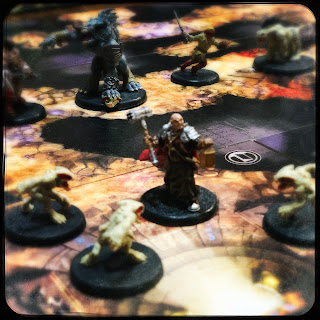
Imagine taking the asymmetrical structure of the classic game Space Hulk (hordes of bad guys vs. a small band of heroes) and cross-pollinating it with some very clever dice mechanics (one even borrowed from the much-loved Euro game, Kingsburg)... and then packing the box as full of high-quality components as possible. And there you have it.
Tips & Tricks:
Both players (the good guys AND the bad guys) have to carefully manage all of their resources - each of them has some pretty nifty "powers" but almost all of those are limited in their use.
Not unlike the original Space Hulk board game, sometimes winning is just taking out as many bad guys as possible before you go under.
Extras
The playing time for Claustrophobia is almost always less than an hour... and, with a few exceptions, it's pretty easy to set up as the caverns will be explored and the game board laid out as you play.
Warning: this is probably the "darkest" game I own (thematically)... this is not for everyone.
The De Profundis expansion has a lot more scenarios, some new monsters & heroes, and a bunch of new tiles & cards... and, as per the designer's wishes, does NOT make this a multi-player game. (Croc - yes, that's his moniker - was very clear that he'd designed a two-player game and that putting more folks around the table would mess up the design.)
The Furor Sanguinis expansion adds a new "faction" - well, to be accurate, giant lizard/demon bad guy. We've had a lot of fun with it.
Yes, I know there's a new edition. But this is the one I own.
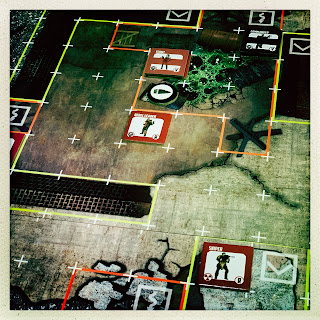
Let me be honest... this ranking is on the strength of the first box of three in this skirmish level wargame that reminds my oldest son of the X-Com computer game. Me? I don't know about the X-Com connection, but it plays quickly and cleanly as a two-player battle and has a brilliant solo system.
Tips & Tricks:
The chit pull system for unit activation works well here - especially when playing in solo mode. It also means you need to attempt to keep your team in cover - leaving them out in the open may expose them to brutal fire if they don't move.
I use a 3x3 piece of felt as the surface for my board when playing... the tiles tend to slide on the slick surface of my regular table. (Note: I like the double-sided map tiles... I just don't want them to move around.)
The system for leveling up units and dealing with their various powers is clever AND simple... which makes it easy to set up a battle and start playing.
Extras
As I said above, I've only played the first box (Streets of Ruin)... but I have both Blood on the Rails and Out of the Basement waiting for me so I can further explore this post-apocalyptic world where, for lack of a better thematic description, Russia used underground nuclear explosions to open the Hellmouth.
This is the 5th solo-recommended game on this list.
This is David Thompson's first of three games on my top 100 games countdown.
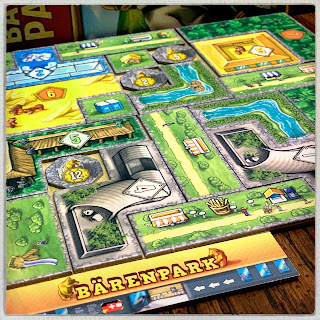
Yet another zoo-related game on the list (there are actually 3 of them!) - this time, it's a very-straightforward tile-laying game that can be give a lot of layers (esp. by using the expansion) or kept simple, straightforward, and very family-friendly with the base game.
Tips & Tricks:
Like many game where players draft from a common pool, timing is extremely important.
As well, this is a game that rewards the Tetris-y spatial skills of looking at a piece and being able to mentally flip it about to find the optimal placement.
The addition of the goals (both from the base game and the expansion) vary up the mental puzzle really well.
Extras
The storage solution in the base game is, well... not very good. I love the Folded Space insert I bought that fits both the base game and The Bad News Bears expansion into the box.
The expansion adds extra goals, an additional piece of land per player for building, grizzly bear enclosures, and tramways. I think the tramways here are much better implemented than in the designer's Cloud City game.
This is Phil Walker-Harding's second of two games on my top 100 games countdown.
currently out of print - but it looks like it's coming back this year
Why It's On The List
I'm not sure why Ra jumps on & off my top games list... it's a splendid auction game that scales well from 3-5 players and is filled with tension and constant reevaluation of values.
Tips & Tricks:
Timing is everything. Seriously.
My first play of Ra was 90 minutes - which was miserable and turned me off the game for a good year or so. When I finally got to play it at normal speed (30-45 minutes), it jumped considerably in my estimation.
There are times (particularly in the final epoch) where winning an auction simply to trade up for a better sun is a good idea. These do not happen as often as I see people making these kinds of trades.
A solidly Alexander Pfister game - but less complicated and long than Great Western Trail and substantially more thematic than Oh My Goods and/or Expedition to Newdale. Added bonus: post-apocalyptic theme sans creepy post-apocalyptic art design.
Tips & Tricks:
Once you head down a particular scoring/development pathway, the shortness of the game requires you to make sure you are doing everything you can to keep that particular game engine fed.
Resources are much more plentiful in 3 & 4 player games... switching back to solo is sobering!
The game can be played as a campaign (7 games long) or as a single game - it works well both ways.
It is not a legacy game - but it does have campaign elements that hang on from game to game.
Extras
I've enjoyed the solo campaign so much that I've played through the seven game arc twice! And that makes it the fourth of 18 games in the countdown I recommend for solo play.
Though it is thematically part of the Roll Player universe (along with #64 Roll Player, Lockup, and Roll Player Adventures), Cartographers works without any experience with the other games. It's a clever flip-n-write that challenges players to map fantasy kingdoms while conforming to a set of scoring objectives.
Tips & Tricks:
One of the required skills of the game is figuring out what goals you have to accomplish and in what order (based on the seasons). Since you score each goal twice, you want to set up to get the maximum score for that goal when it appears in the timeline.
If a landscape card has a choice that is worth gold, take it unless the larger shape will help you meet another scoring goal. Gold taken early pays off four times over the game.
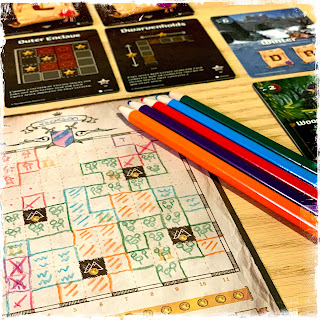
I invested in a set of colored pencils for my set - and while my art skills are almost non-existent, my maps look much nicer in color.
Extras
Cartographers has a really solid solo play option - making it the third of 18 games in the countdown I recommend for solo play.
Cartographers is also a fantastic "Zoom call" game - you just have to use the solo rules for monster placement and you're ready to go.
There are multiple expansions available for the game:
Cartographers: Heroes - which is a stand-alone game that can be used with the original maps or the maps that come with it... and which adds heroes and more active monsters.
Two different Skillspacks which each add a set of special power cards that allow players to manipulate what they draw by spending hard-earned gold pieces.
The Ambush pack which adds four new monsters with different shapes.
Three different map packs (Nebblis, Affril, & Undercity) which add two new maps and 3 cards each with some interesting twists.
More new stuff is on the way - more heroes and three more map packs!
You don't need to own all the extra stuff - but if you play it as much solo as I do, it's nice to have the variety.
Smoosh Dungeonquest and Ascension together and you'd get something close to this fantastic deck-building dungeon crawl... with the very clever “clank” mechanic binding the two together and acting a game timer and source of tension.
Tips & Tricks:
While there is a lot of witty color text, it’s small and doesn’t make the cards more difficult to read.
The graphic design of the cards is really smart – they have used consistent iconography and clear text instructions to make it easy to understand what the card does for you, even when you add in the expansion cards.
The expansions have been packaged well in appropriately sized boxes... and have all been worth their cost as far as enjoyment and variety goes. (Better than you can say for some franchises - I'm looking at you, Adrenaline: Team Play DLC and Carcassonne: The Catapult.)
Extras
You can read my Welcome to the Clank-iverse overview of most of the expansions available for Clank!... and includes Kulkmann's homebrewed rules for a Clank! campaign. (I say "most" because Adventuring Party appeared after I wrote the article.)
Clank! In! Space! is excellent as well... with a slightly higher rules overhead.
My boys and I loved Clank! Legacy. It is longer per game by about 50%, but we had a blast.
The picture includes heroes from various expansions as well as the different versions of the "boss" marker... and the monkey idols. There's a really monkey obsession on the part of the designers.
There's actually a really nice free app from Renegade that has a solo mode for Clank! which works well... making it the 2nd of 18 games on the countdown I recommend for solo play.
This is the first of two games on the countdown from designer Paul Dennen.
Couple a unique treasure-hunting mechanic with beautiful production to create a nifty push-your-luck family game.
Tips & Tricks:
Read the rules carefully - we messed things up in a couple of different ways because we (gamer-ly) assumed we knew how it would work.
It doesn't always work - but it's not a bad idea to put clues into each search - so you get something out of every treasure discovery.
Extras
The one thing missing from the game is a helpful player aid to remind you about amulet powers - thankfully, one has thoughtfully been posted by Evan S over on BoardGameGeek.
An excellent expansion for the game was published in 2020 - Tobago: Volcano. It's available through the Geek Games Shop on BGG.
out of print (but not impossible to find a used copy)
Why It's On The List
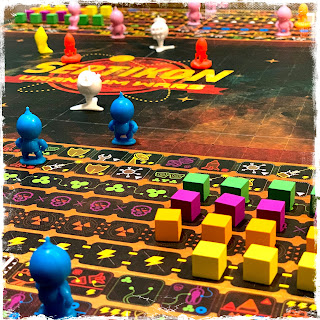
a two-player wargame with elements of tower defense, resource management, and lots & lots of destruction... defend your asteroid while demolishing your opponent.
Tips & Tricks:
This is a Russian game that was Kickstarted in an international version back in 2015 - and that makes it a little easier to locate a copy here in the States.
There are multiple ways to defeat your opponent - some of them are more obvious than others. Part of the fun is finding the less obvious ways.
The Kickstarter versions of the game came with some extra variant cards - they are fun but not necessary. The base game is great "as is".
Learning how to properly position your clones to give yourself a variety of options each turn is a key to winning. By the same token, cutting off your opponent from options is a splendid way to ensure victory.
Extras
I think that my review of Septikon is one of the best pieces of board game review writing that I've done - go take a look!
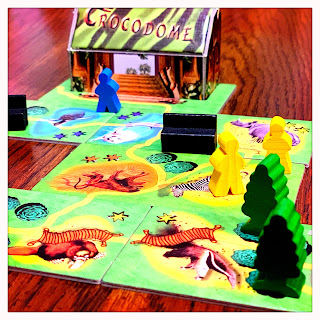
The lovely graphics & components combine with "in the fist" auctions & tile-laying to make a zoo-building game that's relatively quick (45 minutes) and always interesting to play...
Tips & Tricks:
Yes, there are problems with the income system (you get $ based on the number of tiles in your zoo) and the escalating point values (scoring is similar to Acquire) in the later rounds - but in such a short game, part of your job is to plan to deal with both of those issues rather than whine about them when the game is over.
Circular pathways are an important scoring opportunity - and they can't be taken away once they're built.
Extras
The box says ages 9+... but my six-year-old enjoyed this game (when I helped him with tile placement).
This was originally published as ZooSim... and later was republished as Zooronga. (The newest version changes the income rules to all players receiving 3 coins per turn... which I need to try out to see if I like the change.)
This is the first of two designs by Corné van Moorsel in this countdown.
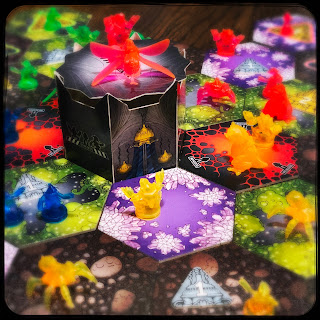
A really well-thought-out "dudes on a map" game that subverts the ever-present turtling problem with a varied set of rewards for attacking other players.
Tips & Tricks:
Hordes of cheaper figures can work just as well as a few expensive figures - and sometimes even better.
This is the rare combat game that works well with 2, 3 or 4 players.
I know I said it in the previous section - but it's worth saying again: turtling does NOT work in this game. ("Turtling" is emphasizing heavy defense and little or no offense, in hopes of getting your opponents to exhaust themselves fighting each other and/or throwing themselves against your defenses in vain.)
Extras
The FFG edition (2nd edition) evidently contains some variant stats for the units as well as some extra tiles and an alternate middle hex - but I haven't played it and am perfectly happy with my H/AH original edition.
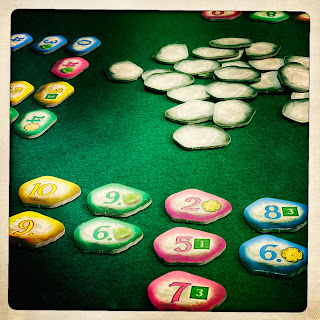
The most straightforward of the Lost Cities/Keltis family - and incredibly portable.
Tips & Tricks:
When playing with 3 or 4 players, don't start lines in all five colors.
It's easy to forget about blarney stones in your first game - don't. The penalty for going short on them is steep.
In German, the name means "the way of the stones." The "Mitbringspiel" is a rough equivalent of our "travel games" - it literally means "bring with game".
This was republished as Lost Cities To Go in 2018... but I've never actually seen a physical copy of it.
Since the publication of Der Weg der Steine, there have been other very good Lost Cities family games... my favorite of the newer bunch is the Lost Cities Roll'n'Write.
This is the fifth of seven (7!) games designed by Reiner Knizia on this countdown.
There had been cooperative games before this one... but Knizia broke the mold and created a sprawling (and gorgeous) cooperative masterpiece that reflects the tensions & storylines of the books in a highly abstracted way. And my wife likes it.
Tips & Tricks:
There are three expansions to the already meat-y base game...
Friends & Foes (which added Foes as well as two new "locations" - boards - to work through) - yes, it did make the game longer by almost half.
Sauron (which added several different ways to play the game, including a "one player - Sauron - versus everyone else" variant that works like a charm)
Battlefields (which added another board for each location... and is highly abstract... I played once and then sold it for a ridiculous amount of money.)
Suggestion: don't combine the Friends & Foes and Sauron expansions - it's just too darn long.
I've played 65+ games of this... and will happily play it again if someone asks. Especially my wife.
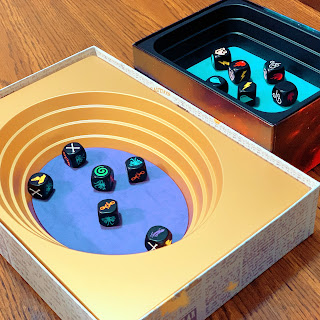
Some days, you just need an excuse to toss dice into a box and hope for the best. Other days, you want to chuck those dice as hard as possible. This is your game.
Tips & Tricks:
I first experienced the complete insanity of the "wing a die into the arena at high velocity in order to knock both dice out of play and force the next player to roll all their dice" tactic while at a weekend gaming event with the Cincinnati crew of the Opinionated Gamers... then made the mistake of telling my older son about this "strategy". Now, when playing with him, I feel like I need goggles and a helmet.
When playing tournament style (one 'game' per player and total scores over multiple games), it's better to finish 2nd than to go out early in a blaze of dice-rolling glory.
Extras
The picture above show Strike (the Harry Potter edition) next to Impact: Battle of Elements... the main difference is the shape and depth of the arena. My boys like Strike better while my wife prefers Impact. I'm happy to play either of them.
I'm not convinced that the magic/elements rules found in the Harry Potter version and in Impact: Battle of Elements actually add anything helpful to the game.
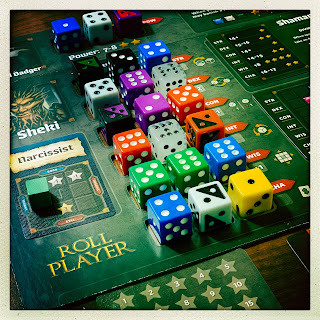
I considered Roll Player a playable but not particularly compelling game until two things happened - (a) I realized I had been taught the rules incorrectly, and (b) the first expansion appeared. Now it's still a game of dice manipulation and bundles of theme, but you don't feel like half of your turns are "take a die I don't want & throw away a card for 2 gold pieces."
Tips & Tricks:
You cannot do everything... unless the dice fall exactly right - and they won't. "Let It Go" is the theme song of Roll Player.
Correctly assessing the value of your resources (gold, experience, etc.) is a key skill... gold can be used when fighting monsters to buy extra dice, so don't blow it on something that's only going to be worth a point.
Extras
I would deem at least one of the two boxed expansions as "must have" - Monsters & Minions and/or Fiends & Familiars. Seriously - they add the extra dimension of monsters to fight and a Big Bad at the end, which gives the game more options and more narrative arc.
Yeah, it's a Tetris-y game that's reminiscent of the designer's game FITS... but the legacy design is top notch. It also has a potato chip quality - we seldom play just a single game... it's more common for us to 2-3 games in a set.
Tips & Tricks:
Paying attention to what buildings are left is a key skill to being successful.
Make sure you pay attention to what is and isn't scoring during a particular game.
Losing a single game in the legacy campaign isn't so bad - the advantages for a last place player is worth a loss or two.
Extras
There's a roll'n'write version of this game on the way (which I'll admit I'm kind of excited about).
This is the third of seven (7!) game designs on this countdown from Reiner Knizia.
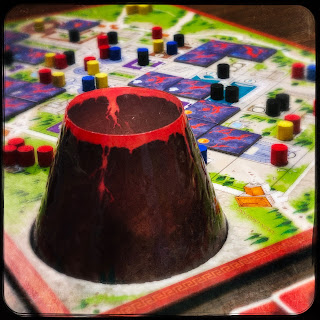
An odd and possibly disturbing theme (the volcanic destruction of the Roman city of Pompeii) turns to make a very nice tactical placement & movement game... along with a healthy helping of "throw your neighbor under the metaphorical bus".
Tips & Tricks:
Do not neglect the power of family members - use your cards wisely to set yourself up to place extra "dudes" on the board.
Easy to miss rule: if an area is filled, you can use those numbered cards as wild cards BUT you can't place family members when you do that.
Tactics is totally dependent on who's playing... I've been in games where folks didn't mess each other over (much) and scores were high, and I've been in games where filling the volcano with pieces seemed like the goal.
Extras
I was pleasantly surprised to find that this game not only worked as an "adult" version of Midnight Party - but also worked great with my then (gamer) 5 year old son as a 2 player game. (He's 16 now and still enjoys it.)
I have The Dancing Flames expansion (created by designer Morgan Dontanville) that adds a couple of twists to the lava draws... I like it a lot.
Designer Wolfgang Kramer took his classic 6 Nimmt game & converted it into a delightful hoot of a board game - and one I'd rather play than the original card game.
Tips & Tricks:
One of the key decisions in the game is "when do I buy more tiles"? Making that decision correctly gives you a better chance at victory.
There is actually more visible information in Tanz than in a standard game of 6 Nimmt... and the ability to pull back tiles when you step in the poop can really mess with what happens next.
Extras
You do not need to have played 6 Nimmt/Take 6 in order to understand "The Dance of the Bulls". Everyone is pretty clear that you don't want to step in the poop.
A new 6 Nimmt board game was released in Germany back in 2019... while I enjoyed it, I like this one better.
This is the second of three Wolfgang Kramer games on this countdown... and weirdly it's right next to another of his designs (#68 - Downforce).
The latest (and most player-friendly) version of Wolfgang Kramer's multi-decade run of card-based auto racing games... produced with class and panache by the team at Restoration Games.
Tips & Tricks:
Crazily enough, Downforce actually works at multiple player counts... I prefer 4 or 5 players, but it's playable at 2-3 and at 6.
Bidding wisely for your car(s) is important... which requires that you (a) properly assess the cards in your hand, and (b) be willing to pick up an 'extra' car cheap in any game with less than 6 players.
Betting is tricky - it's usually wise to bet on a car you can help scoot along - even if it isn't your car.
It's also a good idea to tank the early leader post first betting post... as you'll tank some early bets as well.
Extras
I have owned 4 of the previous games in the series - the original (and non-auto racing) game, Tempo; Detroit-Cleveland Grand Prix; the excellent NASCAR themed Daytona 500; and the direct "father" game, Top Race.
My boys and I were playtesters for the Wild Ride expansion.
This is the first of three games on my countdown designed by Wolfgang Kramer... and ably assisted by Rob Daviau (in his second of eight designs in the 100) and Justin Jacobsen (in his second of three designs).
Any game that involves guys riding dinosaurs into combat around a volcano is totally worth my time. The fact that it's stupidly fun just makes it even better.
Tips & Tricks:
Sometimes, it pays to decimate a particular type of dino (raptors, for example)... so you can use their cards as wild cards for other dino types with more firepower.
Whatever happens... no matter how bad you want revenge for a sneak attack... remember the win condition - when one player is knocked out, the player with the most dinos left wins. It's "all too easy" (thank you, Lord Vader) to get preoccupied and give the game away to satisfy a thirst to beat on the guy who's been hitting you.
Extras
The literal translation of the game's name is "The Battle of the Dinosaurs"... but I've always called it The Battle of the Dinosaur Riders.
This is the first of two games on my countdown designed by Stephen Baker... who is assisting Restoration Games in restoring the classic Crossbows & Catapults.
A small box card game about railroad building across Africa (the title translates as "From the Cape to Cairo") that packs a wallop - the sealed bid auctions are only half of the game, as you struggle with when to invest precious cash into building rails instead of giving your opponent a gift.
Tips & Tricks:
The value of a card is not determined by how cheap it is to build across it - the number of track symbols makes a HUGE difference, particularly if you're trying to catch up.
Saving a decent amount of $ (20-30?) for the your end-game lunge can work... but if everyone is doing that, it can cancel out.
Extras
I love that Adlung managed to pack such a great game into such a small (30 minute) playing time... and I miss the utter crapshoot that was buying the small Adlung card games. (Were you going to get something interesting and playable, or something - not?)
The rules translation of Vom Kap was a bit tricky - but once you get it figured out, it's a keeper.
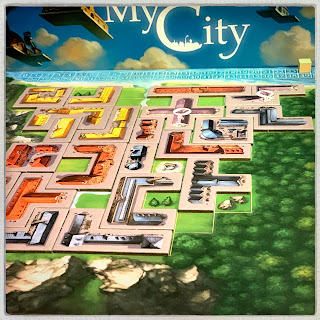
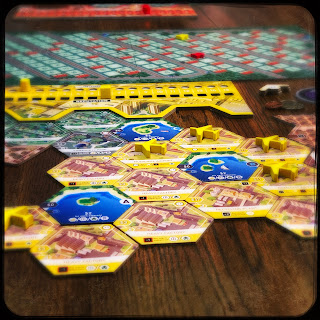
A city-building game that does three things really, really well: 1) it plays cleanly, 2) it uses the Age of Steam braking system in a way that doesn't make me want to throw myself out a window, and 3) every player ends up with a city/neighborhood with it's own personality.
Tips & Tricks:
Over-obsessing about goals early can cause real problems in creating the proper engines to get income and population growth.
Hate-drafting is possible here - if for no other reason that you need another lake to generate some quick cash.
The game is (except with five players) almost perfectly pitched for playing time - you have enough turns to do interesting things but not so many turns that the game wears out its welcome.
In some ways, the 2 player game is more swing-y than the 3 or 4 player game... because of the number of tiles you don't see in the game. (I still really like as a 2 player game.)
Extras
There is are two expansions for Suburbia - I really like Inc. for adding borders and other interesting twists. Five Star is a little clunky but it's the only way to add a fifth player.
The new edition is available now... along with a single box that contains both previously mentioned expansions plus Nightlife and two smaller sets of tiles.
follower of Jesus, husband, father, "pastor", boardgamer, writer, Legomaniac, Disneyphile, voted most likely to have the same Christmas wish list at age 58 as he did at age 8