Monday, October 31, 2016

The Dragon & Flagon (Game Review)


  • Designers: Geoff, Brian & Sydney Englestein
  • Publishers: Stronghold Games
  • Players: 2-8
  • Time: 60-90 minutes
  • Ages: 12+
  • Times Played:7 (with review copy provided by Stronghold Games)
Hail and well met, young adventurer! Sit, grab a pint and let me tell you a tale of long ago, of the times of yore… back when Avalon Hill was still its own sovereign kingdom and the only European games any of us knew were Clue and Risk. (Truth be told, we didn’t even know those games were European - we pretty much thought that the Parker Brothers invented them.)
It was the Year of Our Lord, nineteen hundred and eighty… the year of the Miracle on Ice, the release of Pac-Man, and the summer that the Empire finally struck back. Those were heady times, my young friend - because it was during that same span of 365 days that many of us stumbled into our friendly local game stores to find a game shaped like a double album. (Ah, double albums - I remember them fondly: Pink Floyd’s “The Wall”, ELO’s “Out of the Blue” and the soundtrack from a little film called “Star Wars” were the background soundscape for many an afternoon AD&D session. But I digress…)
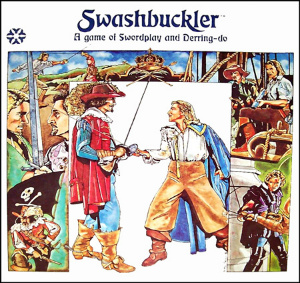
yaquintoswashbucklercoverNow, this wasn’t the first game that Yaquinto released in the album format - but it certainly is the first that I remember. It was called Swashbuckler - and it was a plotted simov game of Three Musketeer-ish bar fighting.
What? You didn’t understand the word “simov”? You thought I was name-checking Viktor Simov, Russian painter? Bah, youngling, I am referring to the great pre-personal computer tradition of simultaneous movement in board games, usually done by plotting movement and attacks on paper and then resolving them with the other players. (Examples include DiplomacyWooden Ships & Iron MenSniper!Dreadnought, and Gladiator.)
The game was, even with the plodding nature of simov plotting, riotous fun. You could swing from chandeliers, tip over tables, and wave your plumed hat to distract your foes. The double album format even offered two boards - one was a bar straight from the set of “The Three Musketeers” (the 1973 version, of course… though the ‘93 version has certain charms and nobody will ever choreograph sword fights like Gene Kelly in the 1948 film.) The other board was, of course, two ships close enough for boarding to begin, a la “Captain Blood.”
Say it is not true, young adventurer, that you have not seen Mr. Kelly as d’Artagnan or Errol Flynn as Captain Blood. This will have to be remedied post haste.
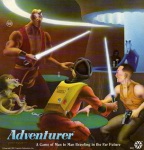
yaq3807Yaquinto released a similar game set in a sci-fi bar/cantina & spaceship called Adventurer - which, while enjoyable, did not work quite as well as the original game. (The introduction of laser guns caused some problematic issues for the system… besides, it was just cooler to be a musketeer.)
Give credit to Richard Garfield (the guy who designed that famous Monopoly-ish baseball card binder game, Filthy Rich… as well as some other game where you collect cards and fight with them) for creatively finding a way around the glacier-fast speed of your average simov with the use of cards to program your robot in his game RoboRally. (For those of you keeping track, that was 22 years ago. Or, my wet-behind-the-ears friend, a year before the first Catan game appeared.)
Since the appearance of RoboRally, a number of us well-seasoned gamers have ruminated about the possibility of using card programming to drag Swashbuckler (and games like it) into the 21st century. I've even seen another prototype that made a valiant effort to marry the two games together.
But, my clean-shaven young friend, it was the Family Engelstein who finally managed to “cross the streams”, fry the Sta-Puff Marshmallow man, and make a wonderful homage to a classic game design.
homage
noun  hom·age \ˈä-mij, ˈhä-\
  1. respect or reverence paid or rendered:
  2. the formal public acknowledgment by which a feudal tenant or vassal declared himself to be the man or vassal of his lord, owing him fealty and service.
  3. the relation thus established of a vassal to his lord.
  4. something done or given in acknowledgment or consideration of the worth of another:
I wish to note that when I suggest that Geoff, Brian & Sydney created an homage to Yaquinto’s Swashbuckler, I am using definitions #1 and #4… not #2 or #3… which would be more appropriate to my relationship to a mortgage lender.
I also wish to note that the Family Engelstein rocked this homage - combining a number of great design ideas into a complete and extremely playable whole.

The Dragon & Flagon Family Tree

Grandpa Swashbuckler - The Dragon and Flagon uses both the theme and the basic structure of Swashbuckler to great effect. It's a bar fight… with all of the theatrical flourishes that requires: jumping on tables, boasting, yanking the rug, slashing with your sword and throwing various objects about with malicious intent.
Crazy Uncle Viva Pamplona - One of the key problems of any brawl themed game is how to figure out who won. The most common answer over the years has been player elimination/last man standing - but there are some real drawbacks to that design choice, especially in a game system with baked-in chaos from programmed movement. Instead, The Dragon and Flagon uses a reputation system similar to the Wolfgang Kramer raucous running of the bulls game, Viva Pamplona. This encourages players to stop targeting those who've been pummeled… while avoiding knocking players out of the game.
Papa RoboRally - Simultaneous movement has always been a great idea in theory… but clunky in practice. As mentioned before, Richard Garfield created a new way to do programmed movement- and The Dragon & Flagon takes advantage of this advance in game design technology. Similar to Wings of WarThe Dragon & Flagon uses a smaller number programmed cards to keep the pace of the game quick.
Weird Cousin Thebes - The more games I play of The Dragon & Flagon, the more I admire the design choice to “cost” moves by the time they take to execute. Simply picking up a mug moves a character marker one space down the track… while swinging across the room takes 3 increments of time (which you could think of as take off, flight & sticking the landing). Like Thebes, your position on the time track determines when you will execute your next action.

Stuff Any Character Can Do
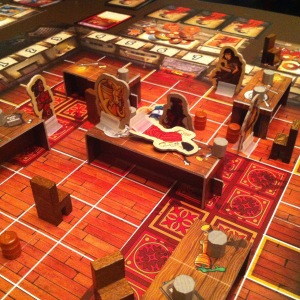
fullsizerenderEach character has a deck of cards to program actions. All characters have a set of common cards that allow them to:
  • Move 1-2 squares
  • Dash 3-4 squares
  • Slash with a sword/knife
  • Pick up & drop stuff
  • Throw mugs or chairs
  • Shove a table
  • Yank a rug
  • Stand on a table & boast
  • Swing on a chandelier
  • Make a charging attack
  • Roll a barrel to knock over another player
  • Party & riposte an attack
(Note: this list could also be called “When the Late Night Werewolf Game at the Con Goes Off the Rails”.)

Special Stuff Only One Character Gets To Do

Each character also has 4 cards that they alone can use… for example, they can:
  • Wave a plumed hat to distract others (the Swashbuckler)... yes, this a figurative tip of the hat to the original game.
  • Fire a hand cannon (the Buccaneer)
  • Emit an aura of holy radiance (the Paladin)
  • Flip a table over… even with people on it (the Barbarian)
  • Subdue your opponent with the Touch of Death (the Monk)
  • Shadow step into position behind another character- where it's easier to backstab them (the Rogue)
  • Mark your prey to increase your damage to them (the Druid)
  • Use your vision to look ahead & better plan your action (the Cleric)
  • Fire arc lightning about the room (the Wizard)
(Note: the above list is not exhaustive. There are literally 36 different "special power" cards in the game system.)

Quaff the Flagon!
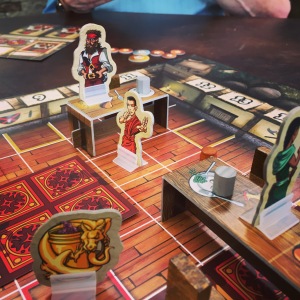
img_6683At the center of the tavern is the Dragon Flagon… filled with a special brew that imbues the drinker with an amazing ability… it's Felix Felicis from the Harry Potter novels, only without the broomsticks & all the snogging.
A character who grabs the Flagon receives a character-specific one-time use special power card that must be programmed like any other card. (As a former pastor, I'm particularly fond of the Cleric’s card that forces other characters to Tithe.)
In our experience, only one or two characters per game actually manage to hoist the Flagon… and not all of them manage to play the card successfully. That makes the race to the middle of the tavern a hazardous and not necessarily profitable decision - which means that these highly powered cards don't become game-breakers.

'Tis A Gift to be Simple

The structure of the game is very straightforward:
  • is your time marker on the current space?
    • Yes… then add cards until you have two cards programmed.
    • No… don't add cards &  instead suggest alternate targets for other players to pummel
  • when all current characters have programmed their moves, resolve their first card in random order
That's it.
Oh, yeah, there's cards that are limited by situation (you can't yank a rug if you're not facing a rug) or circumstance (things that can't happen if you're knocked down)... but the coding for these is clear on the cards and the penalty is simply “use 1 time & don't do the action”. If you're prone, you stand up.
At the end of each character’s activation, they can freely change facing.
The game has a four turn random ending - in other words, the town guard will appear and break up the fight at the end of one of four possible turns. (The characters are taken to the local constabulary to nurse their wounds and engage in post-fight banter.)
Like I said - simple.

Saturday Night’s Alright For Fighting

There are some sly & wonderful bits of design and production tucked into The Dragon & Flagon.
3-D Components - While Stephen Buonocore (head honcho of Stronghold Games) wasn't able to add Smell-o-Vision to the game, the three-dimensional production values are excellent and add a great deal to the playing experience. (Note: Smell-o-Vision was not actually considered for production of this game. And I can't imagine that adding authentic fantasy bar smell would be a prudent publishing decision.)
The 3-D components can also be set up in a dizzying number of configurations... so far, we've tried to keep the tavern "balanced" - but I'm curious what will happen when we create a large open space and/or make it easy for everyone to pick up a chair as their first move. 
Individual Characters - Each of the nine characters has different strengths… but none of them seem overpowered. In our first couple of games, we were convinced that the Pirate was a punching bag… until a drunken & boasting Pirate fired his hand cannon a couple of times while shoving tables and managed a win. As well, we were sure the Rogue was a sure winner- until she was pummeled into submission.
The fact that there is one more character than you can play is a plus in my book - games are unlikely to have the same configuration of characters. Variety is the spice of life… and that's especially true for fighting games, which can fall into predictable grooves.
“Damage” - Characters take 4 kinds of “damage”:
  • Lose reputation (aka victory points)
  • Get knocked down (prone)
  • Get knocked back (moved)
  • Become dazed
For my money, the dazed mechanic is a smart way to cause pain without leaving a character defenseless or permanently out of contention. A dazed character has to program extra cards immediately- to a maximum of three. Presto! The character is dazed but not out. (Note: the Buccaneer has a Chug card which makes him tougher but also perma-dazed for a number of turns.)
Truth in Advertising - As a lad, I learned to mistrust the box covers of board games, particularly when it comes to game length. (Secret formula: with Avalon Hill games, add 50% to the stated playing time. With SPI, double the stated time.)
Number of players can be tricky as well - For example, Goldland says 2-5 players but really should not be played with more than three.
The Dragon & Flagon, on the other hand, gets both of these exactly right. Once everyone has s game under their belt, the game plays in the promised 60-90 minutes.
More importantly, you really can play with 2-8 players. With 2-4 players, each player runs two characters - and because of the simple programming and time expenditure mechanics, it works well - very well. (My games so far have been with 2, 3, 4, and 5 players… and I've enjoyed them all.)
Late Night Convention Rules - Included in the rules… and painfully simple. Once you program an action, you can't look at it again until it's time to activate it.
Now, this may not sound like much - but with 7-8 players, this keeps AP (analysis paralysis) to a minimum while creating more chaos. And let's be honest - if you're bothered by a little chaos, you probably shouldn't be playing a game about a tavern free-for-all cage match.
image1Boarding Parties and No Broadsides - The reverse side of the game board has, just as Swashbuckler did, a pair of ships close enough together to board. There are additional rules for team play on the board posted on the Stronghold Games website.
Our single game on the “at sea” board worked well - the additional treasure chest markers add a nice twist to the game. Sadly, no one went overboard- we obviously need to try again.
The Plate of Cookies - Too often, publishers waste extra space on punch boards - but not Stronghold Games! They managed to honor the original prototype copy and create a usable game component at the same time. (I'll leave the story to the rules - suffice it to say that this is recycling at its best in the Engelstein home.)

Fight For Your Right… To Bolster Your Reputation By Smacking Down Opponents

I've won, I've lost, I've been targeted by my sons (who are always happy to beat up on their dad)... and regardless of how I've done, I've enjoyed every play and look forward to getting it back to the table. The Dragon & Flagon is an experience game - and the experience has been a delightful romp every time. 
Moreover, it's a game that you tell stories about - "remember the time I Godsmack'd you into the wall so hard that your Swashbuckler spent the remaining moments of the game huddled down in the corner of the bar" or "remember the time the Mage managed to hit every character on the board with arc lightning". We've set a low bar for reputation (6) and a high bar (38) - and I'm sure that both will be passed in time.
My biggest surprise is how well the game works with low player counts - normally, these kind of games rely on larger player groups to get the full experience. But even with as few as two players, we've had a lot of fun knocking each around and accomplishing feats of derring-do.
I am a little afraid that all of my talk of the “days of yore” (aka - my teenage years) and “homage" (which is dangerously close to “fromage”, which is actually a creamy soft cheese made with whole or skimmed milk & cream) is going to distract my loyal readers (all four of you) from hearing my primary message: this is a wonderful & chaotic design of gaming goodness, published with style and downright nifty 3D components.
This review originally appeared on the Opinionated Gamers website.

Costumes

The stupidest Halloween costume I've ever worn was actually a decent costume - just wildly inappropriate.

And no, it wasn't a toga.

I'm guessing I was 11 or 12 years old when I decided to put on my heaviest winter coat, a pair of swimming goggle with large individual eye pieces, a knit cap & my for-real camping/hiking backpack (stuffed with newspaper)... to be a climber. It actually was a pretty good-looking costume, if I don't say so myself.

The only problem is where I was wearing these layers of heat-trapping stuff - in southern California on a particularly warm Halloween night. It was like being trapped in a sweat factory of my own making.

It's an apt metaphor for the masks most of us wear around 24/7 - the "I've got it all together" and/or "I'm a Christian so nothing is wrong in my life, no sirree" layers of protective costume we try to hide behind when our worlds are actually coming apart at the seams.

It's time for us to do emotionally & spiritually what I did physically that night - acknowledge that the candies of this life are just not worth it... and turn around & go home so we can strip this monstrosity off.

Home, by the way, is a place where God is real and you are safe to explore the dangerous message of Christ's grace. For me, that's my church (Grace Church in Hendersonville, TN). It's only in the context of other followers of Christ who are struggling with same tendency to suit up and hide that I can really deal with my personal leanings toward inauthentic and spiritually destructive behavior.

A version of this post originally appeared as part of the NewLife Community Church Grapevine... I've edited and rewritten it because I like you guys.


Wednesday, October 26, 2016

#7: Fast Food Franchise (Mark's 100)


Fast Food Franchise

Mark's Ranking
  • 2014: 7th
  • 2012: 6th
  • 2010: 7th
  • 2005: 9th
  • appeared on all four lists
BoardGameGeek
  • rank: 3251
  • rating: 6.4
Print Status
  • really out of print
Why It's On The List
  • Imagine if the designer of Race for the Galaxy decided to take making a roll'n'move that both gamers & non-gamers could love... that combined some very Monopoly-ish elements with tactical board play. And then you can wake up & play it, because this is actually Tom Lehmann's first game design!
Tips & Tricks:
  • Despite initial appearances, all of the companies are viable options for strategies to win Fast Food Franchise. (Some require you to open a second company - particularly those that grow quickly but don't generate cash from other players.)
  • That said, you must watch your cash flow - relative both to your own building needs and the increasing costs of paying your competitors.
  • Rookie mistake? Not advertising.
  • There are two expansions that exist (note: I don't use the word "available"): 2 more companies (Tacos Today & Noodles to Go)... and a set of old skool fast food worker hats for each of the companies.
Extras
  • Fast Food Franchise was one of the 138 Games to Play Before You Die over on the Opinionated Gamers website.
  • Here's what I wrote about the game for The One Hundred.
  • I talked with Tom a couple of years back about the chances of this getting reprinted... he is continuing to try to make that happen, which will make a number of my friends very happy.

Tuesday, October 25, 2016

Pride (In the Name of Facebook)

I have 853 friends on Facebook and 746 followers on Twitter. I even have 305 GeekBuddies on BoardGameGeek.  And, if I'm really honest about what's going on inside my head, my life is better than 90% of them.

That's right - I said out loud (ok, I typed it) what we all pretend doesn't go through our heads every time we pull up a social networking website. It's that sense of smug superiority that bubbles in our hearts as we view someone else's life & life choices:
  • "My kids are smarter/prettier/better behaved than their kids."
  • "My job is cooler/better paying than their job."
  • "I'm still married & they're divorced."
  • "I believe in Jesus and they don't."

This is still pride and it's still deadly. It's just harder to see because it takes the form of the subtle putdown rather than the obvious puffing up. The unstated rationalization is "I'm not being proud; I'm just glad my life isn't like theirs."

We may couch it in spiritual clichés - the classic is "There but for the grace of God go I." Honestly, that's mostly Christian-ese code for "Thank God I'm not like them."

Of course, there's a Bible story (Luke 18:9-14) that sounds rather like this...

Jesus told a story to some people who thought they were better than others and who looked down on everyone else:

Two men went into the temple to pray. One was a Pharisee and the other a tax collector. The Pharisee stood over by himself and prayed, "God, I thank you that I am not greedy, dishonest, and unfaithful in marriage like other people. And I am really glad that I am not like that tax collector over there. I go without eating for two days a week, and I give you one tenth of all I earn." The tax collector stood off at a distance and did not think he was good enough even to look up toward heaven. He was so sorry for what he had done that he pounded his chest and prayed, "God, have pity on me! I am such a sinner."

Then Jesus said, "When the two men went home, it was the tax collector and not the Pharisee who was pleasing to God. If you put yourself above others, you will be put down. But if you humble yourself, you will be honored."

It doesn't matter if it's in front of a temple altar or a laptop – the Message translation says it well: "If you walk around with your nose in the air, you're going to end up flat on your face, but if you're content to be simply yourself, you will become more than yourself."

Another Reason To Stay Humble


Heard on the radio a few years back - a chunk of Elvis' hair sold at auction for $115,000. Really.

I'm willing to bet that exactly none of my readers would pay $1.15 for a chunk of my hair.

Quote of the Week

The Christians are right: it is Pride which has been the chief cause of misery in every nation and every family since the world began. Other vices may sometimes bring people together: you may find good fellowship and jokes and friendliness among drunken people or unchaste people. But Pride always means enmity - it is enmity. And not only enmity between man and man, but enmity to God.

In God you come up against something which is in every respect immeasurably superior to yourself. Unless you know God as that - and, therefore, know yourself as nothing in comparison - you do not know God at all. As long as you are proud you cannot know God. A proud man is always looking down on things and people: and, of course, as long as you are looking down, you cannot see something that is above you.

That raises a terrible question. How is it that people who are quite obviously eaten up with Pride can say they believe in God and appear  to themselves very religious? I am afraid it means they are worshiping an imaginary God. They theoretically admit themselves to be nothing in the presence of this phantom God, but are really all the time imagining how He approves of them and thinks them far better than ordinary people: that is, they pay a pennyworth of imaginary humility to Him and get out of it a pound ’s worth of Pride towards their fellow-men. I suppose it was of those people Christ was thinking when He said that some would preach about Him and cast out devils in His name, only to be told at the end of the world that He had never known them. And any of us may at any moment be in this death-trap.

...Whenever we find that our religious life is making us feel that we are good - above all, that we are better than someone else - I think we may be sure that we are being acted on, not by God, but by the devil. 

from Mere Christianity by C.S. Lewis

A version of this post appeared in the NewLife Community Church newsletter back in 2009... it's been updated because I like you.

Monday, September 26, 2016

#8: Ticket to Ride (Mark's 100)


Ticket to Ride 

Mark's Ranking
  • 2014: 8th
  • 2012: 8th
  • 2010: 73rd
  • 2005: 14th
  • appeared on all four lists 
BoardGameGeek
  • rank: 100
  • rating: 7.50
Print Status
  • in print
Why It's On The List
  • Gorgeous production coupled with easy gameplay... a classic theme (trains!) coupled with a classic Rummy set-collection mechanic... just as playable with 2 as it is with 5.
Tips & Tricks:
  • Playing with 3 or 5 players is MUCH more cutthroat than playing with 2 or 4, due to how crowded the board can become.
  • There are a number of expansions & stand-alone versions of the game. I'm partial to the 1910 card expansion - as well as the first two map boxes (Asia &; India/Switzerland).
  • The iOS app for the game is tremendous!
  • Most importantly, this is an excellent "gateway" game for non-gamers.
Extras

Saturday, September 24, 2016

Life, Liberty & THE PURSUIT OF HAPPINESS (Game Review)


  • Designers: Adrian Abela & David Chircop
  • Publishers: Artipia Games & Stronghold Games
  • Players: 1-4
  • Time: 60-90 minutes
  • Ages: 12+
  • Times Played: 7 (with review copy provided by Stronghold Games)

I’m not sure what fascinates us about “life-building” games. Maybe we all imprinted on Milton Bradley’s oft-maligned ode to large families and stock investment (aka The Game of Life). Perhaps some of us managed to blunder into playing Parker Brothers much more enjoyable Careers - the game that first introduced customizable victory conditions and Uranium Mining as lucrative vocational choice.

Even as the technology of game design has advanced over the past 20 years, “life-building” games continue to pop up. Though not my cup of tea, you can dig into the seedier side of life with Steve Jackson’s Chez Geek franchise or 2F’s Funny Friends. Hasbro published a nifty little card game version of The Game of Life (that is sadly out of print)... and more recently Lapuduti (sp?) created CV (and the expansion, CV: Gossip). I really enjoyed my one play of CV… and it sat right on the edge of my “add to my next game order from my friendly online retailer” for a couple of years.

Though the particular game elements vary - CV uses a Yahtzee-like dice manipulation system, Chez Geek is a take-that card game and The Game of Life Card Game is tableau-builder with two different resources (Time & Money) used as action points - the basic idea of all of these games are the same: players start as teenagers and proceed through their lives, acquiring stuff, building relationships, choosing a vocation, and having various life experiences. Points are awarded for fulfilling goals and/or accumulating points - and the winner is the person with the most “satisfaction”. (Cue up the Stones as a soundtrack… and here’s a thought: it would be interesting - and a bit scary - to imagine a Rolling Stones themed “life building” game.)

That brings us to the newest addition to this particular gaming genre: The Pursuit of Happiness from Artipia Games and Stronghold Games. Pursuit uses a worker placement system as you spend time (hourglass markers) to create your best possible life and parlay those life choices into Long Term Happiness. (Why, yes, LTH is secret game code for “victory points”.)

The Facts of Life

Fact #1: No one in their right mind would name their child “Tootie”.
Fact #2: The Facts of Life TV show ran for nine seasons. Nine. (And Sports Night ran for two. There is no justice.)

And, with that out of my system, we’re back to the game.

There are five “commodities” in The Pursuit of Happiness:

  • Time (your “workers”)
  • Money
  • Connections
  • Creativity
  • Knowledge

Those commodities are spent to acquire cards that represent a variety of experiences and things:

  • Jobs
  • Relationships
  • Items & Activities
  • Projects (there are three types of projects)
    • Regular projects that take multiple hourglasses to complete
    • Group projects which multiple people can join in on… and the more people who particpate, the more rewards each participant receives
    • One time projects (such as appearing on a trivia game show)

These items and activities return a plethora of goodies for the player who invests:

  • Money
  • Resources (Connections, Creativity & Knowledge)
  • Relaxation (lose a Stress)
  • Short Term Happiness (we’ll get into that in more detail a few paragraphs later in the review)
  • Long Term Happiness (aka victory points)

4 Things I Really Like About The Pursuit of Happiness

Stress

Stress can kill you… in real life AND in The Pursuit of Happiness. Taking an action more than once (for example, taking on two Projects in one round) or working overtime or having too many things (Jobs, Projects & Relationships) going at once increase your stress. Let your stress go too far, and you can lose hourglasses (time).

There are also ways to relieve stress - for example, the Rest action gets you back 2 stress. Many activities have a stress-reducing component (called Relax) as well. And if you’re particularly health-minded, there are personal improvement projects that can results in increasing your lifespan and your available time.

Stress eventually will kill you. (Note: this is not a comment on my own vocational choices, but your mileage may vary.) In The Pursuit of Happiness, stress will take you to the end of life. The game timer is marked in rounds:

  • One round of being a Teen, where you can’t start a Relationship, can’t get a job, and can’t work overtime.
  • 5 rounds of being an Adult, when the options of life (within limits, of course) are all open to you
  • 3 rounds of Old Age, during which overtime is no longer an option… and your stress level increases until you reach the End of Life.

Short Term Happiness

One of the “goodies” you can receive is a green smiley face that indicates Short Term Happiness. This is a temporary commodity that lasts only for the current round and is used to:

  • Discount the cost of completing a project (reduce the number of resources needed)
  • Determine the start player for the next round

Of course, you can also have short term unhappiness - which causes projects to be more expensive.

One Time & Group Projects

Players can undertake projects - they start at the first level and it takes an hourglass (worker) and the appropriate resources to advance up to a higher level. The picture above shows one of those projects on the left... and, yes, the first level is "Personal Blog". (Sigh - evidently I'm stuck on level one in real life.)

The Pursuit of Happiness varies up the kind of projects available by two other types of projects.

One-time projects are events - the example above (in the center) is appearing on a Reality Show. You spend whichever level of resources you want - and receive the rewards for that project.

The group project (on the right) allows multiple players to get involved - and at the end of the round, the extra rewards for each player are noted at the bottom of the card. The more who participate, the better the rewards!

Promotions and Retirement

Jobs are not a single career in The Pursuit of Happiness... instead, you can be promoted (there are 3 levels of particular career paths) and eventually retire from a Level 3 job. You can switch careers as well.

Nice touch: all job cards are double-sided, so you can choose the job you most enjoy.

2 Things I Don’t Like About The Pursuit of Happiness

KS Promos

I’m not opposed to Kickstarter - I’ve just backed two games in the last week (Tiny Epic Galaxies: Beyond the Black and Habitats). What I don’t love is leaving out the Kickstarter promos out of the base game box. (Note: Stronghold Games was not a part of the Kickstarter for The Pursuit of Happiness.)

According to BoardGameGeek, the promos include:

  • The Events mini-expansion adds special events that are drawn at random at the beginning of every adult round and come into effect at the beginning at the next round (4 in total).
  • The Trends mini-expansion adds special trends that are drawn at the beginning of the game and effect play throughout.
  • The Pets mini-expansion adds pets to the Item/Activity cards. Pets are different in that you do not have to use card actions to advance them - they do this by themselves during upkeep as long as you feed them (pay the upkeep cost).
  • The Stand-Alone Jobs mini-expansion consists of 3 new jobs that are shuffled in with the standard job cards. The difference between standard and stand-alone jobs are that with a stand-alone jobs you can not be promoted. Instead you can choose to work harder. This is done by paying up to two times the cost in the Work Harder section and thereby getting the same times the reward. This applies to the upkeep phase as well.

Man, I’d love to score a copy of these - this is a good game that would be enhanced by these small additions. (They are available through Artipia Games.)

[Note: the bulleted text in this section is taken directly from the BGG description.]

4 Players

Admittedly, I have only played The Pursuit of Happiness one time with a full complement of four players… but we found it ran a little long with four players. I would note that three of them were new to the game, which probably slowed us down a good bit.

I’m still a bit concerned about the downtime with four players… but before I make any sweeping generalization, I need to give it another try with four players who’ve played previously.

One Is The Loneliest Number

I've played two games "solo" of The Pursuit of Happiness - and while my record is 1-1, I enjoyed both experiences. The solo rules are not difficult or substantially different than the base game... and the key differences are contained on the Life Goal cards which act as part of your victory conditions in solitaire mode.

Variety Is The Spice of Life

I have been pleasantly surprised at how many different paths to victory (or near-victory) seem viable in this game:

  • Son the Younger managed to lose by only a few points without ever getting a profession.
  • Son the Older won a game by diving into a high-level job at the first opportunity.
  • I’ve won a couple of games with a more balanced strategy - sometimes leaning into projects and sometimes into possessions.

The Life Goals set out at the beginning of the game can sometimes direct players in a particular way - but the bonuses paid are not so large that they can't be overcome by skillful decisions to pursue other avenues for Long Term Happiness.

In Conclusion

Back in the second paragraph of this review, I noted that CV had been on my wishlist for the last couple years - but with The Pursuit of Happiness in my collection, I no longer feel a need to add CV as well. Both are very enjoyable games - but I give Pursuit the edge because of the shorter player turns (the dice manipulation in CV can slow down near the end of the game) and the creative variety of the tasks.

The components are nicely made - the art on the cards is cartoon-y but never rude and the board is laid out in an easy to comprehend fashion. The iconography on the cards is clear and easy to read (even upside down). I applaud the designers for their sense of humor - they found a nice balance of silly and sensible that make the game fun to play. (It would be easy to overplay the humor here - and they do a nice job of walking the line so that it doesn't interfere with game play or enjoyment.)

The Pursuit of Happiness is a friendly game - oh, yes, you can grab something that someone else wants, but you can’t block them from making forward progress. As well, only one player can receive a reward for life goals - so there’s a bit of a race there… but it’s not a cutthroat game experience. This makes ideal as a family game - and at the same time, there are a number of interesting decisions that make this gamer-friendly as well.

You could strip the theme off of the game and you'd have a standard worker placement game left - but that misses the point. The designers have done a great job of melding mechanic/ism and theme together - making the game easier to teach and enjoyable to play.

Frankly, I think what I most enjoy is telling the story of a life while getting the opportunity to make clever plays... and getting to do that with friends and family.

The Unofficial THE PURSUIT OF HAPPINESS Soundtrack Album

  • “Life in One Day” - Howard Jones
  • “Grow Old With You” - Adam Sandler
  • “Happy” - Pharrell Williams
  • “Turn, Turn, Turn” - The Byrds
  • “Cat’s in the Cradle” - Harry Chapin
  • “It Did” - Brad Paisley
  • “My Generation” - The Who
  • “The Time of My Life” - Bill Medley & Jennifer Warnes
  • “When I’m 64” - The Beatles
  • “Don’t Fear the Reaper” - Blue Oyster Cult

This post originally appeared on the Opinionated Gamers website.

Thursday, September 22, 2016

Dastardly Dirigibles (Game Review)


  • Designers: Justin De Witt
  • Publishers: Fireside Games
  • Players: 2-5
  • Time: 60 minutes
  • Ages: 8+
  • Times Played: 6 (with review copy provided by Fireside Games)
OK, let’s get this out of the way: the name of this game always makes me think Dick Dastardly and his sidekick, Muttley… and if you don’t know who/what I’m talking about, you’re substantially younger than I am. (You can Google “Wacky Races” if you’re curious… or you can check out their board game on BGG: Dastardly & Muttley in their Flying Machines. No, I’m not making this up…)

But this isn’t a racing game as much as it is a steampunk-themed set-collecting game that makes me smile every time I play it. It’s light… but not helium-filled. Dastardly Dirigibles is a filler with meaningful decisions… and I’m enjoying it a great deal.

Up, Up And Away…

After drawing up their hand to five cards, each erstwhile aerostat (seriously, that’s what they’re called) builder has three actions each turn:


  • Play a card to your dirigible OR play a special (action) card
  • Discard a card
  • Trade a card with the Emporium (a Ticket to Ride-like lineup that contains as many cards as there are players)
  • Clear the Emporium (and deal out new cards to replace them)
Each action may be taken multiple times.

The interesting twist? When Jonathan plays a Gondola Front card on his dirigible, every other player MUST play a Gondola Front from their hand if they have one. This could fill in an empty space (yeah!) or replace an already played card (boo!).

Obviously, the objective is to finish your steampunk mode of transport quickly and efficiently, as the scoring is a little arcane (as befits a steampunk-themed game). The player who ends the round by completing their dirigible receives a 2 point bonus - and other players who finish that round receive a single point.

However, each player scores for the quality of their work:

  • You score 2 points for each card in the largest set of matching suit symbols you have in your creation… and 1 point for each wild card.
  • If you have no wild cards and no matches, you score one point for each card in your dirigible.
  • If you manage to complete your dirigible with no wild cards and no matches, you score a “Muddle” and receive 20 points. (We have yet to see this happen… and our scores for the typical 3 hand game would indicate that doing so pretty much gives you the game.)
The best score at the end of three rounds wins the game. Interestingly, there is no tie-breaker… and that’s a specific design choice from the designer. (I think it’s a good decision - the game is too light for a tie-breaker to be meaningful… and it’s another family-friendly element.)

...In My Beautiful Balloon

The artwork on the cards is quite nice- and the iconography (denoting the various “suits”) is clear and easy to read across the table. I like that the “suits” each have their own style of balloon - and that the wild cards are patchworked together out of whatever someone could find.

Moreover, the game components include 5 player mats which not only provide a nice backdrop for the steampunk dirigible you’re building, but also give the action options in a handy-dandy little chart on the side that makes the game very easy to teach.

Strategy & Tactics

OK, let’s be realistic - in game like this, there’s very little long-term strategy. But there are tactics - so let’s talk about them.

As those of you who have followed my writing about board games over the years well know, I’m a huge fan of Tom Lehmann’s Race for the Galaxy. (Free advice if you haven’t played RftG: ignore the griping about the iconography and give it a try - it’s brilliant!) As you advance in your Race for the Galaxy tactical skills, one of the key concepts you learn is “leeching” - taking advantage of the action choices of other players to advance your own cause.

That same tactical skill is just as key in Dastardly Dirigibles - setting yourself up to play cards (or not to be forced to play cards) can spell the difference between celebrating the thrill of victory or experiencing the agony of defeat. (My sly Wide World of Sports reference also shows my age… that’s becoming a theme in this review.)

Action cards are often a particular sore point for me in game designs - they can be “totally OP” (to quote my oldest son - OP stands for overpowered) or a complete waste of hand space. The action cards in Dastardly Dirigibles, however, seem to be well-designed… they can change the game without overwhelming the basic system. Because rounds in the game can be short, the question is often whether to play an action card (instead of building on your dirigible) or possibly discarding the action card in order to free up space in your hand for new cards.

Another tactical decision is when to cut your losses and stop trying to “win” the round - instead, working to have the best possible score when the round inevitably ends as one of your opponents races to the finish.

Final Thoughts

Dastardly Dirigibles does exactly what it sets out to do… provide a quick moving 30 minute filler game with interesting tactical decisions that has been well-received by kids as young as 8 as well as hardened gamers. It has well-thought-out graphic design and easy-to-teach gameplay… which makes it the perfect addition to my “games to play with non-gamer family” as well as nice opening game for game nights.

Well done, Justin & Fireside Games!

This review originally appeared on the Opinionated Gamers website.