Showing posts with label Habalicious. Show all posts

Monday, January 11, 2016

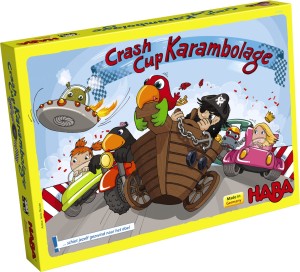
Kid Game Review: Crash Cup Karambolage

    crash cup box
  • Designer: Heinz Meister
  • Publisher: HABA
  • Players: 2-4
  • Ages: 6+
  • Playing Time: 15 minutes
Review by Mark Jackson on a review copy provided by HABA Games (7 plays with Crash Cup Karambolage, 20 plays with the original 1995 edition)
There are a LOT of flicking games out there… from the classics like Crokinole Carabande/Pitchcar to newcomers like Flick ‘Em Up & Cosmic Kaboom - and then there’s oddballs like Hobby World’s Desktopia and Z-Man’s Ascending Empires. (I do love Ascending Empires.) So how do you vary up a game genre that, by definition, has some pretty specific limits?
Over a decade ago, the game Cairo used a die roll to determine which digit you had to flick with… hardly a major innovation, but still a nice idea. (Cairo also had you flicking a die… two years before the much-more successful Tumblin Dice.)
But what if you added a piece of string?
Seriously - that’s the innovation behind the original Karambolage (which won the Kinderspiel award back in 1995)... and the updated version of the game recently published by HABA, Crash Cup Karambolage. Wooden discs are flicked by putting a short piece of string behind the disc and pulling the string taut - thus shooting the disc forward like a slingshot.
I’m on record as being a fan of the original version of Karambolage - though it didn’t make my Kid Games 100 list as I’ve always felt like it was better for older kids and adults than it was for the typical “HABA yellow box set” of preschoolers & early elementary children. The first two games in the rulebook (Rumble Rage & Drift Derby - which appeared in the 1995 version of the game as Karambolage & Karamba) both fall in this category.
Of course, the very things that make it a stretch for younger kids make it ideal for families and gamers:
  • it’s a dexterity game - and the string-flicking at the heart of the game requires some practice to master, as you want to carefully control where the disc you are flicking ends up
  • it’s a game with a need for “look ahead” - much like billiards, you want to finish your shot either by leaving yourself in a position to make another shot by leaving your opponent in a position where he can’t make the first shot
  • it’s a “push-your-luck” game - basic Karambolage scoring is based on how many shots in a row you can successfully make… if you miss, you lose all the points you had gathered that round
So, you ask, why are these three things problematic for younger kids?
  • Dexterity games are not necessarily bad for kids (I’m happy to point families with younger children to games like Maus nach Haus or any one of the multitude of Animal Upon Animal games) - but dexterity games that require finesse demand precision and estimation that are unlikely to be developed enough to compete with older children/siblings and adults.
  • “Look ahead” is a tricky concept for some adult gamers, let alone early elementary school children.
  • “Push-your-luck” isn’t a problem for younger kids - one of the best push-your-luck games out there is HABA’s Cheese Snatching - but combined with the skill needed to keep scoring, this can be frustrating to younger players.
However, all bets are off when you get to the third game in the box, the titular Crash Cup Karambolage. Rather than the billiards-like positioning games in both the original & new editions of Karambolage, this is a racing game using the string-flicking method of propulsion and the flexibility of the new wall design. There are power-ups (small cardboard discs that activate when hit) in this Carabande-ish way to play, as well as the potential for “denting” your car.
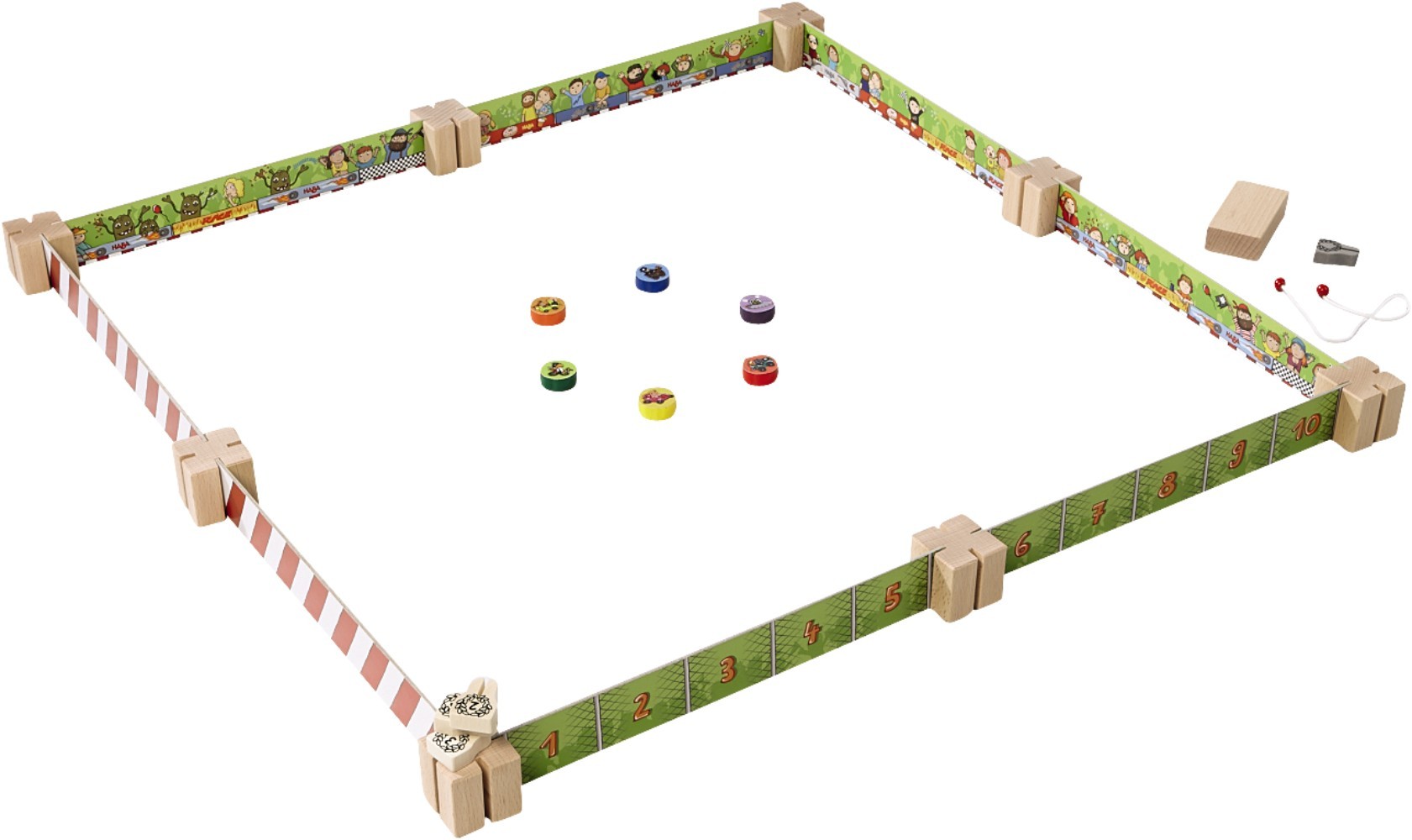
crash cup setup classicThe Stuff In the Box
  • Rulebook (in many, many languages)
  • 8 hefty wooden boundary blocks for anchoring the sideline banners
  • 8 cardboard sideline banners
  • 6 wooden discs (with stickers for their “new” and “damaged” sides)
  • the flicking string
  • the “drift” block (a wooden block used for banking)
  • two six-sided color dice (each side corresponds to a color of one of the wooden discs)
  • 5 wooden point/lap markers (that slot nicely onto the side rails)
  • cardboard tokens & player boards (for the Crash Cup version of the game)
The Games In the Box
There are three different games in the box - each of which involve flicking one of the discs with the string in order to achieve a particular goal. None of them are difficult to teach or play - but playing them well (especially Drift Derby) can be tricky.
Rumble Rage (aka Karambolage)
  • Roll the two color dice to pick two discs.
  • Flick one of those discs into the other for a point. (You get an extra point if you used the drift block to ricochet the disc you shot into the other disc.)
  • Bank your point(s)... or roll again and make another shot.
  • Miss your shot or hit the wrong disc and/or the boundary banners… you lose all the points you’ve gained this turn.
  • Roll doubles (the same color on both dice): double your current points acquired that turn and roll again.
  • First player to 10 points wins.
Drift Derby (aka Karamba)
  • The same basic rules as Rumble Rage…
  • ...but the die roll tells you which two discs you must shoot another disc between - as if you’d drawn an imaginary line between the two colors that you must cross.
HABA Grand Prix
  • First player to circle the track 3 times wins.
  • If you hit another disc or the boundary banner or go off the table, you reset your turn and flip your disc over to the distressed side.
  • If you have another accident while you’re distressed, you take your disc off the race track and restart that lap on your next turn.
  • If you tag a power-up token during your move, you draw from a pile of smaller tokens that contain both good one-use powers (repair, two flicks, etc.) and bad events (lose a turn, distress your car).
crash cup setupSome Thoughts From a Long-Time Karambolage Player
  • HABA Grand Prix is very kid-friendly… I’ve played it with children as young as 7 who do quite well with it. That said, I’d be inclined to take out the “flat tire” chips from the power-up pool when playing with early elementary age kids, as they can pretty much doom your chances of winning and/or finishing the race.
  • There is a specific set-up for the Grand Prix in the rulebook - but nothing prevents you from using the provided barriers to create your own racetrack. You can make it easier or much, much harder by varying the number of barriers and the distance between them, as well as the number of laps required.
  • The playing surface you use will make a big difference in the game. You want to avoid sectional tables and tile countertop-type tables. (This is not specific to Crash Cup Karambolage - it’s true of pretty much any flicking game.)
  • As much as I’ve enjoyed the HABA Grand Prix, I still think that the shining star here is the original game (Rumble Rage).
  • I will say that the new sideline banners are easier to set up and - more importantly - easier to determine if a player has flicked a disc against them (a “foul” in all three of the games in the box). I miss the flexibility of the block & string arrangement from the original version - but not that much.
  • There’s a lot of air in the box - but that’s necessary because of the length of the boundary banners. The box is the same size as Kayanak  or Die Kullerbande (two HABA games pretty much every family should own).
Odd Little Factoid
There’s actually a set of rules in the original edition of the game called Karamboli. Due to the new way in which the borders are created, it can’t easily be played with the new set… but I don’t think that’s much of a loss, as it’s the least effective game in the original box.
Conclusion
It’s great to have this Kinderspiel-winning game system back in print and available to a new generation of players - and it’s even better because of the quality of the components, the clarity of the rules, and the fun that can be had with this wonderful design from Heinz Meister. (Yes, I’m a Heinz Meister fanboy - sue me.)
The age recommendation of 6+ seems right on the edge for me… but I can easily see this as a great game for families with a wide variety of ages. (Then again, I’ve seen kids that age play and enjoy this immensely, so what do I know?)

This review originally appeared on the Opinionated Gamers website... 

Monday, February 02, 2015

Akaba Redux: A Cool Discovery

Highlights

Here's some highlights of what I wrote about Haba's Akaba way back in the day.

I had listed both The Black Pirate & Akaba in my Kid Games 100...
So, you may be wondering why I'd turn back around and put another puffer game on the list. Well, I'll tell you - I think they're both great games that offer very different play experiences. 
This is the more wild'n'wooly of the two games, since each player is working to move as quickly as he can... the active player puffing away at his magic carpet, scooting it around the board, while the player to his left is busy rolling a pair of color dice, hoping for them to match so he can yell "Stop!" and end the active players travel.
Dexterity games are always tricky... younger kids like the action but don't always have the fine motor skills necessary to play competitively.
While kids age 5+ can play the game, you need to be 6-7 years old to have the coordination to carefully puff your carpet across the board instead of blowing it about as if you're in an Arabic remake of The Wizard of Oz.
Of course, I had to get in a final word...
My older son enjoys this game more than The Black Pirate, I think primarily because of the frenetic pace of each of the turns. I was surprised by this, as I thought that the pirate theme would beat the magic carpet theme - but evidently not. I'm good with either of them: Akaba if I'm up for high-charging silliness, The Black Pirate if I'm wanting more of a careful dexterity challenge.
A Cool Discovery 

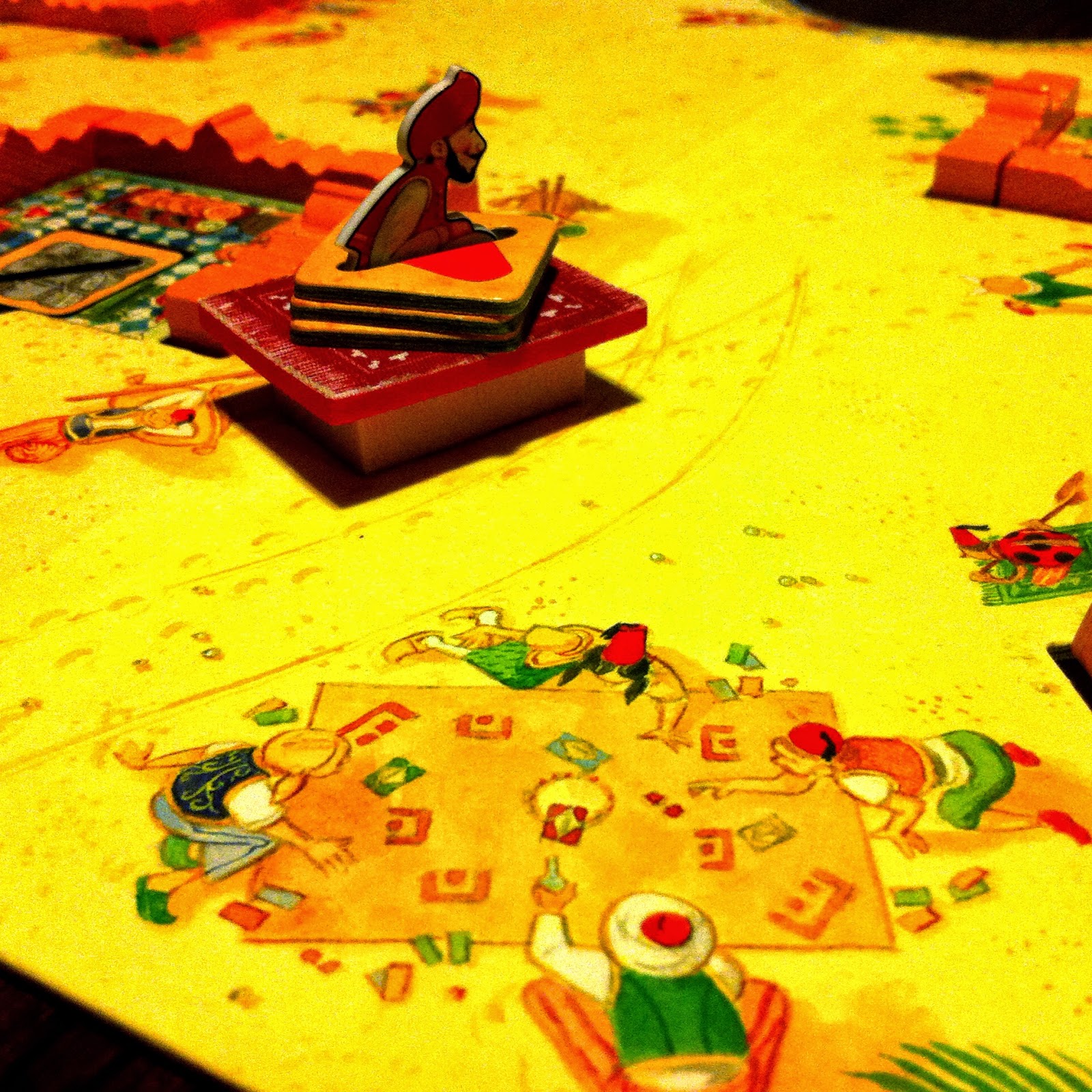
I had played Akaba 20+ times over the past decade... but it wasn't until yesterday afternoon that I discovered this on the board...


Yes, that's right... the guys on the board are playing Akaba. Sadly, the nifty headgear was not included with the actual game. (I'm not sure I'd look good in a fez, but I'm willing to try.)

Monday, October 07, 2013

Essen 2013: Best. News. Ever.

Yes, yes... there will be lots of cool new games at Essen this year - the "official" Geeklist on BGG runs 19 pages as of yesterday. (For the math-challenged among us, that's over 450 board & card games being released.) But the most important board game news is not a new game - it's a reprint. 

Haba is reprinting Kayanak!

To understand why I think that's so cool, you need to know that:

a) it's been out-of-print for quite a while
b) it was the #1 game on my Kid Games 100 back in 2009

Here's what I wrote about it back then - and while there's been some good kid games since (Monster-Falle, for example), it's still #1 in my book.
Yes, my friends, we’ve finally reached Number One on the Kid Games 100. The Numero Uno, the Big Kahuna, the game that I believe is possibly the best kid game ever. 

Or at least that’s what I think today – and for the past year or so. (I actually made the Kid Games 100 list in May of 2008.) It’s possible something better will come along – but for now, this is my favorite. 

Sadly, it’s out of print… which I know (from your emails) makes some of you a bit testy. Sorry about that – but I think two of the best race games on the planet are Entenrallye & Um Reifenbreite… and both of them are OOP as well. 

But why do I like Kayanak so much? In the words of Elizabeth Barrett Browning, “let me count the ways”:
  • the theme (ice-fishing) and the mechanics (using a wooden stick to poke holes in the [paper] ice and fishing out small metal balls with a magnet) work together perfectly
  • the components are, as is typical for Haba games, top-notch. In this case, they not only look good but are extremely functional.
  • The game plays well with 2, 3 or 4 players… and with children as young as four & adults as old as dirt.
  • It's freakishly fun - I mean, seriously - you get to poke holes in paper (what kid hasn't spent most of slow school morning doing that?!), play with magnets, and pretend to be an Inuit out on a frozen lake. (OK, I have no desire to ACTUALLY be on a frozen lake, but the pretending part is fun.)
The gameplay is dice-activated: what you roll tell you what you can do (cut holes, fish, move or a combination of things) as well as how many times you can do them. The dice also give you opportunities to ice over other players fishing holes and "melt" portions of the board (making them impassable). 

There's a lot of ways to play tactically - and yet, part of the charm of the game is that the fish (little metal balls in two sizes: regular & "fish story") sometimes clump together so that make an amazing haul... and sometimes you fish in an area that is, sadly, fishless. (Is "fishless" a word? I'm not sure that I care.)

I never refuse to play this with my boys... or at game conventions... or wherever. And that's why Kayanak is #1.

Thursday, September 19, 2013

Nice Work If You Can Get It...

According to News of the Weird (who is actually sourcing a real article from the NY Post):
Self-indulgent New York City parents have been hiring "play-date" coaches for their preschool youngsters, apparently out of fear that the kids' skill set for just having fun might not impress admissions officers at the city's elite private schools. The CEO of one consulting outfit told the New York Post in July that $400 an hour gets expert monitoring of a 4-year-old in small groups, evaluating, for example, how the child colors in a book, shares the crayons, holds a pencil and follows the rules of Simon Says.
Heck, I'll play Haba games with them for $50 an hour...


Wednesday, December 14, 2011

Kid Game Review: Robin Hound

Robin Hound
  • designer: Eugene Wyss
  • publisher: Haba
  • date: 2010
  • BoardGameGeek rank/rating: not ranked/6.33
  • olayers: 2-5
  • ages: 6+
  • playing time: 20 minutes
  • print status: in print
  • cost: $10.79 (maukilo.com)
It appears we've been sold a bill of goods when it comes to the legend of Robin Hood. Evidently, he is not a human (as portrayed brilliantly by Errol Flynn & much less brilliantly by Kevin Costner) nor is he a fox (as the Walt Disney Company tried to convince us)... he's a dog. A hound - Robin Hound.

And if he's going to loot the castle at Nottingham, he's going to need to gather a band of merry, um, animals. Or, in the case of the game, you're going to have to gather five of them with the help of your fellow players.

The "board" is actually a layout of tiles - a circle of forest tiles with a larger castle tile as the start space/goal. Players place their hound markers on the space, the card deck (with 6 different kinds of animals) is shuffled and two cards are dealt face up in the center of the table.

In turn, players pick up one of the two face-up cards and either
  • keep it in their own hand (if it doesn't match anything they already have) OR
  • give it to another player

A number of the cards have shields on them which denotes that they can only be given to another player.

If you give a card to an opponent that doesn't match any of his cards, you get to move your hound through the forest as many spaces as he has cards in his hand. If, however, you give a card to an opponent that matches one of his cards, the card is discarded and you get nothing.

When a player's hound passes the castle on the forest track OR a player collects a set of five different merry animals, they immediately draw a treasure chest card - which has one, two or three bags of gold on it. The first player to either (a) collect five treasure chests or (b) get 10 bags of gold wins the game.

This is the part of the review where I strongly recommend that you skip to the "professional rules" with all but the youngest players, which are:

  1. There is a penalty for giving another player a duplicate animal - they get to move their hound!
  2. You can choose to discard a card rather than giving it to another player.

Both of these rules make for a more interesting game by giving you choices... and giving your choices a consequence.

This is a light, fast game of memory with a nice blending of cooperative & competitive elements. The art is very cute, the box size is perfect for making it a stocking stuffer, and all the members of our family (ages 6 to 47) have had a good time playing it. It's not going to take the board gaming world by storm like Animal Upon Animal or Maus nach Haus (both Haba games that have very positive feedback from gamers) - it's a solid & very enjoyable game for kids & families.

The box says Robin Hound plays with 2-5 players... and I was skeptical about the lower end of those numbers when I read the rules. However, my 6 year old son & I played two-handed and had a great time, so I was forced to rethink my objections. While I like the game better with more players, it also works well as "just the two of us" parent & child game.

Finally, because there are 6 different suits of merry animals, you could increase the difficulty (and length!) of the game by requiring players to get all six cards in order to grab a treasure chest. (Note: we haven't tried this yet.)

Thursday, October 27, 2011

Kid Game Review: Hit the Throttle

Hit The Throttle
  • designer: Wolfgang Dirscherl
  • publisher: Haba
  • date: 2010
  • BoardGameGeek rank/rating: not ranked/6.00
  • age: 4+
  • # of players: 2-5
  • print status: in print
  • cost: $10.88 (maukilo.com)
Over the years, I've heard Haba's Monza touted as a great introductory racing games for young kids... and I've even personally praised the game as "a great introduction to proper sequencing for young gamers"... but I think it's time for Monza to let another Haba game pass.

That would be Hit the Throttle (not to be mistaken with the great Haba puzzle card game, At Full Throttle). While it's a simple roll'n'move, it's tons of fun for young players, has some simple decisions, and is mercifully short so that parents and older siblings can dive in as well.

Each player is given a secret card at the beginning of the race showing two of the six colored cars - the cars they now will work to get to the end of the race track. On your turn, you roll three color dice and pick one of them, moving that color car one space forward. You then set that dice aside and roll the remaining two dice, picking one of them & moving the respective car. Finally, you roll the last die and move the car indicated. When both of your cars cross the finish line (even if it isn't your turn), you flip your card over & declare your victory!

So, with a game that simple, why do I like it?
  • it's extremely accessible for young players - no number skills are required (just color matching)
  • races are close - we haven't seen a blowout yet
  • the pieces are chunky wooden cars on a colorful track
  • every kid who has played it (including my ten year old son) wanted to play it again
When we talk about "teaching our kids how to play games", Hit the Throttle is an excellent choice for ages 4-5... and the small box footprint would make it an excellent stocking stuffer.

Friday, July 01, 2011

Kid Game Review: Inspector Rabbit

Inspector Rabbit
  • Designer: Heinz Meister
  • Publisher: Haba
  • Players: 2-4
  • Ages: 6+
  • Playing Time: 20 minutes
  • Review by Mark Jackson (6 plays w/a review copy provided by Haba USA)

Let others worship at the feet of Dr. Knizia or fawn over the multi-layered creations from the mind of Martin Wallace… instead, let me have a wonderful day filled with games from the genius that is Heinz Meister.

“Heinz WHO?,” you ask, wondering if I’m just longing for extra ketchup for my french fries. Ah, gentle reader, you have simply missed out on one of the more prolific & successful game designers of the last 20 years. And Inspector Rabbit is the newest addition to his rather large body of work.

In fact, chances are pretty good that you’ve played one (or more!) of his games without realizing it:

  • Hula Hippos (also known as Maus nach haus) – hard to believe you can make such an enjoyable game out of a wooden ring & 20 small bits of wood… but those simple elements are compelling enough that the game has been published successfully by two different companies
  • Igloo Pop (or its ancestor, Zapp Zerapp) – never has vigorously shaking small objects been so much fun
  • Hop Hop Hurray – a bouncing marble game that’s proven to be equally successful with kids & gamers
  • Galloping Pigs – this cute little card/racing game was one of the earliest releases by Rio Grande

You’re less likely to have played some of my favorites from (insert your own Meister/Master/Maestro pun here):

  • Die KullerbandeJust watch – words cannot describe this…
  • Zitternix – yes, it’s vertical pick-up-stix, but it works so much better than you think it would from the description
  • Strong StuffKapitan Wackelpudding for the junior set… a good enough dexterity game that it’s been published twice (once by Goldsieber & once by Haba)

So, with that glowing introduction for the designer, let’s get on to the actual review… yes, yes, I promise to actually review the game once I quit bowing & scraping.

Ahem… well, Inspector Rabbit is a push-your-luck game cleverly disguised as a memory game. This Kinderspiel des Jahres recommended game (last year) borrows the dice mechanism from Herr Meister’s classic adult game, Nur Peanuts (whose title colloquially translates as “Chump Change” and whose gameplay I’ve previously described as “Monopoly boiled down to dice & cash”) and combines it with a relatively simply memory challenge to make for a fast-playing exercise in luck management.

Seems that the Rabbit Police Force has leads on the hiding places of a number of wanted criminals… and it’s time to go out & arrest the bad guys. (Seriously, the Frog has a gun, as does the Chicken. It’s a time of extreme lawlessness.) Weirdly enough, all of the criminals are twins – really! – and therefore you must arrest both of the offenders in order to bring them to justice.

So, pairs of rabbit detective teams head into the garden, searching for the various animals on the lam. Each turn, a player has the option of rolling:

  • a d6 that generates 1-3
  • a d6 that generates 1-6
  • both dice (generating 2-9)

…and then moving one of his rabbit officers the full amount. (You may name your team anything you like: Jon & Ponch, Starsky & Hutch, Cagney & Lacey… I prefer Lenny & Rey, in honor of my favorite Law & Order detective team.) If a rabbit lands on a hiding place, he gets to flip over both of the animals hidden behind the bush.

In subsequent turns, the player must maneuver his other rabbit into position so that they both have cornered matching suspects – and then the player may claim the criminals & send them off to Animal Jail. (Or Rikers… why, yes, I’ve been watching a lot of reruns lately.)

If there are no rabbits left on a hiding place, the two criminal tokens are turned face down… and that’s the entire memory element of the game. It’s thankfully not too taxing for parents & other adults.

There’s one more wrinkle – if a rabbit lands directly on another rabbit, they can relocate them to any empty space on the board.

When one rabbit team has bagged 4 pairs of law-breakers (3 pairs in a four player game), they win.

Some thoughts on the game:

  • I like the dice mechanism a lot… you have to think carefully about where you need to go & the chances you have to get there.
  • The memory element doesn’t overwhelm the game… the dice are what drive the action.
  • Having played with 2, 3 & 4 players, I believe that the four player game is where the game is the most enjoyable (lots of jockeying for position) & the least mentally taxing (most of the hiding places were quickly revealed).
  • The rabbit relocation thing seems overpowered in a 2 player game – I’d suggest a “if you’ll land on another rabbit, move to the next empty space” variant with two players.

My six year old had a hard time with this game the first couple of times we played – it took him a bit to get the hang of choosing the dice he needed to get where he wanted to go. As well, he was really bothered by someone landing on & moving his rabbit. He’s getting better with both of those issues & really enjoyed our last playing.

The artwork is very cute – though if you’re bothered by adorable animals as criminals, this may not be the game for you. I think that the artwork helps sell the game… though I wonder if it doesn’t mislead buyers into thinking this game plays best at the younger end of the age range (ages 6-7). I actually think it works better with 9-10 year olds.

I haven’t had the opportunity to try it with gamers – it would be a light filler but still a nice bit of fun. Where I think Inspector Rabbit will be best, however, is a family game that comfortably allows kids & parents to play together.

This post originally appeared on the Opinionated Gamers website.

Monday, April 25, 2011

Kid Game Review: Animal Upon Animal: Balancing Bridge

Animal Upon Animal: Balancing Bridge
  • Designer: Klaus Miltenberger
  • Publisher: Haba
  • Players: 2-4
  • Ages: 5+
  • Playing Time: 15 minutes
  • Review by Mark Jackson (6 plays w/a review copy provided by Haba USA)

Once upon a time, there was a yellow box filled with chunky wooden animal pieces. Between the whimsical components (gotta love the alligator building base) and the kid-friendly “knock-down” rule (you only have to keep two of the pieces you knock down), Animal Upon Animal became a hit on both sides of the Atlantic for Haba Games in 2005.

In fact, it was such a big hit that Haba released Animal upon Animal – The Duel in 2008, a two-player version of the game that involved a little more dexterity skills coupled with real-time competition and was more appropriate for ages 6+. (It’s also known in the gaming community as “the expansion pack for Animal Upon Animal” – two copies of this give you enough new animals to make for longer, trickier versions of the original game.)

But Haba wasn’t done trading off the goodwill generated by the original game. 2008 also saw the release of Animal Upon Animal: The Card Game… a nice portable dexterity game which probably the least successful of the series as it involves balancing cards rather than wooden animals.

Fast forward to late 2010… and Haba goes to the well one more time for a big box game based on the same theme, Animal Upon Animal: Balancing Bridge. There’s still chunky wooden animals & a gator base in a bright yellow box… but there’s a new twist that makes for a different yet still enjoyable playing experience.

The large box is divided diagonally into 4 quadrants, each decorated with appropriate art (desert, river, forest, etc.) and a symbol which also appears on the die. Across one of the walls lays the balancing bridge of the title – which is not, as I first thought, actually a wobbling bridge. The animals are placed around the outside of the box, divided up between the various sections.

Evidently, the gator wants to make sure that the bridge is safe (he’s like the jungle version of a crossing guard lady) so he’s placed in the middle of the bridge. In turn, players roll the die and place an animal from the determined section onto the bridge – either stacking it or putting it next to an already placed animal. There is also a wild card (pick any animal) side to the die… and a bridge side, which requires players to shift one animal on the bridge.

Each player has three secret assignment cards that show three animals – your objective is to get those three animals to touch. (For example, if you had the bat/lizard/flamingo card, you could place the flamingo where it was touching a bat & a lizard to successfully complete your secret assignment.)

Assignments can be completed – even on another players turn! Completed cards are discarded… and the first player to get rid of all their cards wins.

Of course, with this many animals on the bridge, some are going to inevitably get knocked off. Whichever quadrant they fall into is considered their abode – and players may now use them when they roll the appropriate symbol. As well, the player who knocks animals over must take another assignment card as a penalty.

That’s it. Simple enough for a five year old to enjoy – silly enough to make a nice late night closer with gamers. The secret assignments make for a different game experience that I find equally enjoyable to the original game.

Some random thoughts:

  • We found that 4 (or even possibly 5) cards is a better starting hand for older players, as the game can end too quickly with players with dexterity skills.
  • You can use the number of cards dealt initially to handicap better/older players.
  • The ONLY problem we’ve had with the game was playing with gamers – one of whom decided to knock the pyramid over to keep someone else from winning. Simply put: avoid playing these kind of games with those kind of people.

Added bonus for Animal Upon Animal fans: for a few years, buying two copies of The Duel was the only easy way to “expand” your game… and now, with 25 new animals in the box, you can nearly double the size of the original game with this one purchase. The animals in Balancing Bridge are slightly thicker (the same width as the sheep in Animal Upon Animal) but that doesn’t cause any problems when playing the game. (My older son & I played an Uber Animal Upon Animal, using a complete set of animals from the original game, The Duel & Balancing Bridge – it was a lot of fun!)

And an additional added bonus for parents: the new animals have already seen a bunch of solo play time with my 6 year old son, who uses the game to make up interesting (if bizarre) stories involving the cast of animals.

This review originally appeared on the Opinionated Gamers website.

Tuesday, December 21, 2010

5 Last Minute Stocking Stuffers

They're games... of course.
  • Archaeology: The Card Game ($10) - I was underwhelmed with this set-collecting card game the first time I tried it... but multiple plays have won me over. There's enough luck to blame if things go wrong & enough interesting tactical decisions to claim credit for if you win.
  • Duck Duck Bruce ($10) - This is a reprint of a card game (Kleine Fische) that is VERY similar to Knizia's Circus Flohcati - but was released a year EARLIER. (Hmmm...) I think it's better than Knizia's game, btw. (Read my whole review!)
  • Famiglia ($10) - Two player card game of mob recruiting that has a bunch of interesting decisions... the more we play, the closer the scores get.
  • Hey Waiter! ($15) - Surprising how much game play the designer (go, Anthony!) can get out of a deck with only 4 types of cards... we haven't tried the partnership version yet (the preferred "gamer" way to play according to the buzz on BGG) but have had a lot of fun just playing the basic game.
  • Mummy's Treasure ($12) - A weird but enjoyable cross between Yahtzee & Tetris... the dice-rolling is Yahtzee-esque but the scoring uses Tetris-like pieces. (Read my whole review then check out the variant my son & I created for the game!)

Tuesday, October 19, 2010

Kid Game Review: Moo & Baa

Moo & Baa

  • designer: Thomas Liesching
  • publisher: Haba
  • date: 2009
  • BoardGameGeek rank/rating: not ranked/6.00
  • age: 3+
  • # of players: 2-4
  • print status: in print
  • cost: $17.99 (Maukilo)
The shortest way to describe Moo & Baa is to simply say that it's Go Away, Monster! with some actual game added. (Not to bag on Go Away, Monster!, mind you - we played a LOT of it when our boys were young.) But the folks at Haba have managed to take the simple "draw from the bag & fill your board" mechanic and tweak it in ways that make for a more enjoyable gaming experience for those over the age of 4.

For some reason, the farmers (that would be the players of the game) have managed to mix up their animals: cows, sheep and - because this is not your average farming community - frogs. There's even a few wild animals (beware the free range frog!) thrown in for good measure. The first player to retrieve his set-up for a very odd joke ("A cow, a sheep & a frog walk into a bar...") wins the game.

The animals are placed in three cloth bags (conveniently made from different prints):
  • with younger players, all the animals of the same type go in a bag
  • with older players (4+), the animals are mixed & placed randomly in the bags

Each player has 2 of each animal in their color... and then there are 3 blue-colored "wild" animals which don't belong to any player.

In turn, players draw an animal from the bag - if it is their animal, they keep it. If not, it goes back in the bag it came from. (With very young children, you could simply have them give the animal to the correct player to promote color matching & speed up the game.) Blue animals always return to the bag. The game is quick - someone usually wins in about 10 minutes.

That's it... my 9 year old son described it as "kind of like Bingo" which I guess I can see - but both he & my 5 year old play it gladly. Add to that the enjoyment my wife & I have playing it with our boys and you've got yourselves a really nice family game.

Two final notes:

  • Because the entire game focuses around drawing from the bags, there is a possibility of cheating (peeking in the bag when you're taking your animal). We've used this game to deal with those kinds of issues with our younger son.
  • I've brainstormed (but not tested) a variant for the game in which you would be allowed to put animals that are not your color back in ANY bag - thus making the memory component tougher & allowing for some tactical moves to "hide" an opponents piece and/or "clear" out a bag so you can find your piece.

Addendum: my mini-review of Go Away, Monster! (for comparison purposes):

This is BARELY a game... but for younger kids (3-5 years), it's one they will play over & over & over again. I wish it was more difficult to tell the good things & monsters apart in the bag - but the opportunity to throw a monster tile into the box & yell "Go away, Monster!" at the top of your lungs is an awfully strong selling point.

Friday, October 01, 2010

Breaking News From Haba HQ

The juggernaut that is Tier auf Tier continues to grow... now, you Americans may well know this game as Animal Upon Animal, but regardless of the name, it's slowly becoming a dynasty.
  • First, in 2005, there was Animal Upon Animal, a delightful dexterity for kids as young as 4, complete with chunky wooden animals.
  • Then, based on that success, Haba released Animal upon Animal - The Duel in 2008, a two-player version of the game that involved a little more dexterity skills coupled with real-time competition and was more appropriate for ages 6+. (It's also known in the gaming community as "the expansion pack for Animal Upon Animal" - two copies of this give you enough new animals to make for longer, trickier versions of the original game.)
  • That was followed (also in 2008) by Animal Upon Animal: The Card Game... a nice portable dexterity game but probably the least successful of the series.

But wait! They're not finished... it's time for a big yellow box game in the series, entitled Animal Upon Animal: Balancing Bridge. Here's the description from their website:

Flamingo, giraffe, panther, bat and iguana start the adventure of their life and together set off on a big journey. But there is only a wobbly hanging bridge leading over the four valleys. Fortunately the strong crocodile helps. Each player gets three secret piling assignments. Your task is to pile the animals shown on your assignment cards on the hanging bridge. Whoever proves to be the most skillful will accomplish the assignments first and win the game. A stacking game with animals for 2-4 players ages 5-99.

As far as I can tell, it's going to be released at Essen in late October. As soon as I can, I'll try to scarf up a copy & give my loyal readers a review! (If you'd like to read my review of Animal Upon Animal: The Duel - which includes my "explanation" why the original game JUST missed the Kid Games 100 - you can do so right here.)

Thursday, September 23, 2010

Mummy's Treasure: Variant

I just reviewed Haba's Mummy's Treasure yesterday (two thumb up, BTW!) and ended that review by mentioning that my son Braeden & I had created a variant to ratchet up the tension in the 2 and 3 player versions of the game.

Here's the problem: the game comes with enough pieces for a four-player game... but with that many tiles in play, you never run out of tiles of a particular type. The game, while very enjoyable, is just a solo race to see who can finish first.

When we've played with four players, you have to consider if & when a particular shaped tile (most often the square or the T) is going to run out, putting you in the position of taking more turns to grab smaller tiles to fill the same space.

The solution wasn't difficult - we simply inventoried the tiles & figured out how many are needed to make for a tight game with less players... and now we're sharing this information with you!

In a four player game, there are:
  • six 4 space T's (24 squares)
  • six 4 space squares (24 squares)
  • six 3 space lines (18 squares)
  • six 3 space corners (18 squares)
  • twelve 2 space rectangles (24 squares)
  • twelve 1 space squares (12 squares)
That means there are 80 spaces on the boards (20 squares each) and 120 tile squares.

So, in a three player game, you should have:
  • four 4 space T's (16 squares)
  • four 4 space squares (16 squares)
  • five 3 space lines (15 squares)
  • five 3 space corners (15 squares)
  • nine 2 space rectangles (18 squares)
  • nine 1 space squares (9 squares)
That means there are 60 spaces on the boards (20 squares each) and 89 tile squares.

And a two player game should have:
  • three 4 space T's (12 squares)
  • three 4 space squares (12 squares)
  • three 3 space lines (9 squares)
  • three 3 space corners (9 squares)
  • six 2 space rectangles (12 squares)
  • six 1 space squares (6 squares)
That means there are 40 spaces on the boards (20 squares each) and 60 tile squares.

Let's make it simple, shall we?

To play with 3 players, randomly discard:
  • two 4 space T's
  • two 4 space squares
  • one 3 space lines
  • one 3 space corners
  • three 2 space rectangles
  • three 1 space squares
To play with 2 players, randomly discard:
  • three 4 space T's
  • three 4 space squares
  • three 3 space lines
  • three 3 space corners
  • six 2 space rectangles
  • six 1 space squares
Let us know how you like it!

Wednesday, September 22, 2010

Kid Game Review: Mummy's Treasure

Mummy's Treasure
  • designer: Marco Teubner
  • publisher: Haba
  • date: 2009
  • BoardGameGeek rank/rating: not ranked/6.64
  • age: 5+
  • # of players: 2-4
  • print status: in print
  • cost: $12.00 (maukilo.com)
Mummy's Treasure is a simple yet very enjoyable dice game with an Egyptian theme... it's structured like Yahtzee but the "scoring" is pure Tetris.

Players take turns rolling the five special dice - just like Yahtzee but without all the bookkeeping! - and collecting Egyptian symbols in an attempt to claim the top piece of one of the scoring tile stacks. Match the symbols on the piece & you get to place it on your board.

Of course, as the game builds (quickly!) to the conclusion, you have less & less space to work with - and players find themselves forced to aim for particular tiles in order to complete their board/mosaic. (As in most spatial games, playing a time or two will give you a better idea of what shape spaces you need to leave yourself in the end game for the quickest win.) The first player to finish their board wins; if no player can finish their board, the player with the least empty spaces wins.

The concepts are simple enough for a five year old to join in (roll dice, match symbols, place tiles) but you can also play this is a nice filler with gamers. Game length is dependent on the number of players (it's about 5-10 min. per player) with our 4 player games clocking in at about 20 minutes once everyone understands the game. I enjoy this with or without kids at the table... but it's easy enough for kids to play without adult supervision.

My son & I worked out a system to "gamer-ize" the 2 & 3 player versions of the game, which have less tension than the 4 player game. Read about it here!

Monday, August 02, 2010

Diego Drachenzahn

Of course, one of the few major Haba releases I haven't played in the last year or so wins the Kinderspiel des Jahres - Diego Drachenzahn!

Sorry I don't have more information - I'll get to work on it right away!
(This was JUST announced...) Here's the game description from BGG:
Publisher's website: "Snarl! Dragon Diego Dart has missed the target once again! What's more he has set fire to Uncle Drooge's hat! But which target did he want to hit? Can he still win this race in the dragons' fire spitting competition? A fiery game of skill for 2-4 players."

In Diego Drachenzahn, you will first choose a target alley that you're trying to hit, then roll 3 balls into the right slot. The others will try to guess what your target was. They score when they guess corectly, and you score when your fireballs hit their target. Who will end up with the most points?

Friday, February 12, 2010

Nurnberg Toy Fair - Game Highlights (courtesy of Die Poppelkiste)

It takes two (that's 2 in Arabic numerals, II in Roman numerals) different bits of Internet magic to bring you the latest information about kid games:
  • The first is the wonderful website of Brigitte & Wolfgang Ditt, Die Poppelkiste. Their reviews and previews of games are insightful & informative. And in German. (BTW, you may know Herr & Frau Ditt from their game designs, Nautilus & Big Points, as well as a lot of scenario & variant design for The Settlers of Catan.)
  • The second solves the whole "in German" problem - it's Google Translate. I can click from page to page in a website & get quickie translation of the pages. (Note: there's an art to reading these machine translations... they are literal to a fault & filled with odd syntax.)
With all that said, if you want to read this stuff for yourself, head to the Google Translation of their Nurnberg Toy Fair report.

Or you can simply read my paraphrase in the rest of this post - which doesn't require you to click away.

Here's some highlights:
  • More light games at Nurnberg than at Essen (or at least less "heavy" games).
  • The kid games feature a lot of use of magnetism & memory - which is basically the recipe for making Das Magische Labyrinth, the winner of the Kinderspiel des Jahres in 2009. (Well deserved award, btw... I'll be reviewing it soon.)
  • Their favorite kid game of the fair is Haba's Hexenduell (Witch Duel).
Now, after I've read through it, here's what I'm excited about:
  • Velo City (Abacus) - a tactical dice game about cycling
  • Regatta (Asmodee) - a sailboat racing game that uses a mechanic similar to Techno Witches
  • Hexenduell (Haba) - a magnetic dexterity game with a time element
  • Fauna Junior (Huch & Friends) - a kid-friendly version of the well-liked (as yet not released in English) animal trivia/estimation game
  • Snapshot (Kosmos) - a Rudiger Dorn-designed dexterity game for adults... really!
  • Seeland (Ravensburger) - a Kramer game about Holland & dikes & windmills
  • Turi Tour (Selecta) - send your animals on vacation... and somehow there's a blindfold involved!
  • Asteroyds (Ystari) - described by the Ditts as "RoboRally in 30 minutes"... excellent.
  • Heckmeck BBQ & Heckmeck Junior (Zoch) - 2 new ways to dice for worms!

Friday, December 25, 2009

Merry Christmas!

About that time Caesar Augustus ordered a census to be taken throughout the Empire. This was the first census when Quirinius was governor of Syria. Everyone had to travel to his own ancestral hometown to be accounted for. So Joseph went from the Galilean town of Nazareth up to Bethlehem in Judah, David's town, for the census. As a descendant of David, he had to go there. He went with Mary, his fiancée, who was pregnant.

While they were there, the time came for her to give birth. She gave birth to a son, her firstborn. She wrapped him in a blanket and laid him in a manger, because there was no room in the hostel.

There were sheepherders camping in the neighborhood. They had set night watches over their sheep. Suddenly, God's angel stood among them and God's glory blazed around them. They were terrified. The angel said, "Don't be afraid. I'm here to announce a great and joyful event that is meant for everybody, worldwide: A Savior has just been born in David's town, a Savior who is Messiah and Master. This is what you're to look for: a baby wrapped in a blanket and lying in a manger."

At once the angel was joined by a huge angelic choir singing God's praises:
Glory to God in the heavenly heights, Peace to all men and women on earth who please him.

As the angel choir withdrew into heaven, the sheepherders talked it over. "Let's get over to Bethlehem as fast as we can and see for ourselves what God has revealed to us." They left, running, and found Mary and Joseph, and the baby lying in the manger. Seeing was believing. They told everyone they met what the angels had said about this child. All who heard the sheepherders were impressed.

Mary kept all these things to herself, holding them dear, deep within herself. The sheepherders returned and let loose, glorifying and praising God for everything they had heard and seen. It turned out exactly the way they'd been told!

from Luke 2 (The Message)

Monday, December 21, 2009

Stocking Stuffer Games + Amazon Prime

This weekend, I blogged a bit about Eric's stocking stuff podcast... and thought about adding a few suggestions of my own. Here's 10 really great stocking stuffer games that you can have by Christmas Eve thanks to the magic of Amazon Prime shipping. (While I do receive review copies on a regular basis from Haba & Gamewright, Amazon gives me nothing. I wish they would, of course, but they don't.)
  • Ark (Rio Grande) - not really a kid's game (despite the charming art)... this is a card placement game where you are one of Noah's helpers trying to load the ark so that the wrong animals don't get put in the same cabin. I'm a big fan of this game & think it got sadly overlooked a few years back when it was released. $14.03 is a nice price... and the Ark Extra Mix expansion is only $3.99 with Prime shipping as well! (I haven't reviewed this game... but I'd be honored to teach it to anyone who asks. You could also read Susan L's excellent review.)
  • Can You See What I See? (Gamewright) - a game for the preschoolers in your house... this is a sturdy & enjoyable bingo-ish game that has inspired deep love in my 4 year old. $15.00 is a good price. (Read my review!)
  • Dancing Dice (Mayfair) - as long as you have family members/friends who don't cheat (there's a lot of hidden actions taken in this game), this is a very fun dice game about marathon dancing that's actually more enjoyable with more players! You'll need a big stocking to fit it in, but it's a big deal at only $10! (I haven't reviewed this game - but I really like it, as does my lovely wife, Shari - the non-gamer in the family. You can read Eric V's review, though.)
  • Duck Duck Bruce (Gamewright) - originally published in Germany as "Kleine Fische", (Little Fish), this is a great push-your-luck game that works with kids as young as four & has whimsical duck/dog art to make it even more enjoyable. Well worth $9.55... and you can find this even cheaper sometimes in Target or other stores that carry Gamewright card games. (Read my review!)
  • Ka-Ching! (Gamewright) - originally released in Germany as "Combit", I like this less abstract version better. It's a two-player game of investment chicken... not so much for the kids but great for ages 10+ who like quick-moving but think-y games. The price is right, too - $8.97. (I haven't reviewed this... but I'd be happy to get a copy for Christmas! Meanwhile, read Tom Vasel's review.)
  • Keep It Steady (Haba) - better known by the German name (Zitternix), this is a very clever game of vertical Pick-Up-Stix. A favorite with adults & kids... $17.00. (I haven't reviewed Zitternix, but I'm very glad I own a copy - thanks to Dave Vander Ark for showing it to me originally!)
  • Pig Pile (R&R Games) - it's lighter than air & extremely silly (you keep score with plastic piggies!) but it's become a family favorite in the "better than Uno" light card game genre. A bit pricey at $20.54 but it can be there by Christmas! (I haven't reviewed this game - I've just been playing it consistently since it was released. Neil Thomson has a nice review of it on the Geek.)
  • Pirate's Blast (Haba) - another game possibly better known by the German title (Das Schwarze Pirat: Das Duell). Translated, that's "The Black Pirate: The Duel" and it's a two-player version of the award-winning "The Black Pirate" game. This is a dexterity game of sorts - where two players use air pumps to blow their ships about the table... and fire on them with tiny wooden cannons! This is a STEAL at $12.97! (Read my review!)
  • Pocket Battles: Celts vs. Romans (Z-Man Games) - the first in a planned series of small tile-based 30 minute wargames, this is the only stocking stuffer on the list that I haven't played. I want to - a lot - but it just came out. It would be a treat for any gamer on your list - for example, me! $15.00 is a little higher than you see it in the standard online gaming locations - but Amazon Prime = free 2 day shipping, so it pretty much evens out. (Of course, I haven't reviewed it... but Mike Siggins has.)
  • The Suitcase Detectives (Haba) - a clever & creatively designed smuggling game... can you find the stolen items?! A great deal at $14.54! (Read my review!)