Everything including the kitchen sink... but with special attention paid to board games, Jesus Christ, my family, being a "professional" (and I use that word loosely) Christian, and the random firing of the 10% of the synapses I'm currently using.
while it's not currently in print, you can find some of the versions in the secondary market pretty easily
Why It's On The List
The ultimate "I don't have to outrun the bear. I just have to outrun you" game... which plays up to 8 players and always provides a splendid time for all involved - even if Hugo the Ghost tags your players.
Tips & Tricks:
Don't put your folks close to each other - you need to spread them out a bit.
Starting next to an open door is always a good idea.
The game works well at all player counts... but is best with 5+ players.
I think the older versions of the game are better - while the newer versions feature some twists, the original Ravensburger game is hard to beat.
Extras
Here's what I wrote about it for my Kid Games 100 list back in the day.
This is the fourth of five (5!) Kramer designs on my list.
I'm as surprised as anyone that a game about distilling liquor is among my favorites - seeing as how I don't drink. But both the production and the design of the game are excellent and it's a lot of fun to play.
Tips & Tricks:
After multiple plays, I'm convinced that there is not a single path to victory... you can focus on aging spirits or putting out stuff that isn't aged or some kind of mixture. The trick is doing it efficiently.
It's easy to forget about bottle collections and objectives your first few games... but both are solid sources of points.
The trickiest thing to learn in the game is how to deal with aged spirits you don't sell prior to the endgame. (The excellent player aid card walks you through it - but it's not something that easily sticks in your brain.)
Extras
The Africa & Middle East expansion mostly just adds more variety to the game... while the Cask Strength expansion has four different modules that complicate game play.
Yes, I backed the Cocktails expansion... it's due later this year.
This is the tenth new-to-the-top-100 game on the countdown.
The drafting is similar to 7 Wonders and the tile-laying feels like Suburbia. But that misses some of the innovations that make NEOM more than just another chip off the old blocks.
Tips & Tricks:
The game uses a “bomb” draft item (Flood, Fire, Crime Wave) in each era that hurts others but denies you a turn... and the decision on whether to play or pass this can be really tricky.
The initial “seeding” draft of cornerstone tiles does more to set strategy than the similar Leaders expansion in 7 Wonders.
I know this gets said a lot in game descriptions - but there really are multiple pathways to victory.
Extras
The game is designed for 3-5 players... but the addition of a Fields of Green-like 2 player variant (that works well) and a solo packet variant (that I love) expands chances to get it to the table.
My initial rules read of NEOM (prior to seeing the game) made me think it would be an interesting but difficult to play 7 Wonders knock-off. I’m happy to say that the first day I taught/played (a few weeks after Essen 2018), I was proven wrong… and ended up playing it 3 times in one day. As soon as it became easily available in the U.S., I jumped on a copy… and it’s now in regular rotation here at Chez Jackson.
Solo play: I typically play 2-3 games of this at a shot… since once you’ve got it laid out, it’s easy to reset and try again. I’ve defaulted to play with all the tiles in, which offers more variety and some interesting decisions since you know that you can (sometimes) wait for the tile you need.
It's a very-straightforward tile-laying game that can be give a lot of layers (esp. by using the expansion) or kept simple, straightforward, and very family-friendly with the base game.
Tips & Tricks:
Like many game where players draft from a common pool, timing is extremely important.
As well, this is a game that rewards the Tetris-y spatial skills of looking at a piece and being able to mentally flip it about to find the optimal placement.
The addition of the goals (both from the base game and the expansion) vary up the mental puzzle really well.
Extras
The storage solution in the base game is, well... not very good. I love the Folded Space insert I bought that fits both the base game and The Bad News Bears expansion into the box.
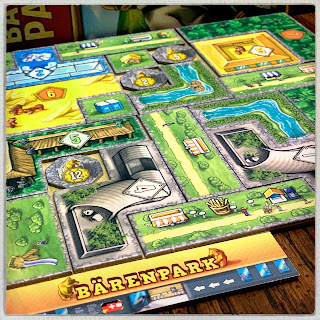
The expansion adds extra goals, an additional piece of land per player for building, grizzly bear enclosures, and tramways. I think the tramways here are much better implemented than in the designer's Cloud City game.
Michael Schacht takes the central game mechanic from his card game Coloretto & develops it into a full-fledged board game with delightful artwork & theme. And then, if that wasn't enough, he keeps expanding that world (thanks to the SdJ win) in some very intriguing ways.
Tips & Tricks:
I didn't like Zooloretto particularly the first time I played it... that, as you can see, has changed. (The theme drew me back in, btw.)
Lots of people like Coloretto better than Zooloretto - they're wrong, of course, but I think that's more a function of "liking a clever mechanic" versus "liking a clever mechanic in the midst of a thematic & enjoyable game".
Zooloretto spawned Aquaretto - which I also enjoy. Aquaretto is the more gamer-friendly of the two - there's more potential for a new player to mess themselves over with bad tile placement.
The plethora of large & small expansions can be confusing - but I like how you can tailor the game to your personal tastes.
The game is best with 3 or 4 players... 5 has a little too much downtime (if you're using any expansions) and 2 is bland.
If you're going to play Zooloretto & Aquaretto together, you should only play with 3 players... or with Michael's 6-player partnership variant.
Extras
I wrote an extensive post about Zooloretto & the various expansions entitled Renovating Your Zoo(loretto) for this blog.
I translated the Big Boss variant from Michael Schacht's site - it's used w/the Zooloretto: Boss expansion.
One of the proudest moments of my life - my son, Braeden (who was 7 at the time), created a really great variant idea for Aquaretto - and Michael Schacht published it on his website! Check out the Touch Pool...
The picture above shows a game with all the expansions in (the white meeples are workers from Zooloretto: Boss).
This is the second of two Michael Schacht designs on my top 100 countdown.
A civilization-building game that plays in under an hour with an evolving set of technologies to power your development.
Tips & Tricks:
Pay attention to the order in which the events are coming as well as their effects.
Each player starts from a slightly different position - don't waste that bump by ignoring how it helps you.
You are unlikely to be able to both build the highest level monuments and recruit the highest level leaders - so specialize in one of those.
The one rule I consistently forget - you do get to purchase a technology card at the end of the final round. (You never use it - but it does count for points and card type scoring.)
Extras
I like the solo system a lot - at least once you start adding to the difficulty level. Once the game is set up, it's easy to reset and play again - which makes it like a bag of potato chips for solo gaming.
This is the ninth new-to-the-top-100 game on the countdown.
A pile of clever mechanisms interlocking create a compelling set of puzzles... but that would just be mish-mash if it wasn't for the excellent production and graphics to accompany it.
Tips & Tricks:
The cardinal rule of these kind of games - you can NOT do everything. Make good decisions about what you will and will not try to focus on. (A little bit of everything is a risky strategic choice.)
You need to invest some energy early on in building your income, especially when playing just the base game.
Often, early point-scoring to get you past the first threshold will allow you to choose the best spot on one of the goals... and that will give you a clear picture of what to chase through the mid- and end-game.
Extras
The Space Agencies expansion is really good - it not only adds new alien species but also a TM: Prelude-ish way to have asymmetric starting positions.
Take the basic card combat idea behind Star Wars: Epic Duels... add in the brilliant LOS board configuration system from Tannhäuser...and infuse the game thematically with a "mix of characters across time & reality" vibe from Heroscape... and then do a top-notch production job... and you've got Unmatched.
Tips & Tricks:
One of the biggest issues in Epic Duels (the need of some characters to turtle for multiple turns in order to make decent attacks) is fixed here... both by better balancing the decks AND by instituting a "getting to the end of your deck" penalty.
Each character/team has different strengths and weaknesses... you cannot play each character the same way and be successful.
The character receiving the least love out of the gate was King Arthur... but I've managed to pull off some wins with him by playing the cards in his deck, not the cards I wish he had.
Some of the newer boxes (and there are a LOT of them) have more complicated decks - but I'm happy to have the variety in play styles and characters.
Extras
Due to the expiration of publication rights, the Restoration Games Unmatched vault already contains the Jurassic Park, Buffy the Vampire Slayer, and Deadpool sets. While Deadpool is impossible to find in retail (and have been for quite a while), the other sets are still available - so if you're interested, it's time to pick them up.
Some quick thoughts on the various boxes - all of which are stand-alone expansions:
Robin Hood vs Big Foot - the best introduction if you're not sure about the series... two great characters and two great maps
Cobble & Fog - two more great maps with four excellent characters - though three of the four characters are not quite as straightforward to play
Jurassic Park: InGen vs Raptors - my least favorite map, though both characters are fun to play. Dr. Sattler vs T-Rex contains the only large figure in the system (so far)... the dino is fun to play occasionally.
Buffy the Vampire Slayer - two more excellent maps... don't love the Buffy character in 1v1 play but otherwise a fan of this box
Volume II - a great map and four excellent medium-difficulty characters
Bruce Lee - a solo character (no map) that's a lot of fun to play... now rereleased as Lee vs Ali with another great fighting character.
Marvel: Redemption Row, Marvel: Hell's Kitchen, Marvel: Teen Spirit, and Marvel: For King & Country - I like the creativity in the Marvel maps and the figures are incredible. Due to some balance issues across the set (my sons both swear that Bullseye is "way OP, dad" and I'm not sure we've ever seen Elektra win), I like these better for 2v2 play. (Note: I love the teen heroes in Teen Spirit... and I haven't seen a production copy of Brains & Brawn yet, which was a great deal of fun to playtest.)
Unmatched Adventures: Tales to Amaze! - we hated the playtest... .but Restoration knocked this one out of the park and it's one of my favorite cooperative games of the last few years (and the heroes are playable in head-to-head fights as well!)
Slings & Arrows - these are not beginner characters... but there's not a bad hero in the set (and the theme comes through beautifully [speaking as a former English/theater major])
The Witcher: both Witcher boxes are really good (Steel & Silver and Realms Fall) - interesting maps, interesting characters... and I'm not even a fan of the IP.
Volume III - we playtested this box as well... and these are the trickiest characters to play in the "volume" boxes.
Stars & Stripes - working on a review of this RIGHT NOW... my younger son & I have been waiting for these characters since we playtested them!
My boys & I have been playtesters on a number of Unmatched sets: Vol. II & III, the Marvel boxes, Tales to Amaze!, Slings & Arrows, the Witcher boxes, Lee vs. Ali, and Stars & Stripes.
I've written a number of reviews about Unmatched for the Opinionated Gamers site:
I wouldn't go as far to say that New Frontiers has fired the classic Puerto Rico for me... but it covers a lot of the same ground with better graphics and a more compelling theme.
Tips & Tricks:
New Frontiers does not seem to have the same "newbie automatically assists player to their left" problem as Puerto Rico... but players still need to pay careful attention to the downstream effects of their action choices.
Don't put all your point-scoring eggs in one basket - especially when it comes to the 9 cost technologies. I have been known to buy a 9 cost tech that was only marginal for me in order to keep it out of the hands of someone who could really benefit from it.
I personally like the goals (which is also true for with both the original card game and Roll for the Galaxy)... but not everyone is fond of them.
Extras
The Starry Rift expansion adds new worlds, a much greater selection of developments, and an excellent solo option.
This is the fifth of seven (7!) Tom Lehmann games that will appear on my top 100 list this time around... and the second of three Race for the Galaxy universe games. Sue me.
It doesn't so much simulate soccer (like Pursue the Pennant attempts to simulate baseball)... instead, it uses a backgammon-ish mechanic to simulate the feel of a soccer game - and does so brilliantly.
Tips & Tricks:
Like playing backgammon, winning at StreetSoccer is as much about the position you leave yourself in as well as pushing hard to score...
And like backgammon, what appears initially to be a random dice game actually reveals itself to be a very tactical game of risk & probability.
Extras
There are three different online PBEM versions of StreetSoccer... the one I used to play on (a lot!) was Little Golem.
A civilization-building game that packs in the game mechanics: deckbuilding, resource management, tableau building, asymmetric factions, multiple game timers, keywords to differentiate similar actions… and each individual civilization has a uniquely structured deck.
Tips & Tricks:
Know what's in the deck you're playing... they do NOT work the same way and tactics can be very different.
Don't forget about Innovate (dropping your hand to get a card you want from the market)... sometimes, it's the best thing you can do.
It will take a few plays, but watching what other players are doing is key to winning.
Extras
I'm on the fence about buying the 3D-printed bits from MeepleSource - but they look really nice..
Here's the review I wrote about Imperium Classics/Legends for the Opinionated Gamers website.
It is a brilliant solo system.
Horizons adds a LOT of content to the game... as well as a trade module which twists things in some interesting ways. It's also has the best comprehensive rulebook for the game.
This is the first of two games on my list by designer Nigel Buckle & the third of four games by Dávid Turczi. (Extra credit - Imperium is the first of two games designed by this team on my list!)
This 3D re-implementation of Matt Leacock's classic Roll Through The Ages did not impress me on my first play... but subsequent plays changed my mind. It's not the same game with cuter bits - it is a different (and more confrontational) game with limited amounts of certain buildings and the ability to bleed your opponents if you choose to pursue that route.
Tips &Tricks:
Important safety tip: don't forget the final phase of each turn, which is Extort. Simply using all your resources won't prevent pain (you gain disaster points instead).
Corollary to the safety tip: in a 3 or 4 player game, you could potentially get hit multiple times in the Extort phase. Plan accordingly.
You can't do everything - but you should at least build a walled area and put some valuable buildings in it (since they are doubled in a completed walled area).
Extras
I consider the Rivers & Roads expansion essential - not only does it add some very interesting new buildings and the titular rivers & roads, it also adds cards for the middle of the table that are much easier to see and understand about the cost & power of each building.
I also own all of the Collector Set expansions... which add a variety of tricky twists to the system. They're not cheap (I used leftover Christmas money to buy them) but if you're enjoying the game system, they're pretty nifty.
The solo mode works well... and building a little working medieval city is very satisfying.
Bag-building and whimsy combined to produce an easy-to-teach press-your-luck game that has been 100% successful with everyone I've introduced it to.
Tips & Tricks:
You need to look at what powers are available - and remember that you can't do everything.
Not worrying about scoring for the first couple of rounds is sometimes worth it for the rat-tail catch-up mechanic.
Extras
I like both of the expansions... though they make the game a little trickier to teach and get into for new players. I'd recommend you wait on Herb Witches and/or Alchemists until everyone at the table has a game or two under their belts.
I have two nifty add-on things for my Quacks collection - the splendid GeekUp Bits tokens (seen in the picture) thanks to a very good friend (King Bob!)... and the Folded Space organizer.
I don't love the new cover for Quacks - but I'm not angry about it. (And I haven't actually played with a new edition, so I have no thoughts on whether it's better or worse.)
This is the second of two games designed by Wolfgang Warsch on the countdown.
designers: Richard Ámann, Thomas Vande Ginste, Viktor Péter, Wolf Plancke, and Dávid Turczi
Print Status
in print - sort of? (it was primarily a Kickstarter product)
Why It's On The List
Crunchy dice-drafting decisions are coupled with oodles of thematic elements across a four game system with gorgeous production values.
Tips & Tricks:
The four games ("episodes") that make up the series are related to each mechanically - each uses a dice drafting mechanism that is placed to activate a variety of actions. But, in practice, each game develops in very different ways as the objectives of the overarching story create intriguing new puzzles for players to struggle with.
The story is a like a fever dream mash-up of LOST, Jurassic Park, and Stargate - but the team makes it work with evocative card & board art as well as really nice miniatures.
The solo system is impressive - not particularly simple to learn but thematically strong and clever to play against.
Objective for 2026: finally play the Chronicles box that connects the four episodes together!
Extras
I purchased a nearly pristine used copy of all three boxes from the BGG Marketplace (thank you, kind sir!)... our hobby can be a really wonderful sometimes.
Mindclash Games has specialized in these sprawling 'heavy' games with splendid production. No surprise - there's another Mindclash game coming on the countdown.
This is the seventh new-to-the-top-100 game on the countdown.
This is the second of four games designed by Dávid Turczi on the countdown.
The best of the customizable dice games out there... and it moves along at a furious pace as you develop your little medieval realm.
Tips & Tricks:
Much like Dominion, being able to look at the collection of special powers/die faces available in the game and make a coherent plan for development is a key to victory.
When there are "attack" die faces in play, you want to make sure you have some defensive capabilities... as the combination of attacks + winter can put you into a death spiral (and hasten the end of the game).
Extras
The Trade expansion is very, very good - and incorporates a version of thesolo & cooperative rules that designer Tom Lehmann posted on BGG.
This is the fourth of seven (7!) games designed by Tom Lehmann on the countdown.
A dexterity game that more about physics than perfect dexterity... and more about the fun of building (and accidentally destroying) a huge house of cards than about tricking your opponent into making a bad move. And, yes, it's a kids game - but it's been successful with pretty much every person I've taught it to.
Tips & Tricks:
Not getting "cute" with your early builds will lead to a more stable base and a MUCH taller building.
The game is random enough (you roll both to see how far your hero climbs AND to win battles against other heroes) that you should not take it seriously.
The only person worth setting up for a fall is the player who is currently highest up on the tower - if they lose, everyone else wins.
Extras
This is part of the very successful Rhino Hero family of games from HABA... the original Rhino Hero is both highly portable and a lot of fun to play. I haven't played the other games.
Picture includes Owen (my younger son's good friend AND fellow Unmatched fan).
This third iteration of the Great Western Trail engine has the right combination of elements to appeal to me - a bit more money in the game that opens up new strategies, two different ways to use sheep (selling & shearing), and an "expansion" board that makes more sense than Rails to the North (from the original game).
Tips & Tricks:
The solo automata is brilliantly designed and offers a competitive game and a relatively low level of player upkeep/overhead for this heavy a game.
There is not a single correct strategy - so much is dependent on what is happening in the game state and you need to constantly adjust your expectations while still planning for future turns.
I avoided playing the original Great Western Trail for a long time – even though I really enjoyed some of Pfister’s designs. My first play was very good – but I just didn’t see who I could get to play it with me. The new versions being released piqued my interest – but not enough to pull the trigger until GWT: New Zealand… and boy howdy, I’m glad it did. There are a number of changes to the base game – though the basics are still the same. It’s as if they took GWT and the Rails to the North expansion, smushed them together, added some clever twists to “loosen” the game up a bit, and then did a better job with the graphics than the previous versions.
Extras
I've only had the opportunity to play GTW:NZ solo and two player - I'd like to try it with 3 or 4 players, but the game time would increase pretty seriously.
This is the second of three games designed by Alexander Pfister on this countdown.
I've described Mr. President as "a solo role-playing game for people interested in domestic and international politics" – and I stand by that statement. (I’m Mark Jackson, and I approve this message.)
Tips &Tricks:
For a game that takes 5-10 hours (not including set-up and tear down), it's a pretty tactical game. Much of the time you're simply reacting to the craziness of the world around and trying to keep all of your plates spinning.
The advice in the rulebook is spot on - "you win the game by doing well at domestic politics; you lose the game by doing badly at foreign affairs."
Extras
This is an overwhelming design - but GMT has gone out of their way to make it playable and enjoyable - especially with the clean-up they did with the second edition.
GMT is currently working on a digital version of the game that will solve the combined problems of "table-eater" and "game length" for some folks.
I wrote a preview of Mr. President in the form of a press briefing/interview for the Opinionated Gamer site.
I heartily recommend the 3D-printed storage system created by PrintablesByCaren... it makes it so much easier to find the right chits when playing.
The developer of the game (Mike Bertucelli) was a long-time member of the gaming group I ran in Central California and a great guy to game with.
This is the sixth new-to-the-top-100 game on the countdown.
The lightest of the Race for the Galaxy family games is not just a sci-fi retread of Tom Lehmann's The City... it's an interesting blend of the two systems to make for a very quick and highly enjoyable tableau building card game.
Tips &Tricks:
Chances are excellent that someone who hasn't played much will tell that a certain building strategy is "broken" and "always wins". See my personal information below for why I raise a Spock-ish eyebrow to that claim.
You only have 6-8 rounds before the game is over... so exploring (drawing extra cards instead of building) is a serious decision. Doing it twice is just a nice way to say "let's play again after you beat me."
Extras
I have played Jump Drive 158 times and The City 113 times.
The new expansion for Jump Drive, Terminal Velocity, not only adds some new elements to the game but also has a really well-done solo mode.
I wrote a review of Jump Drive for the Opinionated Gamers website. (I will note that I am now incorrect in that review - the newest edition of The City makes it much easier to teach - it's in English - and score - it has point chips just like Jump Drive.)
This is the third of seven (7!) Tom Lehmann designs on the countdown... and the first of three Race for the Galaxy-themed games.
follower of Jesus, husband, father, "pastor", boardgamer, writer, Legomaniac, Disneyphile, voted most likely to have the same Christmas wish list at age 58 as he did at age 8




.jpeg)


.jpeg)


