Thursday, November 24, 2016

As the Years Go By (Mark's 100 - 2014)

It's finally done. I've managed to post all of my 2014 Top #100 games. Of course, we're nearly done with 2016, so it's not exactly timely any more. 

My plan is to do a one-time countdown of Top Board Game Expansions next... but I'm guessing that won't start for a couple of weeks (or more). 

In the meantime, here's a chart of when my top 100 games were published. I was intrigued by the low point of 1998 which was in the thick of my German game buying spree. (Man, I miss Adam Spielt.) There are a lot of good games that year - Elfenland, Samurai, El Caballero... but they are all games that I eventually sold or traded. I've still got Mystery Rummy: Jack the Ripper (but it's not my favorite MR game), Zirkus Flohcati, Basari & Medieval Merchant... but they all don't quite make my top 100.

Wednesday, November 23, 2016

#1: Memoir '44 (Mark's 100)


Memoir '44

Mark's Ranking
  • 2014: 1st
  • 2012: 1st
  • 2010: 2nd
  • 2005: 3rd
  • chosen on all four lists
BoardGameGeek
  • rank: 106
  • rating: 7.5
Print Status
  • in print
Why It's On The List
  • The best (and best supported!) of the Command & Colors games... it combines a wonderous toy factor (plastic army men & tanks!) along with remarkably evocative recreations of WW2 battles. This is the perfect collision of all the eras of my gaming life: it's got enough warfare &; tactics for the chit-pusher in me, the gorgeous plastic bits remind me of the day we cracked open Axis & Allies for the first time, and the speedy gameplay fits my current lifestyle. The plethora (si, Jeffe) of scenarios is a definite point in favor of Memoir '44, as well as one of the cleverest 'fog of war' mechanisms ever - the command deck.
Tips & Tricks:
  • Memoir '44 is splendid right out of the box... though the first couple of scenarios are probably the weakest and don't show off the game as well as they could. (They do a good job of getting players used to how the game works.) Don't give up on it until you've played some of the later scenarios.
  • There are a LOT of expansions... and I personally own at least one or two of each of them. (Point of fact: my Memoir '44 collection weighs over 30 pounds now.) There are no duds in the set... though probably the least valuable to a casual player is the Terrain Pack.
  • There's a desktop program for playing Memoir '44 online that is very good... I just don't get to play it as much as I'd like.
  • My favorite way to play is 2 player Breakthrough (using the Breakthrough deck included in the Winter Wars expansion). Close behind that is playing in Overlord (multi-player team) mode or playing a campaign (using one of the Campaign Books).
Extras

Tuesday, November 22, 2016

Sentinels of the Multiverse: The Bloodsworn Arena


The boys & I are big fans of the cooperative superhero card game Sentinels of the Multiverse... we own all of the current physical expansions, we've sponsored the upcoming "final" Kickstarter for Oblivaeon, and we have the full digital version on our iPad. Son the Younger even has a plushy Mr. Chomps (see above).

Yes, it's a sickness. Let's not dwell on that.

When we (and when I say "we", I actually mean "I" - but it sounds better when I included my sons) pledged for the Season 2 Kickstarter of the digital version of Sentinels, one of the things we were most excited about was a Bloodsworn Arena mode. (What follows is the description from the Kickstarter page...)
How many villains can you defeat in a row with the ultimate hero team? Make your own storyline with this randomized campaign mode and last as long as you can. Fans of the game have made several versions of this idea on the tabletop.

If we can reach this goal, Handelabra Games will create an “Arena Mode” for the video game. The details and options of the new mode will be worked out when we get to the design and development stage, and we’ll be getting your input at that time. Some ideas and options include a single fixed hero team with no HP recovery; a drafting mechanic where fallen heroes are replaced; ramping up difficulty with advanced and challenge modes; and more! No matter what, this new mode will keep you on your toes.
Sadly, while the Season 2 Kickstarter was successful, it wasn't successful enough to reach this particular stretch goal.

So, after fruitlessly searching the InterWebs (Homer Simpson: "Oh, they have the internet on computers now!") for some home-brewed Arena rules, we made our own. We offer them here for you as an early Thanksgiving gift. (Homer Simpson: "And Lord, we are especially thankful for nuclear power, the cleanest, safest energy source there is—except for solar, which is just a pipe dream. Anyway, we’d like to thank you for the occasional moments of peace and love our family has experienced. Well, not today, but you saw what happened! Oh, Lord, be honest! Are we the most pathetic family in the universe or what?!")

Enjoy.

The Arena Rules
  • We selected a number of the weaker villains
    • Akash'buhta
    • Ambuscade
    • Baron Blade
    • Deadline
    • Omnitron
    • The Ennead
  • After choosing our team and environment, we shuffled the villains and put the first one into play.
  • We played a normal game of SotM... and when we defeated the first villain, the following things happened:
    • The current hero finished their turn.
    • All defeated Villain cards were removed from the game.
    • All Hero and Environment ongoing cards stayed in place.
    • Heroes retained their current card hand & discard pile.
    • Heroes do not refresh hit points.
    • A new Villain was taken from the stack and set up as usual.
  • The new Villain went first... skipping any Hero turns and/or Environment turns.
  • Lather, rinse, repeat... until the team goes down in a blaze of glory.
  • Possible variants we didn't try:
    • giving each hero back X number of hit points when a villain is defeated (X = number of heroes in the game + number of villains successfully defeated)
    • allowing each player to choose one "backup" hero that jumps in when their hero goes down - would need to decide if incapacitated heroes still get to use their power
How We Did

  • Our team (in player order):
    • Parse
    • K.N.Y.F.E.
    • Unity
  • The environment:
    • Madame Mittermeier’s Fantastical Festival of Conundrums & Curiosities
  • The villains we defeated (in order):
    • Omnitron
    • Ambuscade
    • Akash'bhuta
    • The Ennead
  • The villain who took us out:
    • Deadline (but he only had 15 hit points left)
  • Most impressive attack:
    • Unity's team of robots managed to inflict 56 points of damage on Deadline in one turn... and then catastrophe(s) struck and destroyed them all.
  • Our "review" of our own rules:
    • While it runs a little long, we had a blast playing this way. Particularly with heroes that pile up ongoing cards, you can make some pretty spectacular plays - and that's always fun.
    • The boys & I are concerned that this might not work as well with the tougher villains.
    • We also wondered how this would work against Vengeance-style villains.
    • Overall, we had a lot of fun... and are talking about trying it again soon.

Monday, November 21, 2016

#2: The Settlers of Catan (Mark's 100)


The Settlers of Catan

Mark's Ranking
  • 2014: 2nd
  • 2012: 5th
  • 2010: 1st
  • 2005: 1st
  • appeared on all four lists
BoardGameGeek
  • rank: 214
  • rating: 7.3
Print Status
  • in print
Why It's On The List
  • The game that launched the European "game" invasion... the first true "franchise" game for Kosmos & Mayfair... a game so simple & yet so innovative that it could inspire devoted play with almost any crowd. This infinitely variable game of trading & building is still a personal favorite, even when way too many gamers have left it behind.
Tips & Tricks:
  • While your first game may take 90+ minutes, it's not unusual for experienced players to knock out a game in 60 minutes or less. A lot of that depends on how quickly trading goes and how "aware" the people you're playing are - example: it doesn't matter how many times you ask for "brick", if we haven't rolled it in two rounds, it isn't there for trade. Sigh.
Extras

Friday, November 18, 2016

#3: 7 Wonders (Mark's 100)


7 Wonders

Mark's Ranking
  • 2014: 3rd
  • 2012: 21st
  • 2010: prior to publication
  • 2005: prior to publication
  • rank: 28
  • rating: 7.8
Print Status
  • in print
Why It's On The List
  • Card drafting meets civilization building... and it's playable with 3-7 players in a pretty consistent 45 minutes. No "wonder" it got all those awards... 
Tips & Tricks:
  • I'm a big enough fan to picked up all of the available expansions - Leaders, Cities, Wonder Pack & Babel. And with experienced players, I like playing with all of them, though it is a bit overwhelming.
  • Cities is the easiest expansion to add to the game - and it contains the rules for team play, which is actually pretty cool.
  • The laws portion of Babel and Leaders are the two most difficult expansions to add - they have lots of new symbols that can confuse players.
  • You don't have to jump on the science train to score big points - but you do need to burn up science cards for cash or wonder building to prevent others from doing it.
  • Military still doesn't make sense to me - the worst point loss you can take is -6... and it can be less than that if you can talk your neighbor(s) into a truce.
  • 7 Wonders: Duel is a fantastic game (a two player civ builder) and I can't wait to try Pantheon (the expansion).
Extras
  • Here's my first look at the Cities expansion after I played the prototype.
  • I wrote a preview of the Babel expansion back in 2014 as well.

Thursday, November 17, 2016

#4: Clash of Cultures (Mark's 100)


Clash of Cultures 

Mark's Ranking
  • 2014: 4th
  • 2012: new
  • 2010: prior to publication
  • 2005: prior to publication
BoardGameGeek
  • rank: 146
  • rating: 7.7
Print Status
  • in print... I think (it's still reasonable on Amazon)
Why It's On The List
  • My favorite civilization-building game... the free-wheeling tech-tree and relatively simple mechanics make for an excellent play experience with 2, 3 or 4 players.
Tips & Tricks:
  • I've been involved in an online game of the Tresham version of Civilization... and it makes me like Clash of Cultures even more. The tech tree decisions are more interesting, the random events aren't earth-shattering, and the gameplay has more variety. I'm pretty much done with classic Civ.
  • There are multiple ways to win Clash of Cultures - we've had games that focused on military build-up and games where trade was king. The direction of the game is often affected by the layout of the board.
  • The expansion is highly recommended - it not only adds cavalry & elephants & extra buildings, it adds historically based civilizations to the game.
Extras
  • I have not written a lot about Clash of Cultures... I need to fix that!

Wednesday, November 16, 2016

Abaddon: Shattered Command

Some ways back I wrote a mini-review of Richard Borg's Abaddon:

======

AbaddonAbaddon

review copy provided by the publisher
Extremely Short Summary:

What we have here is your standard “giant robot armies skirmishing on the surface of a valuable but forbidding planet” scenario – filtered through a fog-of-war command system designed by Richard Borg that is a cousin to the Command & Colors system.

Thumbs Up:
  • very nice minis
  • options for play with 2, 3 or 4 players – all of which work well
  • variety of scenarios (with different objectives)
Thumbs Down:
  • the rules could use a polish (though I appreciate the willingness of Toy Vault to include an errata page when the game was published)
  • as in almost all multi-scenario battle games, the introductory/teaching scenarios do a lousy job of showing off how the good the system can be when it’s firing on all cylinders
The Verdict (a year later):

When I played Abaddon on a pre-production copy last year (4 times in a week!), I was delighted by the awesome miniatures and the fast & furious game play. I understood why some gamers didn’t like it – it is more chaotic due to the use of both dice & cards for command than any of Richard Borg’s C&C games. At the same time, I could see it really appealing to my elementary age boys.

Two other observations from a year ago:
  • Mike Gray (from Hasbro) passed by the table while we were playing and remarked that Richard had shown him this game as a prototype a number of years ago.
  • I was given the opportunity to play one of the first “web” scenarios – and both the reorientation of the board and the interesting choices that both players are forced to make from the beginning gave me great hope for Abaddon.
======

We've continued to play Abaddon - I still think it's a lot of fun and enjoy bringing it down for some rough & tumble battling.

So imagine my excitement when I saw that Toy Vault is launching a Kickstarter to expand Abaddon... with Abaddon: Shattered Command!

The expansion will add Command Bunker tokens (minis if they get enough $$ pledged), Unit Upgrades, rules for building scenarios and entering terrain... and, of course, more scenarios.

The expansion is $15 in the U.S. - and if you missed getting the base game, you can do that with the expansion for just $40. (That's an excellent deal, btw.)

The Kickstarter goes through mid-December - but you should jump on now.

Note: I am not being paid or reimbursed for this blog post. I was given a review copy of the game right after it was released... but I just found out about this new expansion project thanks to the folks at BGG.


Friday, November 11, 2016

Veterans Day 2016

Bunker Hill...


New Orleans...


Cemetery Ridge...


Belleau Wood...


Omaha Beach...


Chosin Reservoir...


Khe Sanh...


Baghdad...


...and a thousand other battlefields. We will not forget the sacrifice of our veterans, the men & women who have given their lives so that we may live and worship freely.


Wednesday, November 09, 2016

"You like da juice, huh? Juice is good!" (10 Questions About Fabled Fruit)


  • Designer: Friedemann Friese
  • Publishers: 2F & Stronghold Games
  • Players; 2-5
  • Ages: 8+
  • Times Played (so far!): 11 "games" with a review copy provided by Stronghold Games
Far be it from me to reinvent the wheel… I’ll leave that as something for Friedemann Friese to work at on Fridays. (Though, to be fair, “wheel” is actually “Rad” in German… which doesn’t start with an F.) 

The wheel I’m actually referring to is Dale Yu’s excellent preview and description of Fabled Fruit's gameplay in his Opinionated Gamers post. If you need more details about how the game works, you should start there.

And then come back here.

10 Questions About… Fabled Fruit

Q1: Is Fabled Fruit a good family game?

A1: Yes. 

Of course, that depends on what you mean by “good family game”. If you’re asking about the ability to play with a wide variety of ages, the answer is a qualified ‘yes’. While the game will work best if all players are able to read well the juice cards are face up on the table and younger players (mid-elementary) can be assisted with decisions as necessary.

On the other hand, if you’re asking about the game working well with players of varying levels of gaming experience, the answer is an UNqualified ‘YES!’. I think it’s actually a great gateway game – the decision tree is never overwhelming but there is ample opportunity for clever plays and discovery of interesting combinations of cards. I plan on packing this in my luggage over the holidays - it will go over very well with my non-gamer family members. 

So, to sum up, yes.

Q2:  I’ve read the rules to Fabled Fruit… but I don’t get why people are so interested in it. What makes it interesting?

A2: Fabled Fruit is a near-perfect balance of simplicity (on your turn, you move your piece and either take the action on the juice card or buy it) and tactical cleverness (finding the right action to assist your plans without leaving your opponents in a better position than you). 

Of course, I would be remiss if I didn’t suggest taking some care with reading rules to make snap judgements about the quality/enjoyment of a game… especially simpler games. Personal story: I avoided Knizia’s Res Publica for a long time on the basis of reading the rules… which was a major mistake. (It’s a great game.)

Specifically, since the majority of the game-changing rules are on the cards in Fabled Fruit, you’re missing a big chunk of the actual game in your evaluation.

Q3: OK, it’s clever… but is it fun?

A3: Yes.

Of course, if you’re the kind of gamer who would describe fun as the following equation…

FUN = long-term strategy + engine building

…Fabled Fruit is not the game for you.

Q4: Does Fabled Fruit work as a 2 player game?

A4: Yes.

Of course, I need to point out that we’ve found the game to be more enjoyable with 3-5 players. With two players, it feels like there is too much “room” in the game system. 

While I wouldn’t say “no” to playing it with 2 players, I’d prefer to play it with 3+.

Q5: With such simple gameplay, doesn’t Fabled Fruit start to feel a little same-y?

A5: I don’t think so – our experience has been that the morphing of the game state (through the changing juice cards) makes each game feel a little bit different. There are definite shifts between types of cards… but we’ve been intrigued enough to play on a regular basis since the game showed up on our doorstep.

Of course, that morphing will happen differently for each group – and certain juice cards can hang on in the 24 card tableau for multiple games, changing the options and combos that are available. (Currently, we have cards from #8 to #30 in our tableau – that’s a big spread.)

Q6: Can you compare Fabled Fruit to any other popular games?

A6: Well, it’s a set collection game, so it’s got a definite Ticket to Ride vibe in collecting particular types of cards.  While you acquire juice cards for scoring, there’s no tableau building (well, at least as far as we’ve gotten).

Of course, I don’t know of anything quite like the Fable system for morphing the game. The closest thing is the stacked Legacy deck from Pandemic Legacy.

Q7: How long does a single game last… really?

A7: It takes a minute or two deal out the cards and lay out the tableau… and then you’re off to the (jungle) races to concoct fruit smoothies. 15-20 minutes later, it’s done. (Our longest game was about 25 minutes with 4 players and a combo of cards that made it more difficult to amass the appropriate fruits; our shortest was about 10 minutes with 3 players.)

Of course, we play 2-3 games in row, awarding 2 points to the winner of each “game” and 1 point to everyone but the lowest player. That takes 40-55 minutes for 3 games.

Q8: How many “new” games can you actually get out of this system? 

Q9: We are averaging changing out 9-10 juice cards per game… at that rate, it should take 24-25 games to reach the end of the juice deck.

Of course, the order in which juice cards are purchased (and removed from the game) will make for different combos… and that means that you can play the game again and have a similar but not identical experience. (Look, I think this Fable system is right up there with the Legacy design ethic… both take gaming in some nifty new directions!)

Q9: Give me the elevator pitch on why I should buy this game…

A9: Fabled Fruit is easy to teach, fun to play, and offers a plethora of opportunities to make clever moves in your quest to quench the thirst of your jungle friends.

Of course, it’s also the first Fable game… and for those who are interested in game design, it’s a pretty amazing piece of work to dig into.

11 games in and I’m still excited to get it to the table.

Q10: I don't get the title of this review. Can you explain it?

A10: Hard to believe the SNL skit I referenced in the title of this post is 23 years old.

Of course, a few of us at work were joking about Garrett Morris' Headmaster of the New York School for the Hard of Hearing... just checked - it was first broadcast 41 years ago.


It's official. I'm older than dirt.


Friday, November 04, 2016

#5: Race for the Galaxy (Mark's 100)


Race for the Galaxy

Mark's Ranking
  • 2014: 5th
  • 2012: 2nd
  • 2010: 3rd
  • 2005: not yet published
BoardGameGeek
  • rank: 41
  • rating: 7.8
Print Status
  • in print
Why It's On The List
  • After you climb the iconography mountain to figure out the game, Race for the Galaxy is an amazing adventure in hand management & reading your opponents' mind - made even better by clever card design & interaction as well as great sci-fi art.
Tips & Tricks:
  • Learning Race for the Galaxy can be a bit of a chore - of course, since I've ranked it #2 on my list, you know I think it's worth it - but there are some things you can do to make it easier.
    • First, don't add any of the expansions.
    • Second, the first time you play, play two games in a row.
      • The first game should be open-handed & use the preset hands from the base game.
      • The second game can be "normal".
    • Third, don't get obsessed about winning your first few games. Use them (they're short!) to explore the gamespace & see how cards can work together.
  • There are five expansion sets available for Race for the Galaxy, all of which add numerous cards to the deck:
    • The Gathering Storm (which adds a fifth player, goals & a robust solitaire system)
    • Rebel vs. Imperium (which builds on the previous expansion, adding a sixth player & rules for takeovers)
    • The Brink of War (which builds on the previous two expansions, adding prestige & the prestige/search action)
    • Alien Artifacts (Alien Artifacts does NOT build on the previous expansions but instead is meant to be combined solely with the base game. It adds a fifth player & a new mode of play in which you explore the Alien Orb.)
    • Xeno Invasion (the newest expansion - again, a stand-alone addition to the base game that adds the potential for a non-player adversary attacking all players.)
  • Someday, maybe we'll get an iOS app - until then, the best computer AI for board games out there is Keldon's AI - a free download for PC & Mac. I estimate I've played a couple thousand (2000+!) games against this over the years.
  • My favorite way to play is 2 player advanced with goals & prestige... and no takeovers.
  • I'm also a big fan of Roll for the Galaxy... but that's for my next top 100 (whenever the heck I do that).
Extras
  • I'm surprised how little I've written about Race for the Galaxy - evidently, I've been too busy actually playing the game to blog about it!

Tuesday, November 01, 2016

#6: Heroscape (Mark's 100)


Heroscape 

Mark's Ranking
  • 2014: 6th
  • 2012: 7th
  • 2010: 4th
  • 2005: 23rd
  • appeared in all 4 lists
BoardGameGeek
  • rank: 221
  • rating: 7.4
Print Status
  • out of print... which is so very, very sad
Why It's On The List
  • Heroscape is the ultimate blending of board game & miniatures game... and, in a slick move that allows them to make lots of cool figures, a great blending of genres, as all the characters are warriors sucked through time & space into the world of Heroscape. So, you've got Matrix guys & Braveheart & dragons & robots & kung fu monks & gorillas with guns... yep, it's the ultimate boy game. (And while kids can start with this one at 7-8 years old, there's enough going on that you keep playing it well into your adult years - in my case, age 52 & counting!)
Tips & Tricks:
  • While I have a complete set of figures (including many double & triple sets of squads) as well as two of each terrain expansion, I'm a relative lightweight in the realm of serious Heroscape players.
  • A tough side effect of our huge life change back in 2013 (three states/two moves/most of our stuff still in storage) has been the boxing away of the Heroscape armies... which was finally solved by three rolling carts and a set of shelves in our TV/game room. (Yes, we are playing again!)
  • If you get a chance, find someone and play this. (Alternately, watch garage sales & the BGG Marketplace and start your own collection!)
Extras

Monday, October 31, 2016

The Dragon & Flagon (Game Review)


  • Designers: Geoff, Brian & Sydney Englestein
  • Publishers: Stronghold Games
  • Players: 2-8
  • Time: 60-90 minutes
  • Ages: 12+
  • Times Played:7 (with review copy provided by Stronghold Games)
Hail and well met, young adventurer! Sit, grab a pint and let me tell you a tale of long ago, of the times of yore… back when Avalon Hill was still its own sovereign kingdom and the only European games any of us knew were Clue and Risk. (Truth be told, we didn’t even know those games were European - we pretty much thought that the Parker Brothers invented them.)
It was the Year of Our Lord, nineteen hundred and eighty… the year of the Miracle on Ice, the release of Pac-Man, and the summer that the Empire finally struck back. Those were heady times, my young friend - because it was during that same span of 365 days that many of us stumbled into our friendly local game stores to find a game shaped like a double album. (Ah, double albums - I remember them fondly: Pink Floyd’s “The Wall”, ELO’s “Out of the Blue” and the soundtrack from a little film called “Star Wars” were the background soundscape for many an afternoon AD&D session. But I digress…)
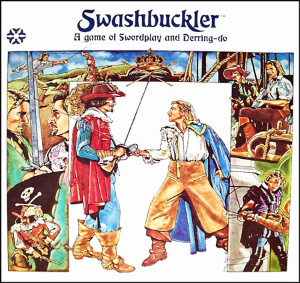
yaquintoswashbucklercoverNow, this wasn’t the first game that Yaquinto released in the album format - but it certainly is the first that I remember. It was called Swashbuckler - and it was a plotted simov game of Three Musketeer-ish bar fighting.
What? You didn’t understand the word “simov”? You thought I was name-checking Viktor Simov, Russian painter? Bah, youngling, I am referring to the great pre-personal computer tradition of simultaneous movement in board games, usually done by plotting movement and attacks on paper and then resolving them with the other players. (Examples include Diplomacy, Wooden Ships & Iron Men, Sniper!, Dreadnought, and Gladiator.)
The game was, even with the plodding nature of simov plotting, riotous fun. You could swing from chandeliers, tip over tables, and wave your plumed hat to distract your foes. The double album format even offered two boards - one was a bar straight from the set of “The Three Musketeers” (the 1973 version, of course… though the ‘93 version has certain charms and nobody will ever choreograph sword fights like Gene Kelly in the 1948 film.) The other board was, of course, two ships close enough for boarding to begin, a la “Captain Blood.”
Say it is not true, young adventurer, that you have not seen Mr. Kelly as d’Artagnan or Errol Flynn as Captain Blood. This will have to be remedied post haste.
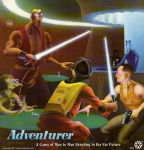
yaq3807Yaquinto released a similar game set in a sci-fi bar/cantina & spaceship called Adventurer - which, while enjoyable, did not work quite as well as the original game. (The introduction of laser guns caused some problematic issues for the system… besides, it was just cooler to be a musketeer.)
Give credit to Richard Garfield (the guy who designed that famous Monopoly-ish baseball card binder game, Filthy Rich… as well as some other game where you collect cards and fight with them) for creatively finding a way around the glacier-fast speed of your average simov with the use of cards to program your robot in his game RoboRally. (For those of you keeping track, that was 22 years ago. Or, my wet-behind-the-ears friend, a year before the first Catan game appeared.)
Since the appearance of RoboRally, a number of us well-seasoned gamers have ruminated about the possibility of using card programming to drag Swashbuckler (and games like it) into the 21st century. I've even seen another prototype that made a valiant effort to marry the two games together.
But, my clean-shaven young friend, it was the Family Engelstein who finally managed to “cross the streams”, fry the Sta-Puff Marshmallow man, and make a wonderful homage to a classic game design.
homage
noun  hom·age \ˈä-mij, ˈhä-\
  1. respect or reverence paid or rendered:
  2. the formal public acknowledgment by which a feudal tenant or vassal declared himself to be the man or vassal of his lord, owing him fealty and service.
  3. the relation thus established of a vassal to his lord.
  4. something done or given in acknowledgment or consideration of the worth of another:
I wish to note that when I suggest that Geoff, Brian & Sydney created an homage to Yaquinto’s Swashbuckler, I am using definitions #1 and #4… not #2 or #3… which would be more appropriate to my relationship to a mortgage lender.
I also wish to note that the Family Engelstein rocked this homage - combining a number of great design ideas into a complete and extremely playable whole.

The Dragon & Flagon Family Tree

Grandpa Swashbuckler - The Dragon and Flagon uses both the theme and the basic structure of Swashbuckler to great effect. It's a bar fight… with all of the theatrical flourishes that requires: jumping on tables, boasting, yanking the rug, slashing with your sword and throwing various objects about with malicious intent.
Crazy Uncle Viva Pamplona - One of the key problems of any brawl themed game is how to figure out who won. The most common answer over the years has been player elimination/last man standing - but there are some real drawbacks to that design choice, especially in a game system with baked-in chaos from programmed movement. Instead, The Dragon and Flagon uses a reputation system similar to the Wolfgang Kramer raucous running of the bulls game, Viva Pamplona. This encourages players to stop targeting those who've been pummeled… while avoiding knocking players out of the game.
Papa RoboRally - Simultaneous movement has always been a great idea in theory… but clunky in practice. As mentioned before, Richard Garfield created a new way to do programmed movement- and The Dragon & Flagon takes advantage of this advance in game design technology. Similar to Wings of War, The Dragon & Flagon uses a smaller number programmed cards to keep the pace of the game quick.
Weird Cousin Thebes - The more games I play of The Dragon & Flagon, the more I admire the design choice to “cost” moves by the time they take to execute. Simply picking up a mug moves a character marker one space down the track… while swinging across the room takes 3 increments of time (which you could think of as take off, flight & sticking the landing). Like Thebes, your position on the time track determines when you will execute your next action.

Stuff Any Character Can Do
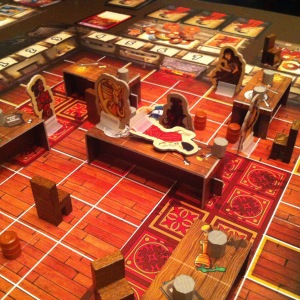
fullsizerenderEach character has a deck of cards to program actions. All characters have a set of common cards that allow them to:
  • Move 1-2 squares
  • Dash 3-4 squares
  • Slash with a sword/knife
  • Pick up & drop stuff
  • Throw mugs or chairs
  • Shove a table
  • Yank a rug
  • Stand on a table & boast
  • Swing on a chandelier
  • Make a charging attack
  • Roll a barrel to knock over another player
  • Party & riposte an attack
(Note: this list could also be called “When the Late Night Werewolf Game at the Con Goes Off the Rails”.)

Special Stuff Only One Character Gets To Do

Each character also has 4 cards that they alone can use… for example, they can:
  • Wave a plumed hat to distract others (the Swashbuckler)... yes, this a figurative tip of the hat to the original game.
  • Fire a hand cannon (the Buccaneer)
  • Emit an aura of holy radiance (the Paladin)
  • Flip a table over… even with people on it (the Barbarian)
  • Subdue your opponent with the Touch of Death (the Monk)
  • Shadow step into position behind another character- where it's easier to backstab them (the Rogue)
  • Mark your prey to increase your damage to them (the Druid)
  • Use your vision to look ahead & better plan your action (the Cleric)
  • Fire arc lightning about the room (the Wizard)
(Note: the above list is not exhaustive. There are literally 36 different "special power" cards in the game system.)

Quaff the Flagon!
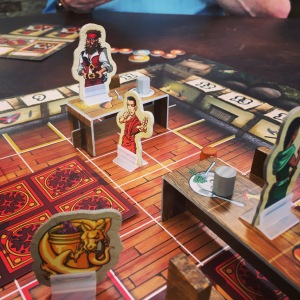
img_6683At the center of the tavern is the Dragon Flagon… filled with a special brew that imbues the drinker with an amazing ability… it's Felix Felicis from the Harry Potter novels, only without the broomsticks & all the snogging.
A character who grabs the Flagon receives a character-specific one-time use special power card that must be programmed like any other card. (As a former pastor, I'm particularly fond of the Cleric’s card that forces other characters to Tithe.)
In our experience, only one or two characters per game actually manage to hoist the Flagon… and not all of them manage to play the card successfully. That makes the race to the middle of the tavern a hazardous and not necessarily profitable decision - which means that these highly powered cards don't become game-breakers.

'Tis A Gift to be Simple

The structure of the game is very straightforward:
  • is your time marker on the current space?
    • Yes… then add cards until you have two cards programmed.
    • No… don't add cards &  instead suggest alternate targets for other players to pummel
  • when all current characters have programmed their moves, resolve their first card in random order
That's it.
Oh, yeah, there's cards that are limited by situation (you can't yank a rug if you're not facing a rug) or circumstance (things that can't happen if you're knocked down)... but the coding for these is clear on the cards and the penalty is simply “use 1 time & don't do the action”. If you're prone, you stand up.
At the end of each character’s activation, they can freely change facing.
The game has a four turn random ending - in other words, the town guard will appear and break up the fight at the end of one of four possible turns. (The characters are taken to the local constabulary to nurse their wounds and engage in post-fight banter.)
Like I said - simple.

Saturday Night’s Alright For Fighting

There are some sly & wonderful bits of design and production tucked into The Dragon & Flagon.
3-D Components - While Stephen Buonocore (head honcho of Stronghold Games) wasn't able to add Smell-o-Vision to the game, the three-dimensional production values are excellent and add a great deal to the playing experience. (Note: Smell-o-Vision was not actually considered for production of this game. And I can't imagine that adding authentic fantasy bar smell would be a prudent publishing decision.)
The 3-D components can also be set up in a dizzying number of configurations... so far, we've tried to keep the tavern "balanced" - but I'm curious what will happen when we create a large open space and/or make it easy for everyone to pick up a chair as their first move. 
Individual Characters - Each of the nine characters has different strengths… but none of them seem overpowered. In our first couple of games, we were convinced that the Pirate was a punching bag… until a drunken & boasting Pirate fired his hand cannon a couple of times while shoving tables and managed a win. As well, we were sure the Rogue was a sure winner- until she was pummeled into submission.
The fact that there is one more character than you can play is a plus in my book - games are unlikely to have the same configuration of characters. Variety is the spice of life… and that's especially true for fighting games, which can fall into predictable grooves.
“Damage” - Characters take 4 kinds of “damage”:
  • Lose reputation (aka victory points)
  • Get knocked down (prone)
  • Get knocked back (moved)
  • Become dazed
For my money, the dazed mechanic is a smart way to cause pain without leaving a character defenseless or permanently out of contention. A dazed character has to program extra cards immediately- to a maximum of three. Presto! The character is dazed but not out. (Note: the Buccaneer has a Chug card which makes him tougher but also perma-dazed for a number of turns.)
Truth in Advertising - As a lad, I learned to mistrust the box covers of board games, particularly when it comes to game length. (Secret formula: with Avalon Hill games, add 50% to the stated playing time. With SPI, double the stated time.)
Number of players can be tricky as well - For example, Goldland says 2-5 players but really should not be played with more than three.
The Dragon & Flagon, on the other hand, gets both of these exactly right. Once everyone has s game under their belt, the game plays in the promised 60-90 minutes.
More importantly, you really can play with 2-8 players. With 2-4 players, each player runs two characters - and because of the simple programming and time expenditure mechanics, it works well - very well. (My games so far have been with 2, 3, 4, and 5 players… and I've enjoyed them all.)
Late Night Convention Rules - Included in the rules… and painfully simple. Once you program an action, you can't look at it again until it's time to activate it.
Now, this may not sound like much - but with 7-8 players, this keeps AP (analysis paralysis) to a minimum while creating more chaos. And let's be honest - if you're bothered by a little chaos, you probably shouldn't be playing a game about a tavern free-for-all cage match.
image1Boarding Parties and No Broadsides - The reverse side of the game board has, just as Swashbuckler did, a pair of ships close enough together to board. There are additional rules for team play on the board posted on the Stronghold Games website.
Our single game on the “at sea” board worked well - the additional treasure chest markers add a nice twist to the game. Sadly, no one went overboard- we obviously need to try again.
The Plate of Cookies - Too often, publishers waste extra space on punch boards - but not Stronghold Games! They managed to honor the original prototype copy and create a usable game component at the same time. (I'll leave the story to the rules - suffice it to say that this is recycling at its best in the Engelstein home.)

Fight For Your Right… To Bolster Your Reputation By Smacking Down Opponents

I've won, I've lost, I've been targeted by my sons (who are always happy to beat up on their dad)... and regardless of how I've done, I've enjoyed every play and look forward to getting it back to the table. The Dragon & Flagon is an experience game - and the experience has been a delightful romp every time. 
Moreover, it's a game that you tell stories about - "remember the time I Godsmack'd you into the wall so hard that your Swashbuckler spent the remaining moments of the game huddled down in the corner of the bar" or "remember the time the Mage managed to hit every character on the board with arc lightning". We've set a low bar for reputation (6) and a high bar (38) - and I'm sure that both will be passed in time.
My biggest surprise is how well the game works with low player counts - normally, these kind of games rely on larger player groups to get the full experience. But even with as few as two players, we've had a lot of fun knocking each around and accomplishing feats of derring-do.
I am a little afraid that all of my talk of the “days of yore” (aka - my teenage years) and “homage" (which is dangerously close to “fromage”, which is actually a creamy soft cheese made with whole or skimmed milk & cream) is going to distract my loyal readers (all four of you) from hearing my primary message: this is a wonderful & chaotic design of gaming goodness, published with style and downright nifty 3D components.
This review originally appeared on the Opinionated Gamers website.